_-_by_Pudelek.jpg)
Pravčická brána
It looks like a single span of stone, and it is not. The Pravčická brána is two rock masses propped against one another, holding position by mutual pressure, and the arrangement is watched by sensors because nobody wants to be surprised. Twenty-six and a half metres of clear span, sixteen metres of air beneath, a deck three metres thick at its thinnest - the largest natural sandstone arch in Europe, standing about three kilometres northeast of Hřensko in the Czech Republic. Border officials writing in 1410 and again in 1451 already had a name for it. They called it the Great Gate, which is what you call a thing when you have no better word for it.
How a Gate Gets Made
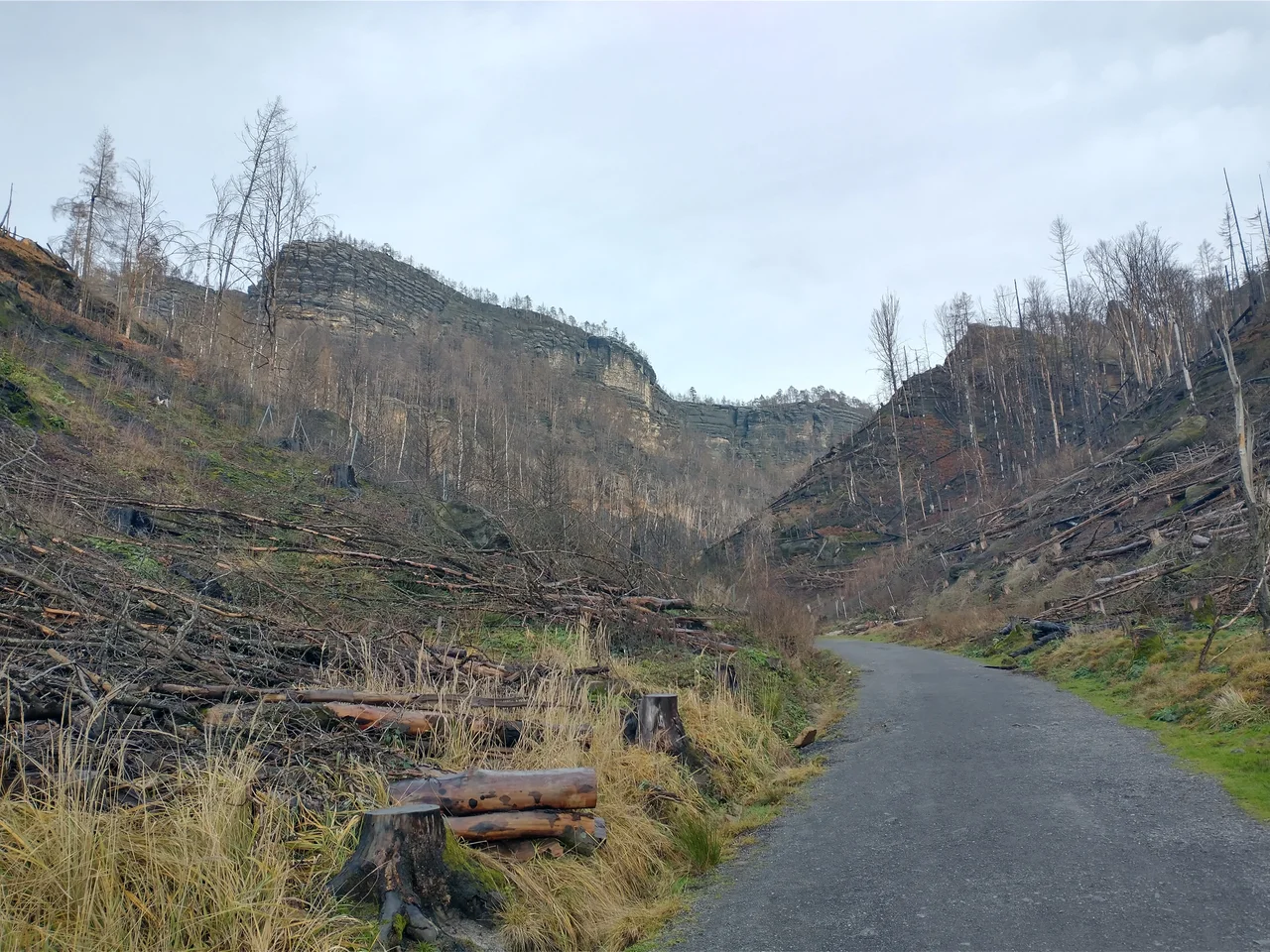
This is Cretaceous seabed. The sand that became the Elbe Sandstone Mountains was laid down under shallow water, lithified, lifted, and then cut apart along joints by rain and frost and running water over millions of years. Wherever the cementing was weaker, the rock went first. What remains standing is the harder material - the towers, fins and, in one place here, a bridge of stone left behind after everything beneath it was removed. The arch is not stable in the way a masonry bridge is stable. Sandstone spalls, freezes, absorbs water and sheds grain, and the lower section carries cracks that are measured rather than ignored. The formation is protected as a Czech national nature monument, a category that acknowledges what is obvious on the walk up: this is a temporary object working on a very long clock.
Andersen Came in 1831
The Romantics found it before the tourists did, which is the usual order of events in this corner of Europe. Hans Christian Andersen made the walk in 1831. The painters Ludwig Richter and Carl August Richter came too, and their pictures did what pictures do - turned a piece of remote border forest into a destination. Infrastructure followed the reputation. A small bark hut went up in 1817 for forestry workers and fire watch, and in 1826 it was licensed as an inn, which made it the first place near the arch where a walker could buy something. Then, in the summer of 1882, the Hotel Falkennest was inaugurated below the span - Sokolí hnízdo in Czech, the Falcon's Nest in both languages - built for Prince Edmund of Clary-Aldringen as a fifty-bed hotel and a summer residence. It is still the strangest building in Bohemian Switzerland: a timbered Swiss-chalet fantasy wedged under a natural arch.
Sixty Centimetres of Missing Rock
For a century and a half, the whole point was to walk across it. Steel stairs and railings were fitted, and generation after generation of visitors went up and over. Sandstone does not survive that. By the early 1980s, surveys found that boot traffic had removed a layer sixty to eighty centimetres deep from the crossing - not chipped, not vandalised, simply worn away by people enjoying themselves. In 1982 the arch was closed. The stairs and railings came out, and the deck has been out of bounds ever since. You now pay at a gate, walk the terraces below and beside it, and look. It is a small, unglamorous piece of conservation arithmetic: the thing everyone came to do was the thing destroying what they came for.
The Bridge That Was Filmed but Not Crossed
In 2005 the arch had a second career. Landscape sequences for The Chronicles of Narnia: The Lion, the Witch and the Wardrobe were shot here, and the rock made the transition to fantasy without much effort - it already looked like the entrance to somewhere else. But the actors are not on it. Because the deck had been closed for over twenty years by then, the shots in which characters appear to run across the span were filmed in a studio and composited in afterwards. The most photographed natural bridge in central Europe played the part of a bridge that nobody was allowed to walk on.
Getting There on Foot
The arch belongs to a landscape, not a car park. The long-distance mountain path from Eisenach to Budapest runs past it, and the ordinary approach is a climb of an hour or so up from Hřensko, the village at the lowest point in the Czech Republic where the Kamenice meets the Elbe. The terrain has been in private hands since the hotel was privatised, so there is an entry fee and opening hours, which surprises walkers who have spent the morning in an otherwise wide-open national park. Come early. The stone takes light well at the beginning and end of the day, going from grey to a warm ochre, and the gap under the span frames the wooded ridges running north toward the German border and Saxon Switzerland beyond.
From the Air
The Pravčická brána stands at 50.88 N, 14.28 E in Bohemian Switzerland, close to the Czech-German border and about 3 km northeast of Hřensko. Best viewed between 1,500 and 3,000 feet AGL. The arch itself is a small target from the air, but the approach is easy to follow: track the Elbe upstream from Dresden to where it crosses the border at Hřensko, then look northeast into the wooded plateau for the pale sandstone crags standing clear of the conifers, with the dark timber bulk of the Falcon's Nest hotel directly beneath the span - the building is often easier to spot than the rock. The gorges of the Kamenice cut in to the east. Nearest airports are Dresden (EDDC), about 24 nm northwest, and Liberec (LKLB), about 29 nm east. Valley fog along the Elbe and in the ravines is frequent in the mornings and can persist below the plateau while the tops stay clear.
Nearby Stories
- Moritzburg Castle 2.8 km away
- Zittau 3 km away
- Bautzen 13 km away
- Upper Market Square (Görlitz) 16 km away
- Kaditz Lime Tree 22 km away
- The Defenestration of Prague: The Thrown Men Who Started a Thirty Years' War 61 km away
- The Anschluss: When Austria Vanished Overnight 279 km away
- The Battle of Vienna: The Cavalry Charge That Saved a Continent 289 km away