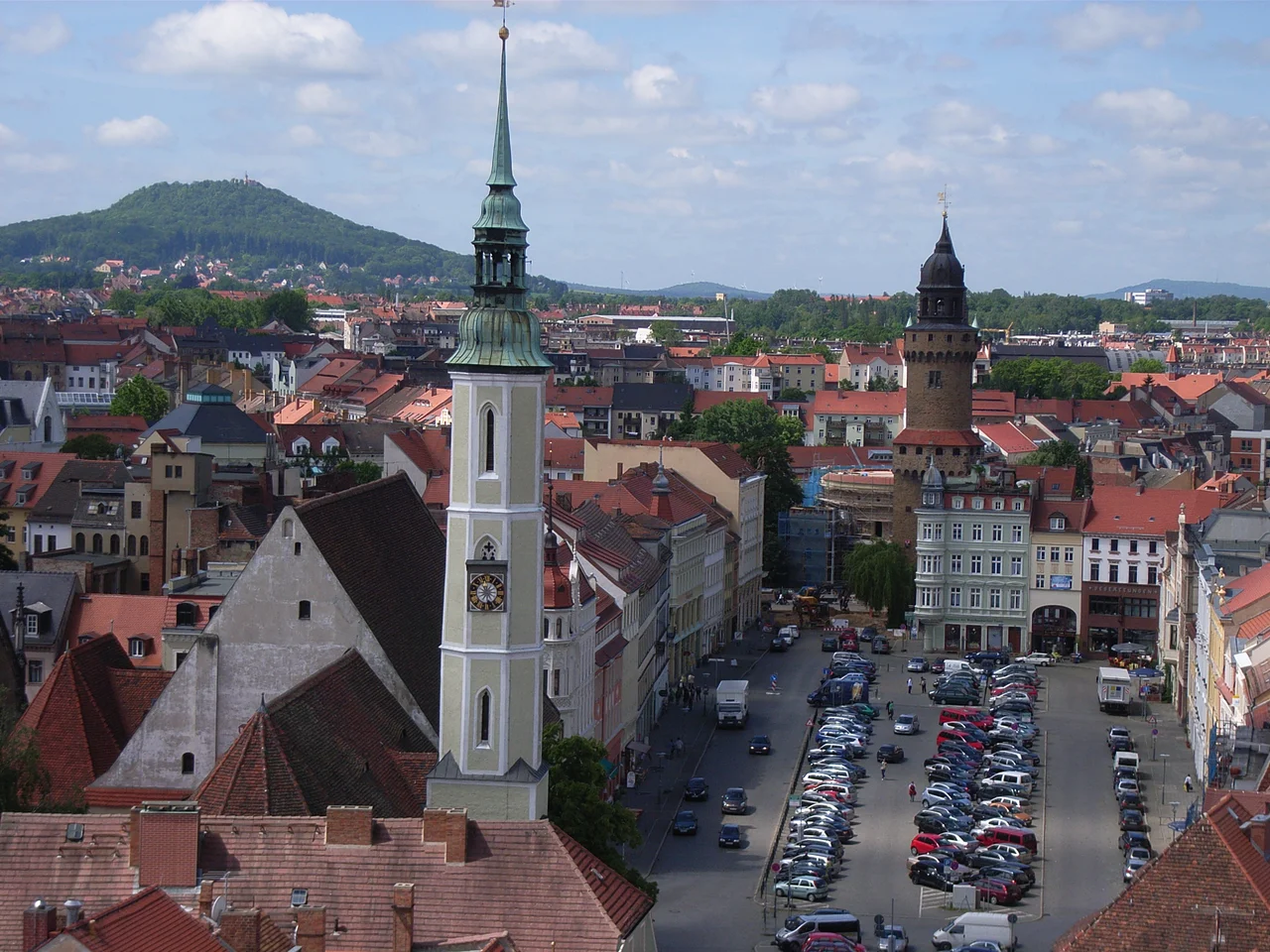

Upper Market Square (Görlitz)
On May Day 1946 up to ten thousand people filled the Obermarkt under a canopy of red flags, carrying banners that read Nie wieder Krieg - never again war. People standing close enough noticed that the flags were not new. Each one carried a darker circle at its centre, where a white disc and the swastika inside it had been removed. Görlitz had not made new flags. It had taken the old ones down from the attics, unpicked the middle, and hung them back up. Improvisation of that kind is more or less what this square has done since 1250, the year it was laid out along with the Lower Market at the far end of Brüderstraße. It is the largest open space in the old town, and almost every version of Germany has stood on these cobbles and addressed a crowd.
Seven Hundred and Fifty-Four Carts
For most of its life the square did a plain job: it sold grain. A salt house stood in the middle of it from about 1407, and in 1535 it was converted into a cloth hall and dance floor, since until then only the town hall had anywhere for the better sort to dance. Grain came in from the Upper Lusatian countryside in quantities the square could barely absorb - on 19 July 1804 there were 754 loaded carts crowded onto it. Earlier, in January 1451, the Franciscan preacher John of Capistrano had a pulpit built in front of the salt house and delivered fifteen sermons from it. The town fire of 1717 destroyed every building on the north and west sides, which is why the oldest houses here are nearly five centuries younger than the square they stand on.
The Monk, the Defier and the Tower
Three buildings anchor the western end, and each has collected a nickname. The Dreifaltigkeitskirche began as a Franciscan monastery church, consecrated on 21 August 1245; its Gothic choir, built between 1371 and 1381, is the oldest Gothic work in Görlitz, and the bell turret above it has been called the Mönch - the Monk - for centuries. In the Barbara Chapel hangs the Goldene Maria, a winged altarpiece made in a Breslau workshop between 1510 and 1515, beneath a vault painting of thirty-two angels that nobody laid eyes on between the Reformation and 1909. Beside it the Reichenbach Tower rises 51 metres, first recorded in 1376, given a battlemented drum in 1485 and a copper Baroque dome in 1782; its last tower keeper moved his family out in 1904. Next to that squats the Kaisertrutz, a bastion that earned its name in 1641 by defying imperial and Saxon troops while Swedish forces held the town.
Whoever Was in Charge Spoke Here
On 9 November 1918 a crowd gathered outside the Kaisertrutz, then the main guardhouse, broke the military prisoners out and ran a red flag up the roof; the duty officers could not stop them. A decade later Paul von Hindenburg was greeted from private windows with the black-white-red of the vanished empire, while only the public buildings flew the republic's black-red-gold. On 6 October 1940 the battalions of Infantry Regiment 30 marched back from Poland and France through a gate of honour hung with swastikas. In 1951 the square was formally renamed Leninplatz, a decision the town declined to adopt in speech - there was still a Lower Market, and now apparently no Upper one. On 17 June 1953 several thousand people filled it demanding new elections and lower prices. The radio dealer Artur Hellwig lent them his loudspeaker and received ten years for it. His younger colleague Horst Kanzog got six.
House Number Fifteen
The square's Jewish shopkeepers were stripped of their businesses under the programme the regime called Aryanisation. Jakob Abramowitz lost his menswear shop at No. 11, Paul Kafka his shoe shop on the Steinstraße corner, the Meirowsky brothers their clothing store at No. 7. Artur Dresel, a Social Democrat who had held many unpaid civic offices, was accused of molesting a teenage customer during a fitting; the local paper and Der Stürmer printed everything they could invent. The court acquitted him. He was sent to the prison in Breslau anyway, where he is said to have taken his own life, and at a trial in Bautzen in 1948 it emerged that a resentful neighbourhood craftsman had denounced him. Above the funeral parlour at No. 15, a group of dismissed Social Democrats under Wilhelm Baumgart printed leaflets, carried material in from occupied Czechoslovakia and helped French prisoners. One of them, Willy Leisten, outlived the Nazis and died in a Soviet camp.
Two Hundred and Forty-Five Tenants
After the war the square held more residents than at any point in its history. The 1949/50 address book lists 245 tenants in 32 houses, several families to a flat, thirty-four people in one building alone. Many were refugees from Silesia; many others had walked a few hundred metres across a bridge, because their homes were the eastern suburbs of Görlitz, now the Polish town of Zgorzelec. Among those who came back was a Jewish tenant the Nazis had driven out, who reopened the Abramowitz textile shop at No. 11. On 27 September 1990 Helmut Kohl spoke here to a crowd the Dresdner Morgenpost put at 25,000; puzzled by an unfamiliar gold and white flag, he asked what it meant and opened by addressing them as Lower Silesians. Willy Brandt came in November and drew far fewer. The Ullrich funeral home, founded in 1893, is now the oldest business on the square.
From the Air
The Upper Market sits at 51.155 N, 14.987 E, at the western end of the Görlitz old town, roughly 200 metres above sea level and about 700 metres west of the Lusatian Neisse, which here is the German-Polish border. Best read between 1,500 and 3,000 feet AGL. From the air the square is an elongated open rectangle interrupting a dense block of pitched roofs: the Reichenbach Tower and the round Kaisertrutz break the building line at its western end, the Dreifaltigkeitskirche closes the south side, and the narrow slot of Brüderstraße runs east to the smaller Lower Market and the town hall tower. South-west of town the isolated basalt cone of the Landeskrone rises just over 400 metres out of otherwise gently rolling country and is the surest visual fix in the area. Flugplatz Görlitz (EDBX, 750 m grass) lies 3 km west of the centre; Dresden (EDDC) is about 56 nm west, Wrocław (EPWR) about 72 nm east, and Berlin Brandenburg (EDDB) about 91 nm north-west. Haze settles in the Neisse valley on summer mornings; a low winter sun from the south-west throws the tower shadows straight across the square and makes it easiest to identify in the early afternoon.
Nearby Stories
- Zittau 13 km away
- Pravčická brána 14 km away
- Lusatia 16 km away
- Branitz Palace 27 km away
- Sorbian Settlement Area 31 km away
- Krzeszow Abbey 50 km away
- Lubiaz Abbey 70 km away
- Nazi War Crimes in Occupied Poland 249 km away