
Sorbian Settlement Area
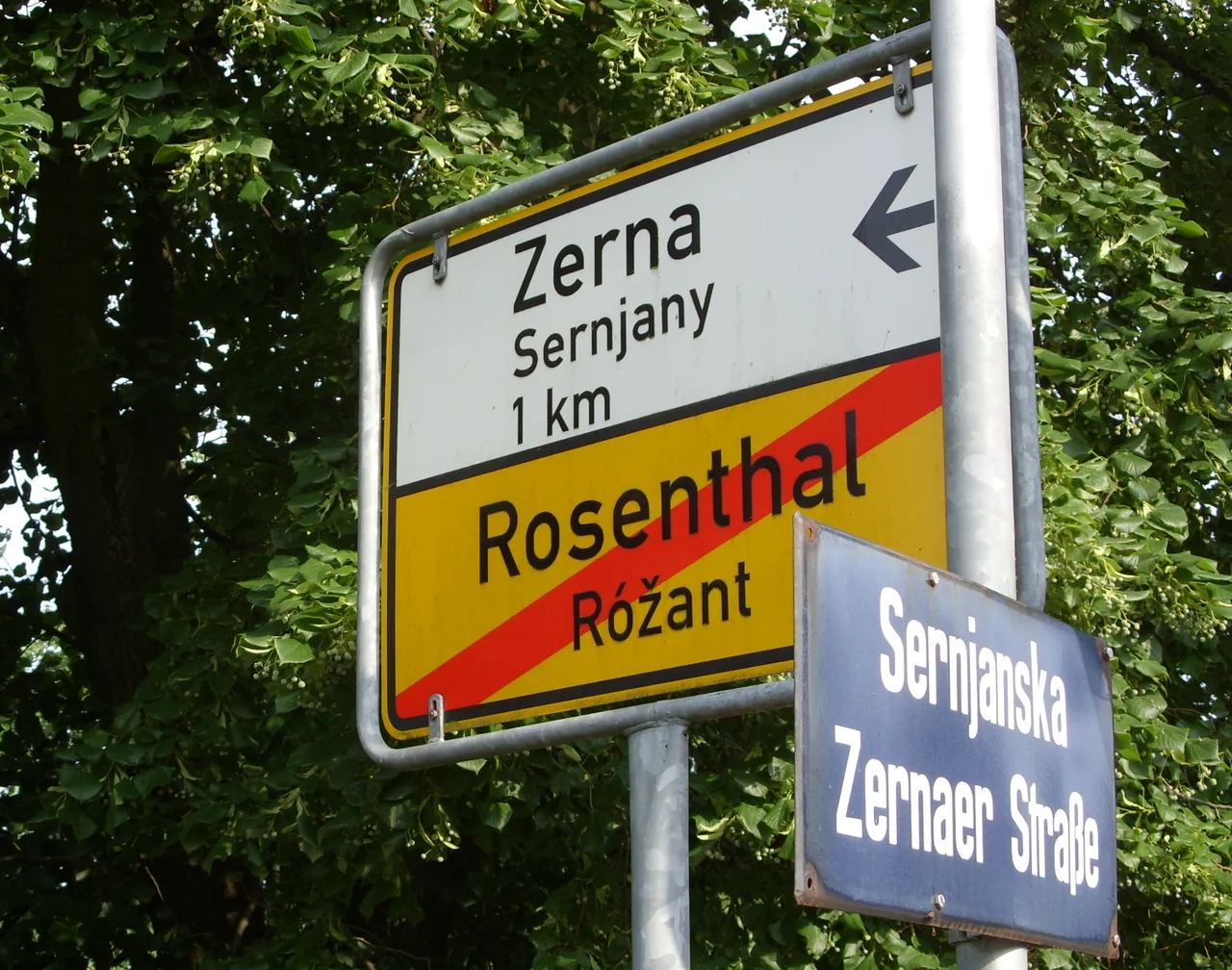
Ask how many Sorbs live in eastern Saxony and southern Brandenburg and nobody can tell you. German law makes the answer a matter of personal declaration: identifying as Sorbian is free, and no authority may verify or record it. So the homeland of Germany's indigenous Slavic minority is measured not by headcount but by statute and by road signs. Drive east from Dresden or north from Cottbus and the place names start doubling on the boards at the edge of town, Bautzen with Budyšin, Cottbus with Chóśebuz, Kamenz with Kamjenc. You have crossed into the Sorbian settlement area, called Sorbenland in everyday German, and known to its own people by the languages spoken inside it: Upper Sorbian in the south, Lower Sorbian in the north, and in Brandenburg the older name Wends alongside Sorbs.
Two Names on Every Sign
Saxony and Brandenburg each define the area by law, and they went about it very differently. Saxony fixed its boundary permanently, deliberately using statistics gathered in the 1880s so that the settlement area would be preserved in its historical dimensions rather than its shrunken present. Brandenburg originally required municipalities to prove a continuing Sorbian linguistic and cultural presence before they could join, a demand minority representatives attacked on two grounds: it made recognition depend on a town council's goodwill, and it asked for evidence of continuity precisely from the communities where Prussian assimilation policy had worked hardest at breaking it. A 2014 amendment lowered the threshold to corroborating either language or cultural tradition, and the Council for Sorbian/Wendish Affairs can now request a municipality's inclusion. Town and guide signs are mandatorily bilingual, and since 2014 every Brandenburg municipality inside the area officially carries a German and Lower Sorbian double name. The further obligations, bilingual street signs and websites, are rarely met outside the core. In 2016 the Brandenburg parliament recognized several municipalities that had gone to court to be left out.
How the Map Shrank
German kings began conquering this country in the tenth century. About a hundred years later the West Slavic speech of the people already living here started to become what we now call Sorbian, and from that point the written record goes almost silent. What survives is mostly evidence of hostility. Leipzig prohibited the language in 1327; Altenburg, Zwickau and Chemnitz followed in 1377. Martin Luther, early in the sixteenth century, had contemptuous things to say about the Sorbian villagers around Wittenberg. The language once reached northeast to the Polish speech border near Crossen and Sorau, and was still spoken in villages east of the Bóbr and the Oder into the seventeenth century. Assimilation and Germanization pulled the edges inward for centuries. In the twentieth, lignite finished the job in places: open-cast mines across Lusatia excavated whole villages out of existence, taking with them the kitchens, taverns and churchyards where a minority language actually lives.
What Muka Found on Foot
The first serious attempt to draw the boundary came from Sorbs themselves. Jan Arnošt Smoler mapped the area in 1843, though his real interest was collecting folkloric tales. Four decades later Arnošt Muka did the harder work. He travelled from municipality to municipality asking people directly how they spoke, and published detailed statistics alongside written accounts of the conversations he had along the way. He counted roughly 166,000 Sorbs. He also documented how quickly Sorbian was giving way to German, particularly in Lower Lusatia, so his figures were a snapshot of a decline already well underway. More than a century later those same figures are the legal foundation of Saxony's settlement area, which is defined by Muka's 1880s fieldwork rather than by any modern count.
1937
In 1912 the Sorbs founded the Domowina, an umbrella organization for their societies, with its seat in Bautzen. Twenty-five years later the Nazi state banned it, along with the cultural society Maćica Serbska and the Sorbian press, pushed the language out of public life entirely, and arrested Sorbian teachers, priests and writers. Maćica Serbska was not revived until 1991. After the war, East Germany took the opposite official line, guaranteeing Sorbian rights, funding Sorbian schools and subsidising the Domowina's publishing house. That protection was real, and so was its limit. The same state that promised Sorbian schooling was clearing Sorbian villages for coal. Legal recognition and physical erasure ran side by side for decades, which is a large part of why the map looks the way it does now.
Where It Is Still Spoken Every Day
Inside the official area sits a smaller one that matters more: the core settlement area, where Sorbian remains a daily language. It centres on the largely Catholic countryside of Upper Lusatia between Bautzen, Kamenz and Hoyerswerda. In Radibor and the five municipalities of the Am Klosterwasser association, more than half the population speaks Upper Sorbian; in Göda, Neschwitz, Puschwitz and the town of Wittichenau, more than a third. Lower Sorbian stands in a far weaker position. North of Cottbus, in villages such as Drachhausen, Dissen-Striesow and Jänschwalde, it is spoken by somewhere between 15 and 30 percent of residents. UNESCO classifies Upper Sorbian as definitely endangered and Lower Sorbian as critically endangered. The most serious response has been immersion schooling. On 1 March 1998 the first WITAJ group opened in Sielow, outside Cottbus, with twelve children, modelled on the Breton Diwan schools. Roughly 1,200 children a year now learn Sorbian this way in Upper Lusatia, and about 250 in Lower Lusatia.
From the Air
Centred near 51.50 N, 14.25 E, spanning eastern Saxony and southern Brandenburg between Dresden and the Polish border. From 8,000 to 15,000 feet the region reads as a mosaic of pine forest, fishpond chains around Bautzen and Königswartha, and the flooded former lignite pits of the Lusatian Lakeland, with the Spreewald canal network in the north. The active open-cast mines at Jänschwalde and Welzow and the cooling towers of the Lusatian power stations are the clearest daylight landmarks. Nearby airports include Dresden (EDDC), Cottbus-Drewitz (EDCD) and Rothenburg/Görlitz (EDBR); Berlin Brandenburg (EDDB) lies about 60 nm northwest. Winter haze and low stratus are common in the river lowlands.
Nearby Stories
- Karl May Museum 6.1 km away
- Cottbus 11 km away
- Stalag VIII-A 18 km away
- Battle of Hochkirch 23 km away
- Moritzburg Castle 28 km away
- Upper Market Square (Görlitz) 33 km away
- Kummersdorf 52 km away
- Sonnenburg concentration camp 98 km away