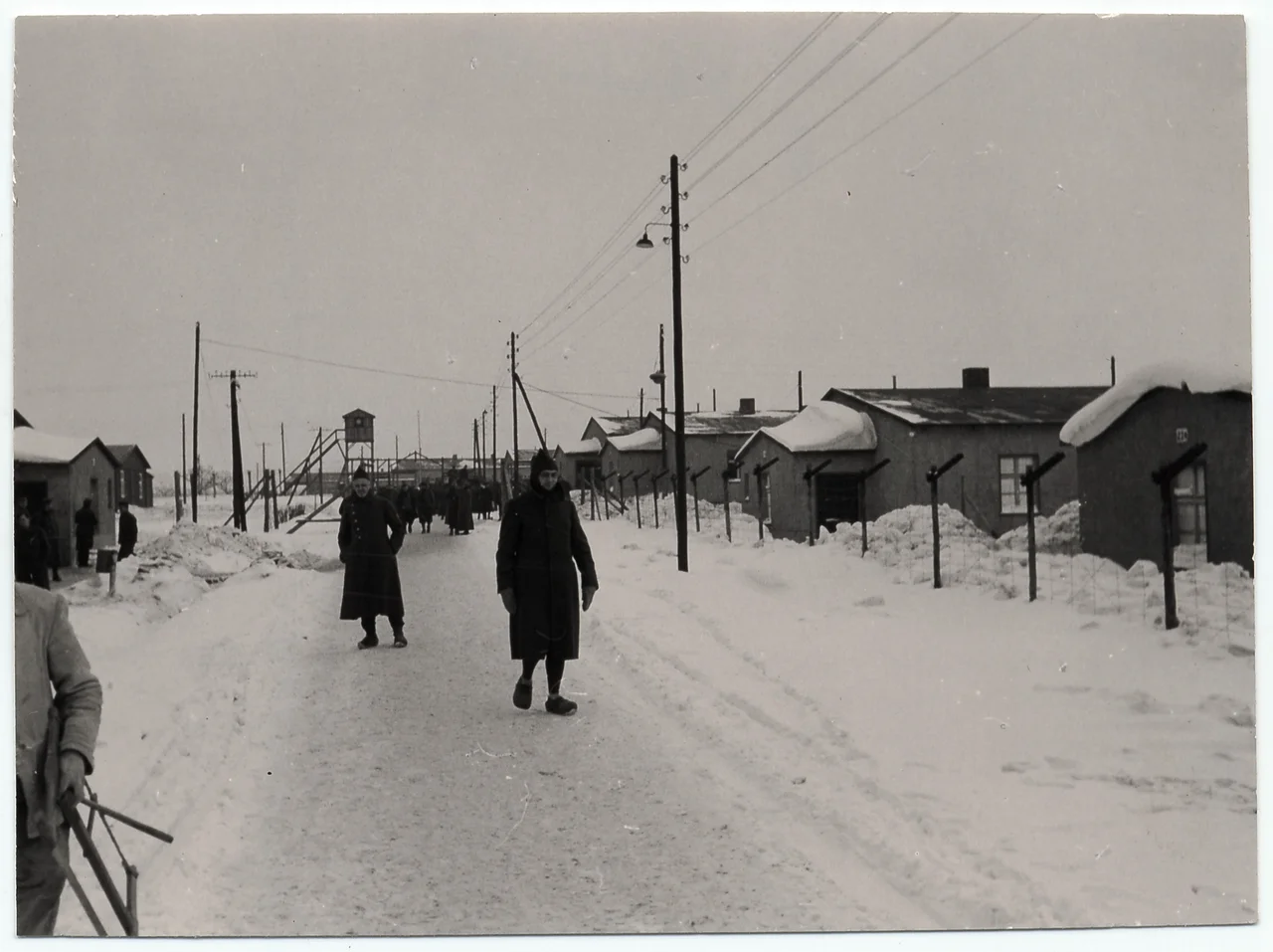

Stalag VIII-A
Roughly four hundred men crowded into Barrack 27 on the evening of 15 January 1941 - prisoners of war and German guards sitting together in a wooden hut that doubled as the camp theatre, in cold hard enough to stiffen fingers. Four Frenchmen took their places: Olivier Messiaen at a piano, Jean le Boulaire with a violin, Henri Akoka with a clarinet, Étienne Pasquier with a cello. What they played had been written inside the wire, and it was about the end of time. Messiaen said afterwards that he had never been listened to with so much attention and understanding.
The Guard Who Brought Pencils
Messiaen was thirty-one, a medical auxiliary in the French army, and already a composer of standing when he was captured in June 1940. He had met Pasquier and Akoka the year before in a military orchestra at Verdun; while the three of them waited to be shipped east, Akoka sight-read the fiendish solo clarinet movement *Abîme des oiseaux* off the page and grumbled about it. At Stalag VIII-A they found le Boulaire, and Messiaen found something rarer - a German guard, Carl-Albert Brüll, willing to supply him with manuscript paper and pencils. A quartet for violin, clarinet, cello and piano is an odd combination. Messiaen wrote for it because those were the four men and the four instruments the camp happened to contain.
Quatuor pour la fin du temps
The title comes from the angel of Revelation who swears that there shall be time no longer, and Messiaen meant it musically as well as theologically: the piece dissolves regular metre, stretching some movements almost to stillness. There are stories attached to that premiere that have grown in the telling - about broken instruments and audiences of thousands - and Pasquier, interviewed near the end of his life, put the crowd at around four hundred. The truth is remarkable enough without embroidery. Four prisoners performed a difficult, deeply strange new work in a freezing hut in Lower Silesia, and it has been played in concert halls all over the world ever since. Akoka's own war continued: in April 1941 he jumped from a moving cattle car during a transfer, still holding his clarinet, and got away.
Before There Was Music
The camp existed before the composers arrived, and its first prisoners are the ones most easily forgotten. Stalag VIII-A was established on 26 August 1939 - days before Germany invaded Poland - on an eighteen-hectare field converted from a Hitler Youth site, and formally named on 23 September. About fifteen thousand Poles were brought here, soldiers and civilians alike. It also served as a transit point for Polish women, teachers, activists and members of the intelligentsia seized in Silesia, Greater Poland and Pomerania during the *Intelligenzaktion* and sent on to concentration camps in Germany. Around three thousand were held at the camp itself while seven thousand went to forced-labour subcamps nearby. Czechs, Lithuanians, Belarusians and Jews were among them. More than 1,500 Jewish prisoners were deported from here to Lublin in 1941; the last Poles were sent away in 1942.
Forty-Seven Thousand
After the Battle of France, Belgian and French troops arrived in numbers the camp could not absorb, and through the middle of 1940 many of them lived in tents. A separate compound went up for Soviet prisoners in 1941 - men held under conditions the German army applied to no one else. In 1943 came 2,500 British Commonwealth soldiers from the fighting in Italy, British, Canadian, Australian, New Zealand and South African, and later that year more than six thousand Italians from Albania. The register peaked at 47,328 in September 1944, in facilities built for fifteen thousand. French medical orderlies did what they could. The death rate stayed high.
Meetingpoint
On 14 February 1945 the Americans and British were marched west ahead of the Soviet advance, and the evacuation ground on until May, on foot, with every vehicle reserved for military use; the long winter marches killed men the camp had not. Soviet troops freed the last prisoners on 7 May 1945. The border moved afterwards, and the site now sits in Zgorzelec, Poland, across the Lusatian Neisse from Görlitz in Germany - one town made into two by a river. In 2014 a joint German-Polish project called Meetingpoint Music Messiaen opened a European centre for memory, education and culture beside the old camp, built on an idea first floated in December 2004. Its founders were deliberate about the brief: not only a memorial, but a place where young people from three countries come to make things. In 2011 the German band Topictoday dedicated a song, "Helden ohne Namen" - "Heroes without Names" - to the men who were held here.
From the Air
The camp site lies at 51.1196 N, 15.0135 E on the southern edge of Zgorzelec in Lower Silesian Voivodeship, Poland, immediately east of the Lusatian Neisse. From 2,000-3,500 ft AGL the defining feature is the river itself, running north-south with the twin towns of Görlitz and Zgorzelec facing each other across it; Görlitz's dense red-roofed old town on the German bank is the easiest visual fix, with the wooded camp memorial ground about 2 km south-southeast of the crossing. Terrain is gently rolling and rises toward the Karkonosze/Giant Mountains 40 km to the south, which is the only significant relief in the area and a reliable source of lee turbulence in strong southerly flow. Dresden (EDDC) lies about 85 km west, Wrocław (EPWR) about 130 km east. Visibility is generally best in early autumn; winter inversions in the Neisse valley can hold haze for days.
Nearby Stories
- Ještěd Tower 8.2 km away
- Pravčická brána 22 km away
- Sorbian Settlement Area 22 km away
- Lusatia 28 km away
- Ústí Massacre 31 km away
- Krzeszow Abbey 43 km away
- Ksiaz Castle 63 km away
- Nazi War Crimes in Occupied Poland 255 km away