
Kummersdorf
You are not permitted to walk in this forest. Some 3,200 hectares of pine and sand about 25 km south of Berlin have carried protected-monument status since June 2007 and a general ban on entry for longer than that, and the reason is what is still in the ground: unexploded shells, and the chemical residue of seventy years spent testing things designed to destroy other things. Kummersdorf was the German army's proving ground from 1875 until Soviet troops reached it in the last week of April 1945. Nearly everything that army fired or drove was tried here first. And for a few years in the early 1930s, a very small team working on the western edge of the range fired the first liquid-fuelled rocket motors that would eventually lead to the V-2.
Why the Range Moved
In 1871 the Prussian ministry of war decided that its artillery test range at Tegel, then a village on the northwestern edge of Berlin, was too close to the city - a judgement history has endorsed, given that the site became an airport. The replacement went into the Kummersdorf forest, financed out of the reparations France paid after the Franco-Prussian War. It opened on 15 October 1875, the day the Royal Prussian Military Railway reached it. The first firing experiments followed in 1880 along a range running twelve kilometres southeast to northwest, and their object was blunt: find out what fortifications could absorb and what projectiles could do to them. The grounds eventually covered 878.1 hectares. By 1913 the work had gone airborne, with trials dropping bombs from the airship LZ 13 Hansa and from Wright biplanes.
The Quiet Decade
After 1918 the Treaty of Versailles set hard limits on what Germany was allowed to develop, and through the 1920s Kummersdorf ran programmes in artillery, armoured vehicles, motor transport, signals and aviation that were not advertised. Rearmament after 1933 removed the need for discretion and brought the money. Hitler visited for the first time on 21 September 1933. The site expanded into a full research campus with its own motor-vehicle proving facility, the Verskraft, whose test tracks and halls later took the Maus, the heaviest tank Germany ever attempted and one that never got past prototypes. From 1939 the Army Weapons Office also ran nuclear research here as part of the German uranium project. The name Kummersdorf covered a great many things at once, and almost none of them were public.
Test Stand West
In 1929 the German defence ministry began investigating rocket propulsion for military use and assigned it to the Ballistics Branch of the Army Weapons Department. Walter Dornberger arrived in 1930. By December 1932 they had built a test stand for liquid-propellant motors on the western edge of the range - Experimental Station West - and on the 21st of that month Dornberger, Walter Riedel and a twenty-year-old Wernher von Braun ran their first motor on liquid oxygen and 75-percent ethyl alcohol. Arthur Rudolph joined them. They built the Aggregate 1, moved on to the A-2, and used a wind tunnel to work out shapes that stayed stable from standstill through supersonic speed. In December 1934 two A-2s flew successfully from the North Sea island of Borkum. Then the whole programme moved north to Peenemünde on the Baltic, and out of Kummersdorf's hands.
Where the Test Stand Led
What happened at Peenemünde is not Kummersdorf's story, but it begins in that sand pit. The weapon that came out of the line of development started here, the V-2, was assembled from January 1944 in tunnels near Nordhausen by prisoners of the Mittelbau-Dora concentration camp. Around 60,000 people passed through the Mittelbau camps between August 1943 and March 1945. Roughly 20,000 of them died there - about one in three of everyone sent. The first rocket built in those tunnels was launched at London on 8 September 1944. It is worth holding both ends of that arc in view at once: three engineers with a stopwatch and a hand-built burner in a Brandenburg wood, and, eleven years later, a workforce dying underground to build what the burner became.
A Forest You Cannot Walk In
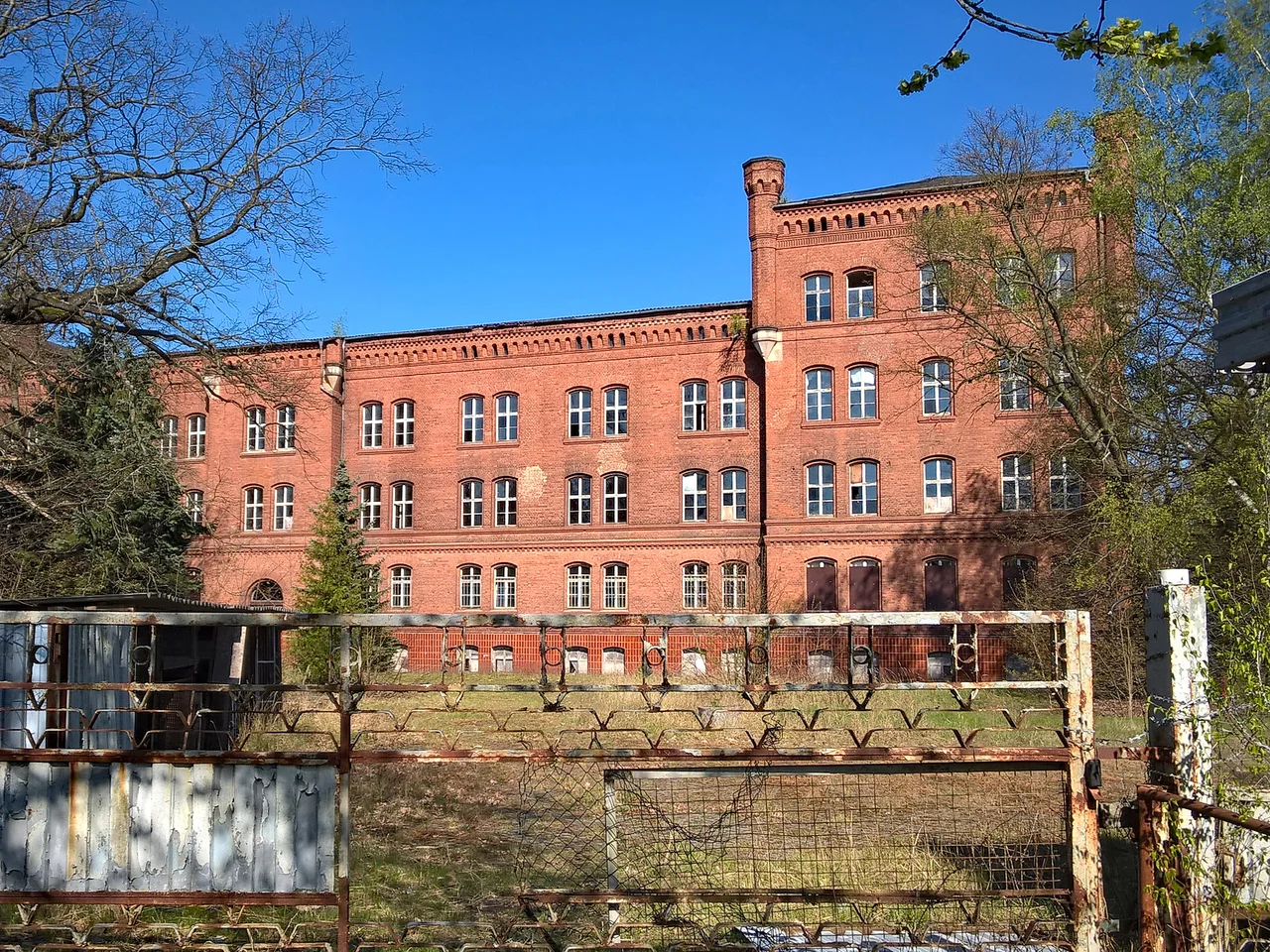
By April 1945 the range was the front line. Whatever was still at Kummersdorf got thrown together into improvised units - a handful of tanks, some of them captured from other armies, and the site's own workers and civilians handed rifles and formed into a makeshift grenadier company. On 21 April one such group fought south toward Baruth against the Soviet 1st Ukrainian Front and was destroyed. These were technicians and labourers, not infantry. Afterwards the Soviets stripped the technical installations and kept the land military; East Germany built the Sperenberg airfield nearby in 1958, and the last Russian commander left in 1994. A volunteer association now runs a historical-technical museum on one corner of the site and takes visitors round on Sunday afternoons from March to October. Everything beyond that stays closed. Roofless brick barracks stand in the pines, concrete test stands sit in clearings, and the ground between them is still not safe.
From the Air
Kummersdorf-Gut lies at 52.103°N, 13.376°E in the municipality of Am Mellensee, Teltow-Fläming, about 25 km south of Berlin at roughly 46 m elevation. The country is flat glacial sand covered in pine plantation and scattered with lakes - the Mellensee sits about 4 km northeast and Sperenberg with its former airfield about 6 km east. The old range shows from the air as a long cleared corridor running southeast to northwest through the forest, with barracks ruins and concrete structures at its northern end. Berlin Brandenburg (EDDB) is roughly 30 km north-northeast; Schönhagen (EDAZ) is about 19 km northwest and is the practical general-aviation field for this area. Recommended viewing altitude 1,500-3,000 ft. The site itself is closed to entry on the ground due to unexploded ordnance and contamination.
Nearby Stories
- Operation Gold 3.3 km away
- Wendish-German double church 8 km away
- Treuenbrietzen 9.6 km away
- E11 hiking trail 11 km away
- Falkenhagen Bunker 21 km away
- Lichtenburg Concentration Camp 22 km away
- Eisenhüttenstadt 39 km away
- 2001 American Memorial 45 km away