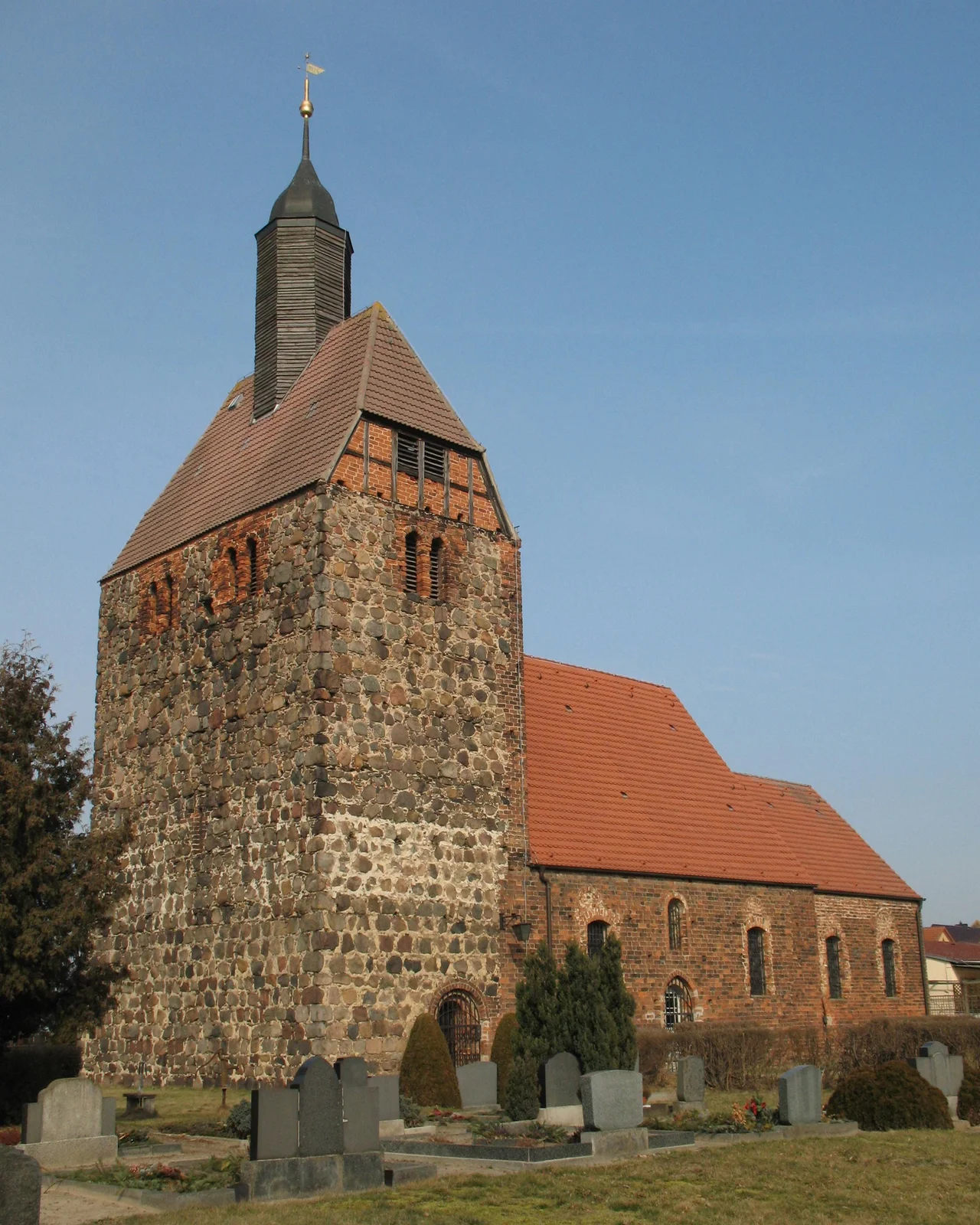

Treuenbrietzen
Four men walked out of a sandpit near the village of Nichel on 23 April 1945. One hundred and twenty-seven did not. The 131 who had been marched into the woodland that day were Italian soldiers — men who, after Italy left the Axis in 1943, had refused to keep fighting for Germany and had been stripped of prisoner-of-war status and put to work instead. For two years they had made ammunition in the factories of Treuenbrietzen. The Red Army had taken the town two days earlier and then briefly lost it again; in the gap, German troops shot them. Four survived.
Faithful Brietzen
The name is a medieval compliment that stuck. Brietzen appears in writing in 1217, and in 1348 an impostor claiming to be the long-dead Margrave Waldemar surfaced in Brandenburg and made a serious bid for the margraviate. Brietzen refused to let him inside its walls, holding instead for the Wittelsbach Louis V, who had held the title legitimately since 1323, through the crisis of 1348 to 1350 — and afterwards it was Treuenbrietzen, faithful Brietzen. The other survival from the town's older life is a tree. Martin Luther came to preach here in 1537 and found his way into the Marienkirche blocked, so he preached outside beneath a lime tree instead. It is still there, still called the Lutherlinde. Nineteenth-century textile mills gave the town its first industry; today around 7,500 people live in Treuenbrietzen and the villages around it.
Werk A and Werk S
Arms manufacturing arrived in the 1930s and reshaped everything. Dr. Kroeber & Sohn, formerly a maker of steam and gas gauges and small engines, turned to aircraft engine parts for the Luftwaffe. Treuenbrietzener Metallwarenfabrik ran two cartridge factories — Werk Sebaldushof, known as Werk A, north of the town, and Werk Selterhof, Werk S, to the south — with three more plants elsewhere in Germany and East Prussia. The labour came from a subcamp of Sachsenhausen opened here after 1936, and from foreign workers held under conditions they had not chosen and could not leave. The Italian internees were part of that system. They had been in the town two years when the front reached it.
The Week the Front Passed Twice
Soviet troops of the 51st Guards Tank Regiment, part of the 1st Ukrainian Front, took Treuenbrietzen on 21 April 1945. During those first hours a Soviet officer was shot. German forces — Wehrmacht and Waffen-SS — pushed back into the town and held it briefly before retreating for good on 23 April, and it was in that window that the Italians were killed at Nichel. When the Red Army returned, it took reprisal. Soldiers rounded up townspeople at the edge of a wood, separated the men from the women and children, and shot the men. An official assessment by the state of Brandenburg puts the number of German civilians killed at between 30 and 166. Local claims of around a thousand circulated for decades but cannot be reconciled with the size of the town. Between 24 April and 1 May the region became part of the battle of Halbe, fought out in the forests to the east as encircled German units tried to break westward.
Six Graves and a Date
The historic centre came through the war essentially intact, which gives Treuenbrietzen the disconcerting quality of a town whose worst week left no visible mark on its architecture. The evidence is in the cemeteries. Six mass graves lie at the Triftfriedhof. The Italian dead were not left where they fell: some were repatriated to Italy, and others were reburied in the Italian section of the Waldfriedhof at Zehlendorf in Berlin. Since 1995 the town has marked 23 April officially, as a day of remembrance for the victims of both massacres — the Italians shot by German troops and the civilians shot by Soviet troops, named together on the same date rather than set against each other.
Feldheim Makes Its Own
One of the villages inside the municipal boundary has become unexpectedly famous. Feldheim, among the smallest places in the municipality, built its own wind turbines and a biogas plant and then did the harder thing: it laid its own electricity and heating network rather than feeding into somebody else's. It was the first village in Brandenburg to run entirely on energy it generates itself, and it has been studied far outside Germany ever since. The rest of the municipality is quieter — cattle country, a market square, a lime tree with a plaque. Treuenbrietzen has also produced a fair number of people who left: the theologian Martin Chemnitz, the composers Christoph Nichelmann and Friedrich Heinrich Himmel, two generations of Turley organ builders, the mycologist Gottlob Ludwig Rabenhorst, and the boxer Henry Maske, born here in 1964.
From the Air
Treuenbrietzen lies at 52.097°N, 12.871°E, in the Potsdam-Mittelmark district of Brandenburg, on the northern edge of the Fläming heath about 32 km north-east of Wittenberg. Best viewed at 1,500-3,000 ft AGL. The town reads from the air as a compact medieval oval — an intact historic core ringed by the line of the old walls — set in gently rolling farmland with large pine blocks to the south and west. The wind turbines at Feldheim, a few kilometres south-west, are the most conspicuous landmark and the most useful visual fix. Navigational anchors: the Fläming ridge to the south, Beelitz to the north-east, and the A9 autobahn running north-south a short distance west. Nearest airports: Schönhagen (EDAZ) about 20 km north-east, Berlin Brandenburg (EDDB) about 50 km north-east, Leipzig/Halle (EDDP) about 85 km south-west. Terrain is low and unobstructed apart from the wind farm; note turbine heights when operating low.
Nearby Stories
- Kummersdorf 2.1 km away
- Marienfelde Refugee Transit Camp 4.2 km away
- Bauhaus Dessau 5.7 km away
- Paretz 10 km away
- Genthin Rail Disaster 10 km away
- Stork Farm Loburg 15 km away
- Lichtenburg Concentration Camp 23 km away
- Wendish-German double church 50 km away