
Paretz
"Just remember always that you are building for a poor farmer." That is the line that has followed the house at Paretz ever since the Crown Prince of Prussia handed the commission to the Berlin architect David Gilly in 1795 — and the strange thing is that Gilly obeyed. There is no grand stair at Paretz, no gilding, no dome. What stands at the end of the village street is a plain two-storey block with a shallow roof, flanked by four barns, two to a side, arranged to close a semicircular yard. The summer residence of Frederick William III and Queen Louise looks out at cattle sheds. Around four hundred people still live here, on the flat Havel bottomland about fifteen kilometres west of Potsdam, and the village is now a borough of the town of Ketzin.
The Boy Who Was Happy Here
The estate belonged to the von Bredow family until 1677, when the Brandenburg diplomat Christoph Caspar von Blumenthal bought it. Paretz is where his daughter Wilhelmina eloped in 1689 with Ernst Christian von Weiler, a married man — the sort of scandal a village remembers for three hundred years. A century on, the property had passed to Count Hans von Blumenthal, a former commander of the Gardes du Corps who spent his retirement as tutor to the Prussian crown prince. Frederick William's childhood was unhappy in most of the places he was obliged to be. It was not unhappy here. So in 1795 he bought the estate outright from his old tutor's son, Count Heinrich von Blumenthal, the playmate of his boyhood, for 80,000 Thalers. Gilly got the commission, and the instruction about the poor farmer. In 1804 the royal couple went further and had the entire village rebuilt to Gilly's designs — though very little of that uniform scheme is legible on the ground today.
Schloss Still-im-Land
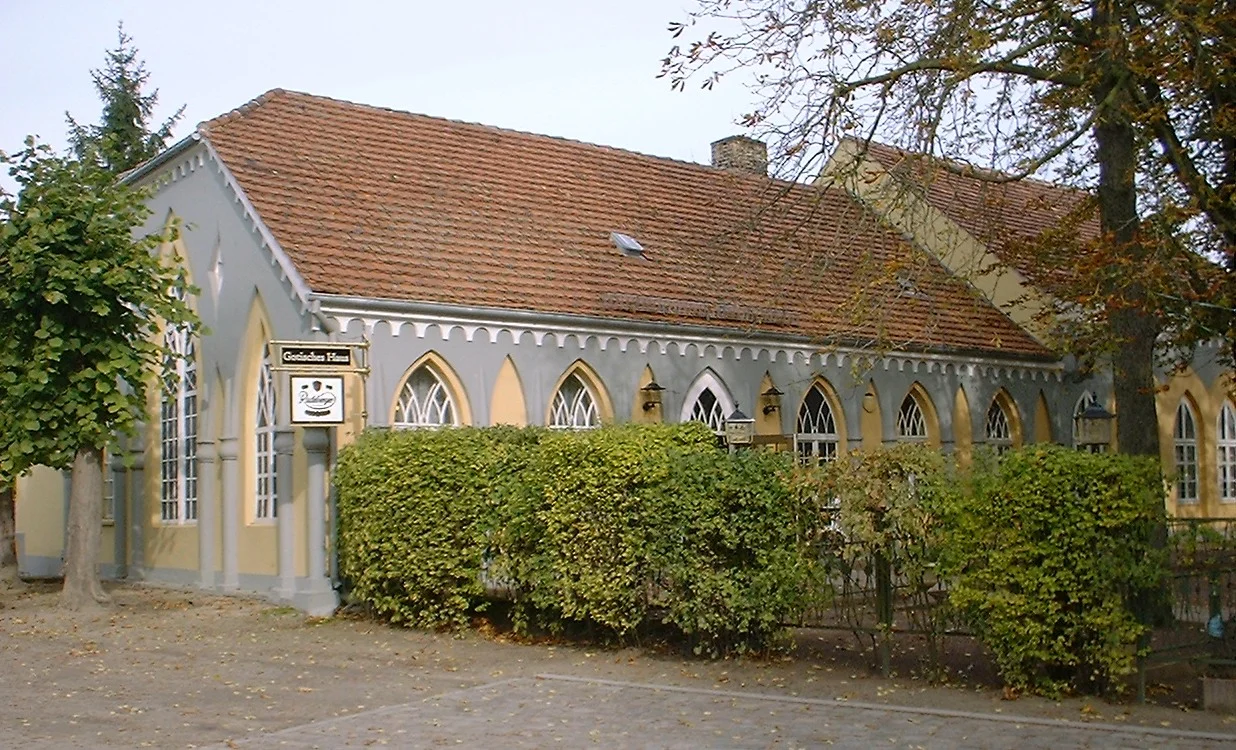
Louise died in 1810, and her husband left the house exactly as she had known it. Nothing changed for thirty years. Not until 1840 did Frederick William IV order new wallpaper and furniture for a handful of rooms, and whatever spell the place had cast as the Schloss Still-im-Land — the quiet-in-the-country palace — did not survive the redecoration. After that it simply stood, empty for most of a century, while Hohenzollern hands passed it along: to Wilhelm I, who became German Emperor in 1871; from 1888 to Prince Heinrich; and after his death in 1929 to his widow, Princess Irene of Hesse and by Rhine, who held it until the family lost everything in 1945. Nearby, the old royal forge survives as the Gothic House, the one neo-Gothic flourish in a village otherwise committed to plainness. It is a restaurant now.
What Was Carried Out in Time
The finest things at Paretz are on its walls: hangings worked with exotic plants, birds, and views of the Potsdam landscape. They exist because somebody took them down before the Second World War reached Brandenburg and stored them in the New Palace at Potsdam. The building they came out of had a harder time. The Red Army took the grounds in April 1945 and the troops did not leave until the middle of 1946. A year after that, refugees moved into the buildings — postwar Brandenburg had no shortage of people with nowhere to go — and in 1948 the palace was signed over to the Central Administration of Mutual Aid to Farmers. The alterations that followed, running through 1950, changed the look of both palace and farmyard past recognition. The wallpapers came home to a house that had become somewhere else.
Holes in the Ground
Nineteenth-century Berlin ate bricks. The city grew faster than anywhere in Europe and it grew in fired clay, which meant that the villages of the Havelland, sitting on good clay ground, filled up with brickworks. Paretz had them too. Then the trade slackened after the First World War, the workings were abandoned, groundwater came up through the floors of the pits, and the diggings turned into a scatter of small lakes: the Erdlöcher, the holes in the ground. After the second war some were backfilled with rubble from bombed Berlin, which closes a strange circle — the clay left as bricks and came back as ruins. Most of the rest were left alone. They are protected now, quiet green-brown ponds thick with waterfowl, and they are the reason the fields around the village are not simply flat.
Two Canals and a Border
Theodor Fontane came three times, in the spring of 1861, again in 1869, and in May 1870, and he wrote Paretz into his Wanderungen durch die Mark Brandenburg. He walked in from Uetz, barely half a mile off, through meadows that smelled of hay, past a haze of sunlit river mist that marked where the Havel spread into its bays; the village, he noted, does not appear until the very last moment, after the path climbs onto a levee lined with poplars and crosses a light bridge called the Infantenbrücke. The Havel here is a working river, and it has been reshaped twice for reasons a lifetime apart. The Sacrow–Paretz Canal was cut in the 1870s to shorten the run toward Potsdam and Berlin. The Havel Canal, dug in the 1950s from Paretz to Hennigsdorf, existed for a colder reason: it let East German barges reach Berlin and the Oder–Havel Canal without entering the stretch of river that West Berlin controlled. Both still carry traffic past a village of four hundred.
From the Air
Paretz sits at 52.470°N, 12.876°E on the west bank of the Havel, roughly 15 km west-northwest of Potsdam. Best viewed between 1,500 and 2,500 ft. The village itself is small, but the water around it is unmistakable from the air: the Havel broadens into a chain of shallow lakes immediately east, and two canals leave the junction on dead-straight lines — the Sacrow–Paretz Canal running east toward the Jungfernsee, the Havel Canal heading northeast toward Hennigsdorf. The scatter of round ponds in the fields nearby is the Erdlöcher, the flooded nineteenth-century clay pits. Ketzin lies just west along the river. Nearest airfields: Bienenfarm (EDOI), a Sonderlandeplatz about 23 km north-northwest; Schönhagen (EDAZ) about 35 km southeast; Berlin Brandenburg (EDDB) about 44 km east-southeast, with controlled airspace extending well west of the field — check the Berlin TMA structure and NOTAMs before routing overhead. Haze over the Havel lowlands is common on still summer mornings and again from November through February.
Nearby Stories
- Schwerbelastungskörper 1.7 km away
- Maybach I and II 7.6 km away
- Battle of Fehrbellin 8.5 km away
- Bogensee 12 km away
- Genthin Rail Disaster 13 km away
- Treuenbrietzen 13 km away
- Stork Farm Loburg 18 km away
- Holy Blood of Wilsnack 35 km away