
Maybach I and II
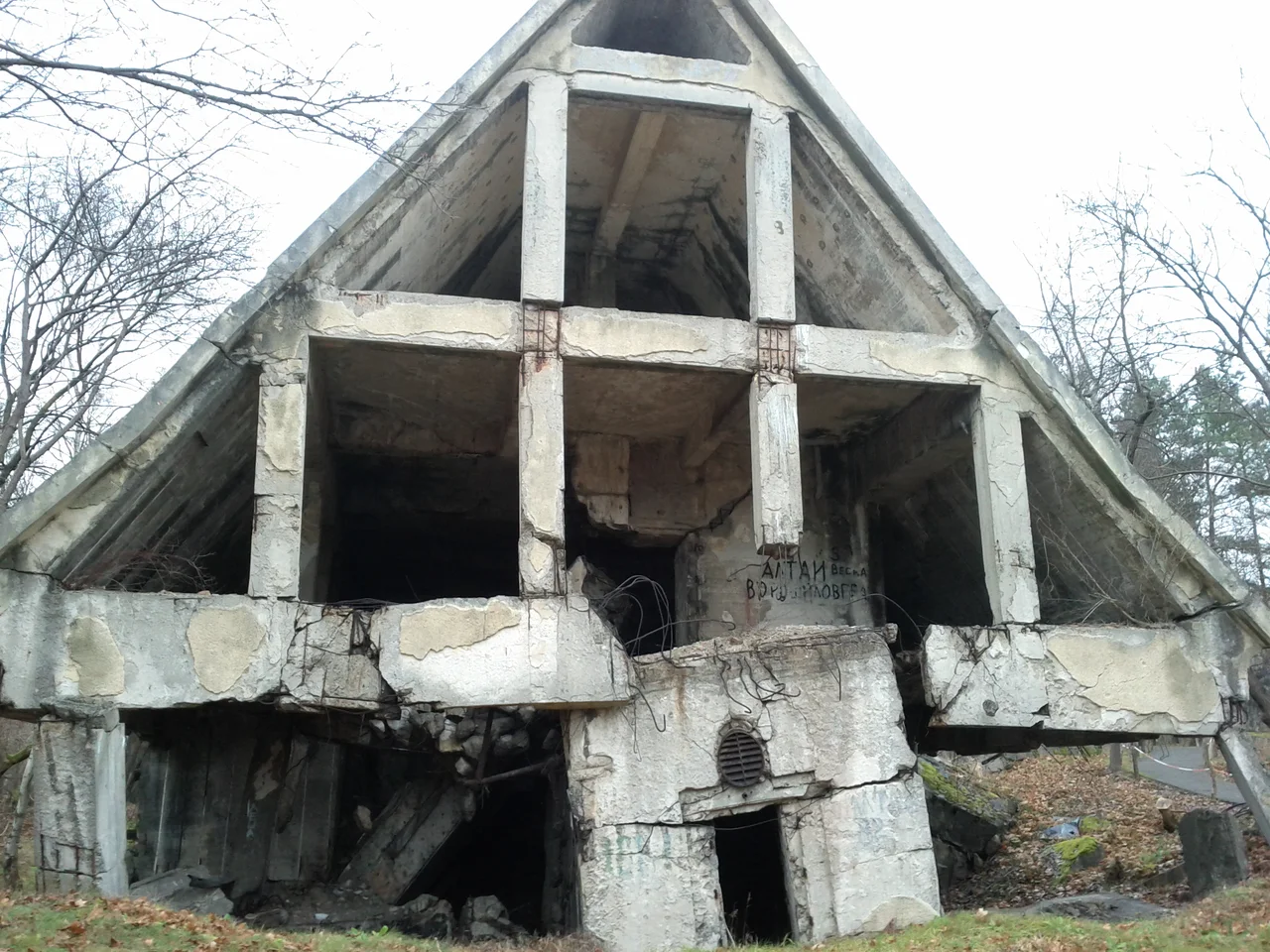
From the air it read as a quiet street. Twelve buildings with pitched roofs and ordinary domestic proportions, arranged in the Brandenburg pines about twenty kilometres south of Berlin, looking from above like housing for a small town. They were not houses. Each one was the visible top of a shaft leading into two floors of interlinked bunker with walls two feet thick, set as deep as twenty metres, and together the street was the headquarters from which the German army ran its war. The complex was code-named Maybach I, after a car engine. A second, Maybach II, went up alongside with eleven more of the same buildings. Between them, at the end of a tunnel, sat one of the largest communications hubs of the Second World War.
Houses That Were Not Houses
Construction began in 1937 near Wünsdorf, in the district of Zossen, on ground the army had used since imperial times. Maybach I was finished in 1939 and the Army High Command moved in on 26 August, a week before the invasion of Poland. Maybach II followed in the summer of 1940, built to the same pattern. What made the site work was not the concrete but the ordinariness above it. The roofs were pitched, the windows were placed where windows go, and reconnaissance photographs came back showing a village. Underneath were wells for drinking water and plumbing, filters against gas attack, and diesel generators to keep everything running if the outside world was cut off. Later they added camouflage netting. Around twenty air-raid shelters went up in the surrounding area for everyone who was not important enough for the bunkers.
Amt 500
The communications bunker was built by the Reichspost, the German post office, on orders from the armed forces high command between 1937 and 1939. Its cover name was Amt 500 - Post Office 500. The structure was a two-lane longitudinal building 117 metres by 22, with a three-storey annex measuring 57 by 40, and in 1938 a third entrance was added: a building presented as a Reich Post facility that light trucks could drive into, with a stairwell and a lift down to the working levels. A tunnel ran southwest to the two Maybach complexes. Orders left this room for every front in Europe until April 1945, which makes it, in a real sense, the most consequential room on the site. Its other code name was Zeppelin.
The Safe at Zossen
After the 20 July 1944 attempt on Hitler's life, investigators opened a safe at Zossen and found what the conspirators had kept there. The papers included extracts from the diary of Wilhelm Canaris, head of military intelligence; correspondence between Abwehr officers; material on the secret Vatican contacts around the abandoned coup plan of 1938 and the Oster conspiracy; and documentation of the resistance work of the Lutheran pastor Dietrich Bonhoeffer. The discovery cost the men named in it their lives. Canaris, Hans Oster and Bonhoeffer were all executed at Flossenbürg concentration camp on 9 April 1945, four weeks before the German surrender. A bunker built to protect the people who ran the war ended up holding the evidence that killed the people who tried to stop it.
The Twentieth of April
Between 15 and 17 January 1945 the Army High Command moved back into Maybach I and the general staff into Maybach II. British and American bombers worked over the site repeatedly that spring; a raid on 15 March injured Hans Krebs, chief of the army general staff. On 20 April the Soviet 3rd Guards Tank Army came within reach of the headquarters. Krebs asked Hitler for permission to withdraw and destroy the important material, and by the time the permission came back there was no longer time to destroy anything. The army command left for Eiche near Potsdam at midday and the armed forces command for Krampnitz. Soviet troops arrived that afternoon and found the whole complex empty except for four German soldiers.
Ranet, and the Book Town
Late in 1946 Soviet engineers demolished most of both Maybach complexes, acting under the four-power agreement on occupied Germany and an Allied Control Council order. Zeppelin came through nearly intact and the Soviets simply kept using it, renamed Ranet, at the centre of what became the headquarters of the Group of Soviet Forces in Germany. At its height Wünsdorf held between fifty and seventy-five thousand Soviet soldiers and family members, with a daily train to Moscow. They left in 1994. Clearing up after them meant removing 98,300 pieces of ammunition and 47,000 other items of ordnance from 260 hectares. Since 1998 the old restricted zone has been the Bücherstadt, a book town, with second-hand dealers in the former garrison buildings drawing around twenty thousand visitors a year - some for the books, some for the bunker tours that go down through the ruined entrance houses of Maybach I. Maybach II has been almost entirely obliterated. The same stretch of pine woodland held the Halbmondlager of the First World War, where Germany built its first mosque for prisoners it hoped to recruit. Wünsdorf has been repurposing itself for a very long time.
From the Air
The Maybach and Zeppelin sites lie at 52.193°N, 13.468°E at Wünsdorf, part of Zossen in Teltow-Fläming, about 20 km south of central Berlin. The terrain is flat pine forest and sandy lake country; the Wünsdorfer See sits immediately west and the A13 autobahn runs north-south a few kilometres to the west, the clearest linear feature from the air. The garrison town itself reads as a dense grid of barracks blocks in otherwise unbroken forest. Berlin Brandenburg (EDDB) is roughly 19 km north; Schönhagen (EDAZ) is about 21 km west and is the practical general-aviation field here. Recommended viewing altitude 1,500-2,500 ft. Watch for EDDB approach and departure corridors passing overhead.
Nearby Stories
- Operation Gold 3.3 km away
- Wendish-German double church 8 km away
- Treuenbrietzen 9.6 km away
- E11 hiking trail 11 km away
- Falkenhagen Bunker 21 km away
- Lichtenburg Concentration Camp 22 km away
- Eisenhüttenstadt 39 km away
- 2001 American Memorial 45 km away