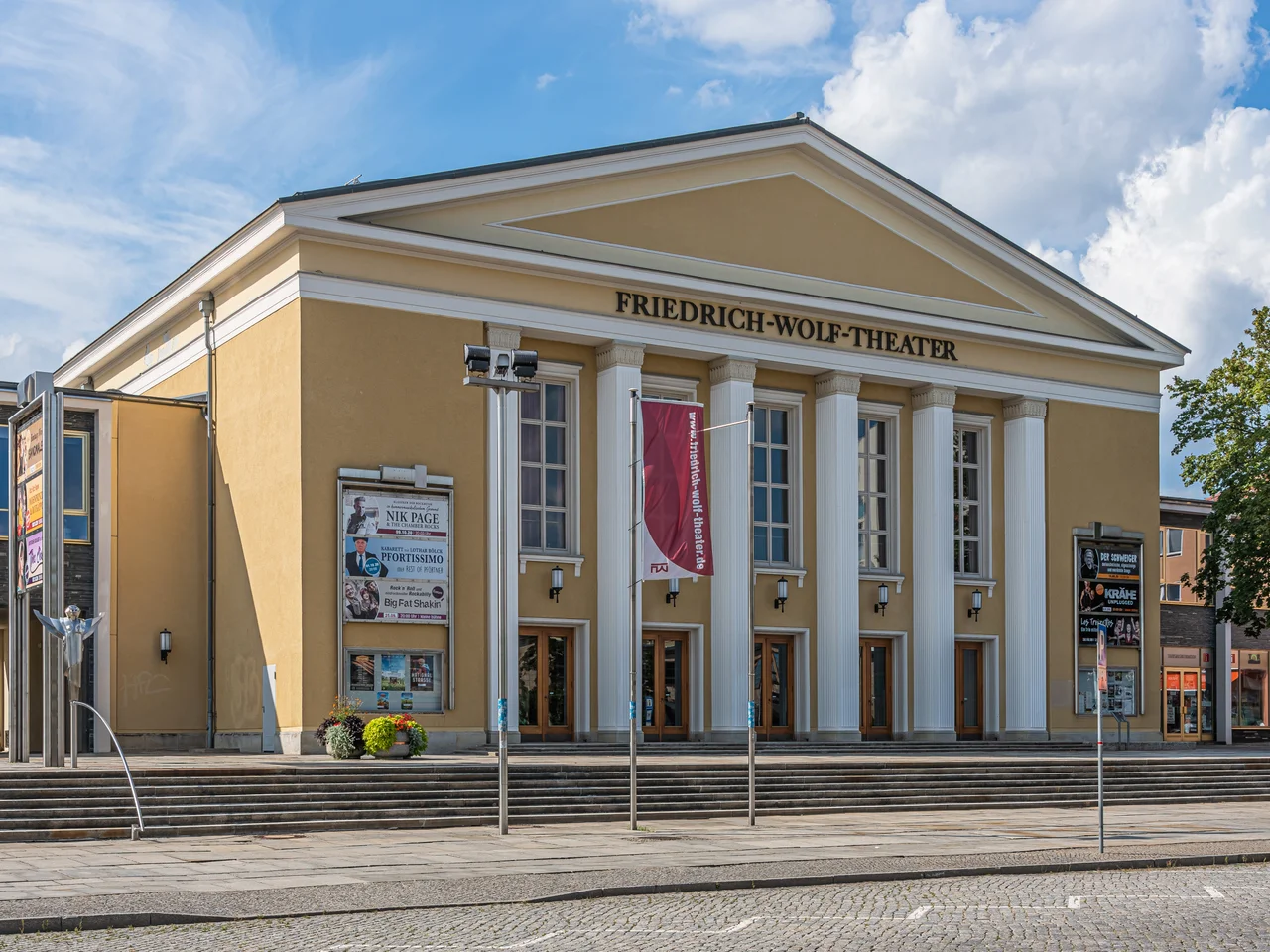

Eisenhüttenstadt
The mill came first. In 1950 the Socialist Unity Party decided to raise a steel combine on the sandy terrace where the Oder-Spree Canal meets the Oder, on the brand-new border with Poland, and then to build the workers somewhere to live beside it. Ground was broken on the town itself on the first day of 1951. Two years later the place took a name borrowed from a dead man: Stalinstadt, granted in 1953, months after Joseph Stalin died in Moscow. In 1961, during de-Stalinization, the name was quietly withdrawn and replaced with Eisenhüttenstadt - iron-works town. Few places announce their purpose so bluntly. Fewer still were drawn street by street as an argument about how people ought to live, then built at full scale to see whether the argument held.
Three Plans and One Winner
The first design for the new residential quarter arrived in August 1950 from Franz Ehrlich, a Bauhaus-trained modernist who had spent years in Buchenwald as a political prisoner and had been forced there to letter the words above the camp gate. His scheme scattered the town across the landscape along functional lines. The Ministry for Reconstruction rejected it, then rejected the next proposal too, from the architects Kurt Junghanns and Otto Geiler. What actually got built was Kurt Walter Leucht's plan, drawn to the GDR's newly published Sixteen Principles of Urban Development: a broad central boulevard, the Lindenallee, with numbered residential complexes ranged along either side. Each complex was meant to contain everything daily life required - school, kindergarten, shops, green courtyards - within a short walk of every front door. This was ideology worked out at the scale of a grocery run.
The Village That Was Already There
Eisenhüttenstadt did not appear on empty ground. Fürstenberg had stood at the river since 1251, changing hands the way border towns do: to Bohemia, where Emperor Charles IV bought it from the Cistercians of Neuzelle and licensed a bridge over the Oder to open a trade route into Poland; to Hungary under Matthias Corvinus in 1469; back to Bohemia in 1490; to Saxony after the Peace of Prague in 1635; to Prussia in 1815; to the German Empire in 1871. A river port opened in 1925.
Then came the war. The Germans ran Stalag III-B at Fürstenberg, holding Polish, French, Belgian, Serbian, Soviet, American, Dutch, Italian and British prisoners, with forced-labour subcamps scattered through the district, a forced-labour camp for Jewish men, and a subcamp of Sachsenhausen. In February 1945 the retreating Wehrmacht blew the Oder bridge. The socialist future was laid directly on top of all of it.
Eight Years Under Another Man's Name
The 1953 naming ceremony was staged with the Soviet ambassador Ivan Ilyichev in attendance. Then Moscow changed its mind about Stalin, and in 1961 so did Berlin: the name was dropped, and the young town was merged with old Fürstenberg under the plain compound Eisenhüttenstadt. The people who grew up in the years between make a strange and specific generation. Rudolf Bahro went to school here before writing The Alternative, the critique of "real-existing socialism" that landed him in prison. Tamara Bunke sat her school-leaving examinations here and died in Bolivia in 1967, fighting alongside Che Guevara. Rolf Henrich, a lawyer, became the first signatory at the founding congress of New Forum - the citizens' movement that helped bring down the state that had built his town.
After the Combine
Reunification came in 1990, and the state-owned steel works met the market. Privatization cut a workforce of roughly 12,000 to about 2,500. The town had been sized precisely to the mill; when the mill contracted, the town had no other reason to be that big. Population fell from just over 50,000 to under 30,000, and entire apartment blocks - built for families who had gone west for work - came down. What survived best was the oldest part. Residential complexes I to III, together with the Lindenallee, are protected as a Flächendenkmal, an area monument, and many of the 1950s buildings have been renovated rather than razed. The GDR's first planned city is now, quite literally, a listed object, and the people who still live there live inside the exhibit.
170,000 Ordinary Things
The Museum Utopie und Alltag occupies a building that opened in 1953 as a crèche and served as a kindergarten until 1990, which is about as fitting a home as a museum of GDR daily life could ask for. Its holdings run to some 170,000 everyday objects, alongside 18,500 works of fine and applied art from the Beeskow archive: the shampoo bottles, wall units, textiles and party banners that most institutions throw away. The town's other exports are less solemn. Paul van Dyk, born here in 1971, became an internationally known DJ and producer, and Eisenhüttenstadt turned out an improbable run of Olympians, among them the shot-putter Udo Beyer, who took gold in 1976 and held the world record. One more first belongs to the place: the 1986 twinning with Saarlouis was the first between an East and a West German town.
From the Air
Eisenhüttenstadt sits at 52.147N, 14.630E in Brandenburg, on the west bank of the Oder directly on the Germany-Poland border, about 25 km south of Frankfurt (Oder) and 110 km southeast of Berlin. From the air the layout reads clearly at 3,000-5,000 ft: the ArcelorMittal steelworks with its blast furnaces occupies a large industrial block west of the town, and the residential grid runs off the arrow-straight Lindenallee in regular rectangular complexes - a geometry unlike the organic street patterns of older German towns. The Oder-Spree Canal terminates here at the river, giving a clear water junction for navigation. Nearest major airport is Berlin Brandenburg (EDDB) to the northwest; Zielona Góra-Babimost (EPZG) lies east across the Polish border. The Oder floodplain is flat and open, so visibility is usually good, though river fog is common on autumn and winter mornings.
Nearby Stories
- Cottbuser Ostsee 13 km away
- Spreewald 16 km away
- Falkenhagen Bunker 17 km away
- Gigafactory Berlin-Brandenburg 19 km away
- Stalag Luft III 31 km away
- 2001 American Memorial 37 km away
- Gorzów Wielkopolski 40 km away
- Czocha Castle 122 km away