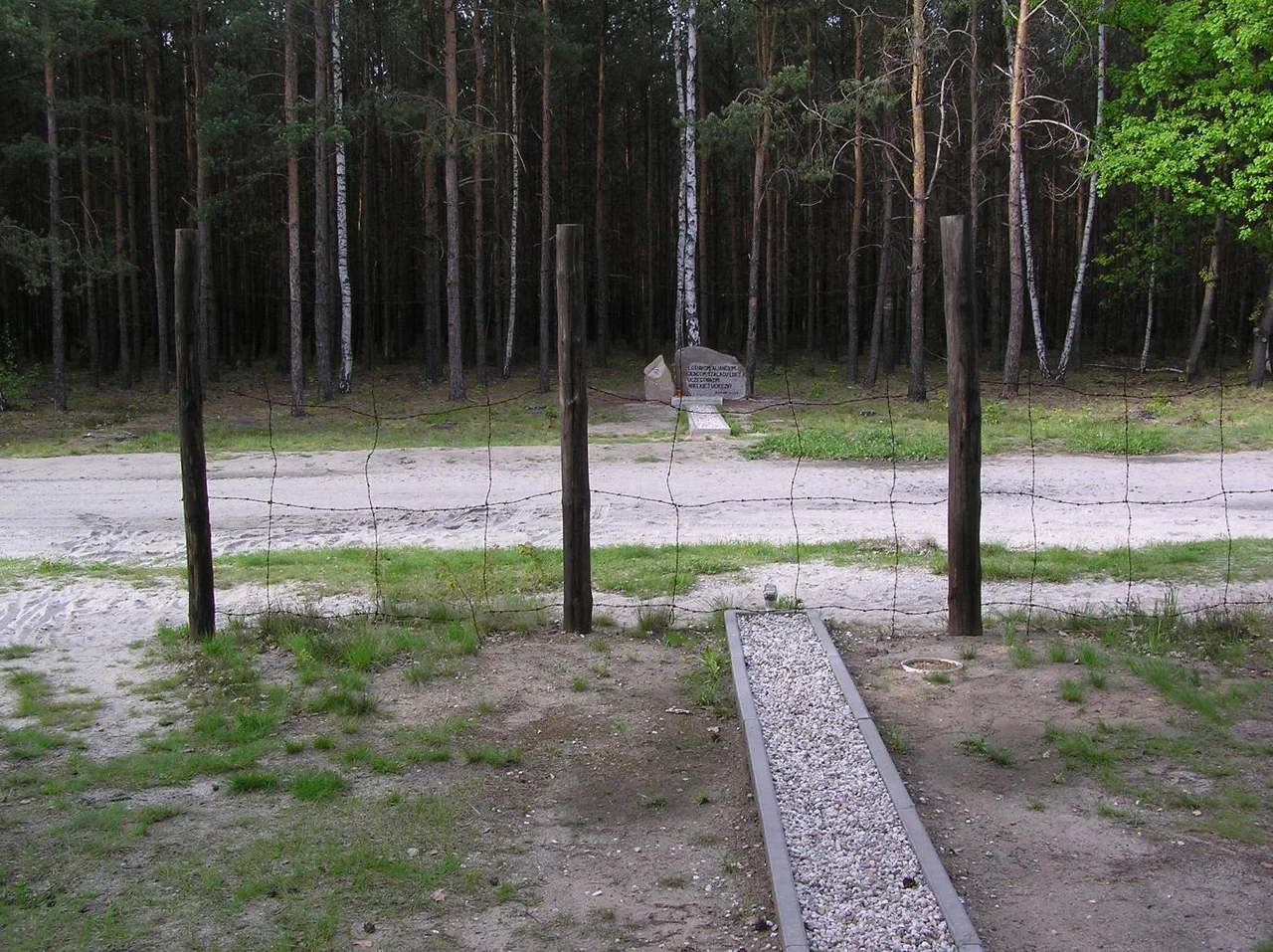

Stalag Luft III
The Germans chose the sand on purpose. When the Luftwaffe opened Stalag Luft III in March 1942 near Sagan (now Żagań, Poland), about 160 km southeast of Berlin, the site was picked because the subsoil was a loose, bright yellow sand that collapsed on anyone who tried to dig through it - and, worse for a tunneller, showed up like a stain against the grey topsoil above. Barracks were raised on stilts so guards could see underneath. Seismographs were buried around the wire. Over the next three years, roughly 10,900 Allied air-force officers passed through the camp's 24 hectares, and a good number of them spent their imprisonment doing precisely the thing the sand was supposed to make impossible.
The Wooden Horse
Their first success came out in the open. Prisoners built a vaulting horse, carried it out into the compound each day and gymnasted over it while, inside its hollow body, men dug straight down. Flight Lieutenant Gordon "Moose" Miller was one of those who lifted it in and out under the guards' eyes, never letting the weight of two concealed diggers and a day's spoil show in his stride. On 29 October 1943, Eric Williams, Michael Codner and Oliver Philpot came up outside the wire. Williams and Codner reached Stettin and stowed away on a Danish ship; Philpot travelled as a Norwegian businessman and got to Sweden by way of Danzig. All three made it home - a clean sweep almost unheard of in the escape business. Williams turned the story into a book and then a film, both called *The Wooden Horse*.
Tom, Dick and Harry
The bigger project was already underway. Squadron Leader Roger Bushell, known throughout the camp only as "Big X," organised three tunnels at once on the theory that the Germans would find one, congratulate themselves and stop looking. Harry ran 336 feet at a depth of about nine metres, shored with bed boards and ventilated by a hand-worked pump. The scale only became clear when the Germans took inventory afterwards: four thousand bed boards gone, along with ninety double bunks, 635 mattresses, 1,219 knives, 34 chairs, a thousand feet of electrical wire and 3,424 towels. More than 1,400 powdered-milk tins had been beaten into ducting and lamps. Wally Floody ran the digging; Jerry Sage was responsible for making some two hundred thousand pounds of yellow sand disappear into gardens, ceilings and trouser legs.
The Night of 24 March 1944
Two hundred men were prepared to go, in forged papers and hand-tailored civilian clothes. Seventy-six got out before a guard spotted the seventy-seventh man emerging and the alarm went up. Three of them made it: the Norwegian pilots Per Bergsland and Jens Müller reached Sweden, and the Dutch pilot Bram van der Stok, given an early slot for his languages, crossed most of occupied Europe with help from the French Resistance and walked into a British consulate in Spain. Seventy-three were recaptured, and it is what happened next that the camp is remembered for.
The Fifty
Hitler wanted every recaptured man shot. Told that a massacre on that scale would invite reprisals against German aircrew held by the Allies, he settled on "more than half" and passed the order to Heinrich Himmler, who passed the selection to General Arthur Nebe. Fifty officers were then taken out by the Gestapo, singly or in pairs, and shot. This was murder, not execution: they were prisoners of war, unarmed and in custody, and killing them broke every convention Germany had signed. Roger Bushell was among the dead. A handful of survivors owed their lives to nothing more than a name - Bob Nelson may have been spared because his captors wondered about Admiral Nelson, and Dick Churchill because of the Prime Minister. Seventeen recaptured men were simply returned to the camp. Anthony Eden told the House of Commons what had happened on 19 May 1944 and promised, on 23 June, that those responsible would face justice. They largely did: an RAF Special Investigation Branch manhunt under Wing Commander Wilfred Bowes ran the killers down, and the murder of the fifty was among the charges at Nuremberg.
What Stands There Now
The camp commandant, Friedrich Wilhelm von Lindeiner-Wildau, had run the place by the Geneva Convention and had the respect of his senior prisoners; he was removed and threatened with court martial. A later commandant, Oberst Werner Braune, was appalled enough by the killings to let the surviving prisoners build a memorial to their fifty comrades, and contributed to it himself. It still stands where they put it. Just before midnight on 27 January 1945, with Soviet troops sixteen miles away, the remaining 11,000 prisoners were marched west through six inches of snow toward Spremberg - thirty-four miles to Bad Muskau, thirty hours' rest, sixteen miles more. Paul Brickhill, who had been dropped to the bottom of the escape list when his claustrophobia was discovered and always believed it saved his life, wrote the book that made the story famous in 1950. The 1963 film took liberties - there were no American escapers and no motorcycle - but it fixed fifty murdered airmen in the world's memory, which is not the worst thing a film has ever done.
From the Air
The camp site lies at 51.5986 N, 15.3075 E on the southern edge of Żagań in Lubusz Voivodeship, western Poland, roughly 160 km (86 nm) southeast of Berlin and about 100 km northwest of Wrocław. From 2,500-4,000 ft AGL the ground still reads: a large clearing in dense pine forest just south of the town, with the museum and memorial marked, and the Bóbr river winding past Żagań to the north. Pine and sand define the whole region, and the flat Silesian lowland offers no terrain hazard. Nearest fields are Wrocław (EPWR) about 100 km southeast, Zielona Góra-Babimost (EPZG) about 75 km north-northwest, and Dresden (EDDC) about 145 km west-southwest. Winter here delivers the same low cloud, snow and hard cold the prisoners marched through in January 1945; late spring and early autumn give the clearest air over the forest.
Nearby Stories
- Muskau Park 5.7 km away
- Villa Wolf 12 km away
- Battle of Hochkirch 24 km away
- Zgorzelec 28 km away
- Lubiaz Abbey 46 km away
- Neuzelle Abbey 51 km away
- Battle of Leuthen 81 km away
- Nazi War Crimes in Occupied Poland 219 km away