.jpg)
Battle of Hochkirch
The church bell struck five, and the Austrians came out of the woods. Most of the Prussian army was asleep in its tents. Croat light troops went through the camp cutting tent ropes so the canvas collapsed onto the men inside, then bayoneted them as they fought the cloth. One lane in the village of Hochkirch is still called the Blutgasse - Blood Alley - for what happened in it that morning. Frederick the Great had been warned repeatedly, and had refused to believe that Leopold Josef Graf Daun, the most careful commander in Europe, would ever risk a battle. It was, by general agreement, the worst mistake of his career.
The King Who Would Not Believe It
The campaign of 1758 had ground to a stalemate. Frederick had left half his army in Pomerania after Zorndorf and marched the rest 180 kilometres in seven days to face Daun in Saxony; Daun had brought 80,000 men 120 kilometres from Görlitz in ten. Between Bautzen and Löbau the two played cat and mouse for weeks, Frederick offering battle and Daun declining, exactly as he had all year. That pattern hardened into a conviction. Ordered to seize the Strohmberg, the hill commanding the ground, General Wolf Frederick von Retzow found the Austrians already there in strength and judged an attack pointless - so Frederick relieved him of command and had him arrested. On 10 October the Prussians camped at Hochkirch, spread in an S-shaped line facing east, with barely nine battalions covering the weak western side. Frederick had roughly 30,000 to 36,000 men. He was not expecting to need them before breakfast.
Eggs and Misinformation
Daun, meanwhile, had been feeding the deception. His own secretary had been passing information about Austrian plans to Frederick, and when Daun discovered it he did not execute the man: he promised him his life on condition that he keep writing, and keep getting it wrong. What Daun then planned he told almost nobody: thirty thousand hand-picked troops would move before dawn through the woods, swing wide around the Prussian flank, and close on a camp that had no idea they were coming. Hochkirch stands on a slight rise with open country around it, but heights to the south block the view entirely, and it was from there the Austrians came. The village had Frederick's best troops in it. The trouble was that they were in their tents.
Blood Alley
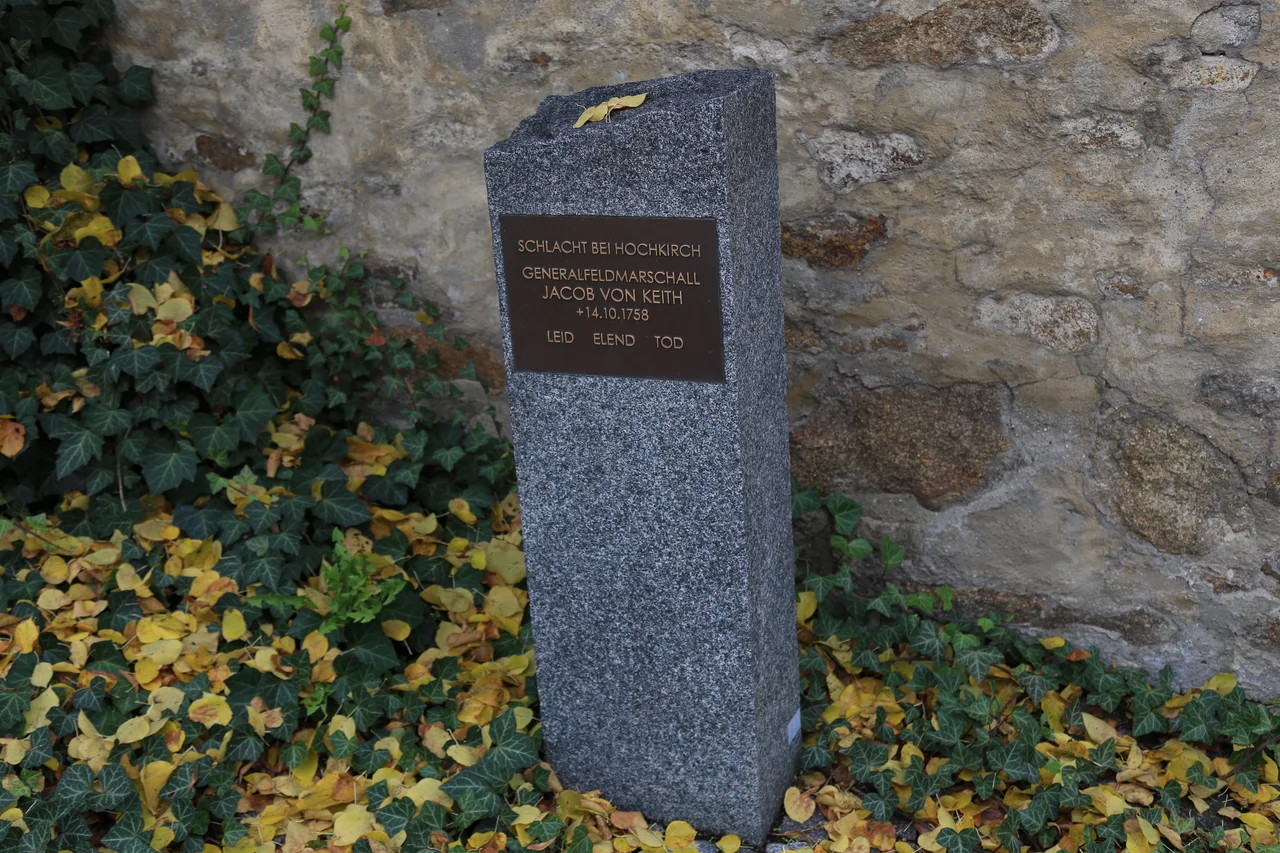
When the firing started Frederick assumed it was an outpost skirmish, or the Croats loosing off their weapons as they did most mornings. His staff struggled to wake him. He understood only when captured Prussian guns - taken so fast that nobody had spiked them - began shelling his own camp. His generals had not slept at all, and had kept their horses saddled; it was they who put the resistance together. The Prussians drove through the village and reached the Austrian battery at bayonet point, but cohesion was gone. Field Marshal James Keith was hit through the body and was dead before he left the saddle. Prince Francis of Brunswick-Wolfenbüttel had his head taken off by a cannonball as he came up to the village, and his troops broke at the sight of the body still upright on a panicking horse - Frederick himself rode over to steady them. The walled churchyard held. Major von Langen's musketeers of the 19th regiment kept it, covered the men falling back through it, and bought the time that made the difference between a retreat and a rout. By ten the Prussians were pulling away northwest, answering every pursuit with a wall of musketry.
What It Cost
Frederick lost 9,400 men killed, wounded and captured - over thirty percent of his force - along with 101 guns, 70 munitions wagons, 28 flags, two standards and nearly every tent his army owned. Five generals were dead, and Maurice von Anhalt-Dessau was wounded and taken prisoner. That casualty list was not accidental: Frederick required his generals to lead from the front, and the Prussian officer corps lost half its strength across the war's first three campaigns. The Austrians paid too - about 5,400 killed and wounded, three standards lost, with some modern estimates of their total losses as high as 7,300. Behind those numbers were men who had gone to sleep in a camp their king believed was safe, and who were killed in the dark before they could stand up.
A Sword From the Pope
News reached Vienna while the court was celebrating the Empress's name day at Schönbrunn. Maria Theresa eventually settled an endowment of 250,000 florins on Daun and his heirs, and Pope Clement XIII sent him a blessed sword and hat - an honour normally reserved for commanders who had beaten infidels, now given for beating a fellow Christian monarch. The victors were less exultant than the capitals. When Daun and Franz Moritz von Lacy found Keith's body laid in the village church, both men broke down; Keith had been the closest friend of Lacy's father during his service in Russia. Andrew Mitchell, the British envoy who normally wrote warmly about Frederick, concluded that there was nobody to blame but the king. And yet the discipline held. Once out of the burning village the Prussians re-formed and joined another corps, and by 5 November - the anniversary of Rossbach - Frederick was marching on Neisse and the Austrians abandoning their siege. Frederick, having lost the battle, still held Saxony and Silesia when the year closed.
From the Air
Hochkirch lies at 51.15 N, 14.57 E in Upper Lusatia, Saxony, about 9 km east of Bautzen. Best viewed between 1,500 and 3,000 feet AGL. The village is easy to identify because the ground reads exactly as it did in 1758: a low rise in gently rolling farmland with the church tower on the highest point, open sightlines east, west and north, and wooded higher ground closing in from the south - the cover the Austrian columns used. Bautzen and its old town on the Spree lie just west. Nearest airport is Bautzen (EDAB), only about 3 nm northwest of the battlefield, which makes this one of the easier historical sites in Saxony to reach from the air; Dresden (EDDC) is about 30 nm west. Autumn morning fog is characteristic of this country and was itself decisive on the day - the attack went in under it, and the Prussians could not tell friend from foe until it lifted.
Nearby Stories
- Czocha Castle 14 km away
- Sonnenstein Euthanasia Centre 14 km away
- Ústí Massacre 16 km away
- Kromlau Azalea and Rhododendron Park 23 km away
- 2001 American Memorial 25 km away
- Ještěd Tower 29 km away
- Stalag Luft III 33 km away
- Krzeszow Abbey 67 km away