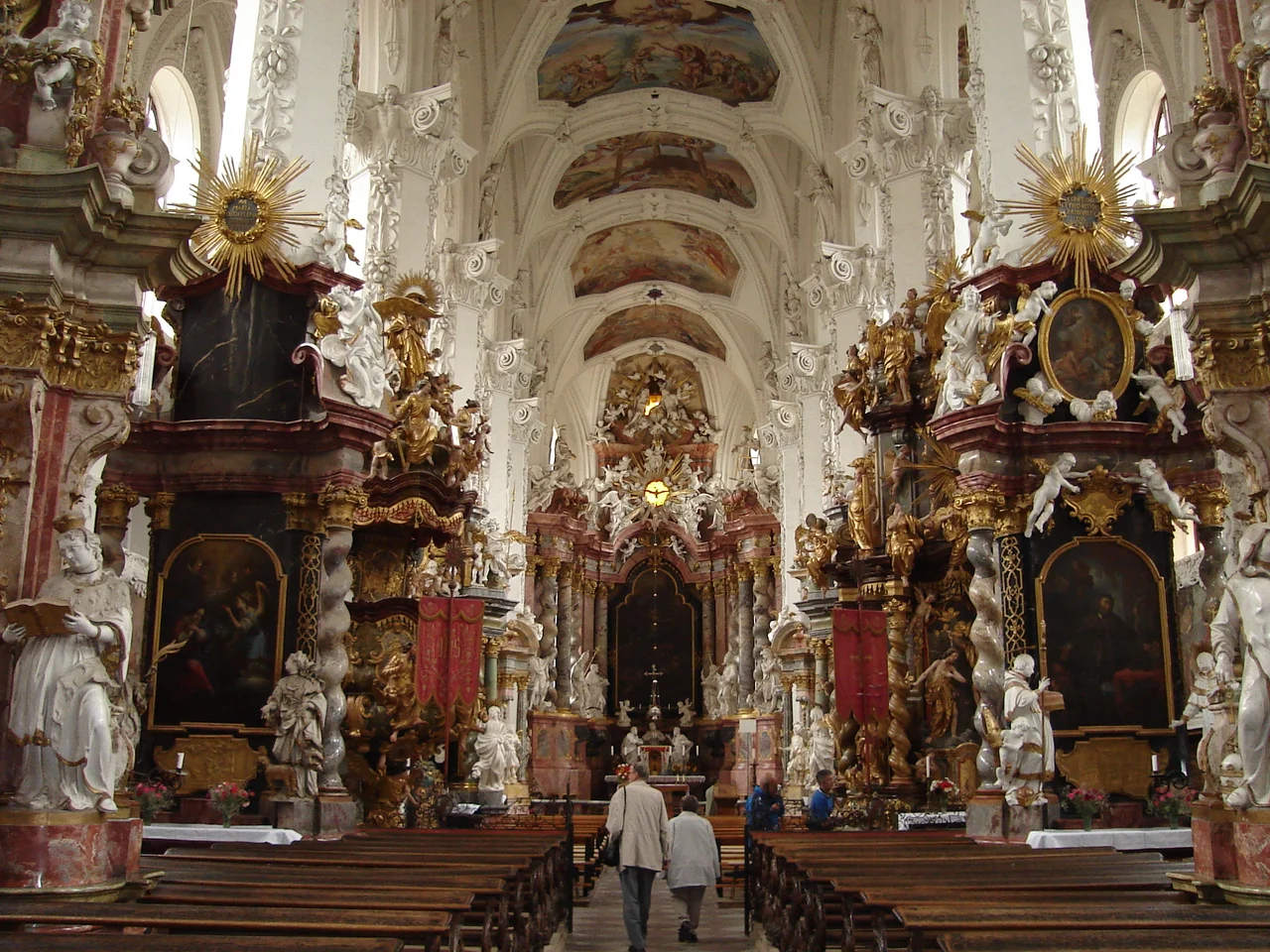

Neuzelle Abbey
Brandenburg is brick country. Its churches are Gothic, its walls are red, its architectural temper runs to the plain and the Protestant - and then, in a village a few kilometres west of the Oder, a door opens onto gilded saints tumbling out of painted clouds, marbled columns and altars crowded with sculpture. Neuzelle's abbey church looks as though it were built in Bohemia and set down in the wrong province. In a sense it was. The monks who commissioned it came mostly from Bohemia, trained at Charles University in Prague, and remained loyally Catholic in a countryside that had followed Martin Luther generations before. Brandenburg's tourist board calls the place the baroque wonder of the March, and for once the marketing undersells it.
Nova Cella, 1268
The abbey began as an act of grief. In 1268 Henry the Illustrious, Margrave of Meissen and Lusatia, founded a Cistercian house here called Nova Cella - the new cell - for the benefit of the soul of his dead wife Agnes. It sat on a contested seam of the map, in the border country between Lower Lusatia and the March of Brandenburg, and borderlands make poor real estate for men who have taken vows of stability. In the fifteenth century the Hussite wars swept through repeatedly. The monks refused to accept the teachings of Jan Hus, and for that refusal they were killed or carried off; the community later honoured them as martyrs. The abbey was destroyed more than once and rebuilt around 1500, which is roughly the moment its luck turned - just in time for the Reformation.
The Island That Stayed Catholic
By about 1550 nearly everyone in the surrounding countryside had gone over to Luther. Neuzelle did not. It survived the Reformation as a Roman Catholic abbey in a Protestant landscape, staffed largely by Bohemians, its intellectual centre of gravity pointing south toward Prague rather than west toward Berlin. When the Thirty Years' War handed Lower Lusatia to Saxony, the abbey's peculiar position was formalised rather than dissolved: the Emperor reserved certain rights over it and tied it ecclesiastically to Prague. That Bohemian connection is written all over the art. One altar in the abbey church honours John of Nepomuk, the martyred archbishop whose cult is Prague's own, and the church's altar of the Divine Infant is modelled on the Infant Jesus of Prague from the church of Santa Maria de Victoria. Stand in a Brandenburg village and you are looking at Czech devotion.
Building the Wonder
The baroque remaking began in 1650 and worked outward from the Gothic bones, which are still visible if you know where to look - cross-ribbed vaulting, corbel carvings, sculpture and late medieval painting survive in the cloister and enclosure. Around a central courtyard the complex arranged itself with a certain confidence: enclosure buildings, church and administrative wing to the north, including the grandly named Princely Wing; the arcade with the entrance portal and the foundation registry to the west; coach stalls to the south; and the cloister garden spilling east. Two churches, not one, carry the message - the foundation church and the so-called peoples' church, both worked in South German and Bohemian baroque, both announcing that this small house on the empire's edge had become something considerable in the eighteenth century.
A Garden Facing the River
In 1760 the abbey laid out a baroque garden, and the site handed the designers a gift: ground that falls away in stages toward the Oder. The result is an elongated terraced garden in which each level offers a different composition - the clipped geometry of the beds in the foreground, the abbey buildings behind, and beyond both the wide flat expanse of the Oder meadows running to the horizon. It is the kind of garden meant to be read as a sequence rather than seen at once, and it takes a slow walk to work. The whole complex was restored over years of painstaking work, with the programme completed in 2018 in time for Neuzelle's 750th anniversary.
The Monks Come Back
The end came from Berlin. When the Congress of Vienna transferred parts of Lower Lusatia to Prussia in 1817 and folded them into the Province of Brandenburg, King Frederick William III ordered the abbey secularised. From 1820 the buildings were put to educational and administrative use, though the churches stayed Catholic and served as parish churches; in 1947 one of them was consecrated as a pilgrimage church of the Blessed Virgin Mary. Today the complex belongs to a public foundation of the state of Brandenburg. And in 2018, at the request of Wolfgang Ipolt, Bishop of Görlitz, the Austrian abbey of Heiligenkreuz refounded Neuzelle as a priory under the name Maria Friedenshort - Cistercians back in Neuzelle two hundred and one years after a king dissolved them. There is no room for them on the state-owned historic grounds, so they are building a new monastery at Treppeln, on land that once belonged to the Stasi, and living meanwhile in provisional quarters at Bernhardshof. The community numbers a handful of monks who also serve the local parish. The brewery beside the cloister still works too, and its dark Schwarzer Abt - the Black Abbot - keeps the abbey's name on bar shelves across eastern Germany.
From the Air
Neuzelle Abbey stands at 52.09 N, 14.65 E in the Oder-Spree district of Brandenburg, a few kilometres west of the Oder and the Polish border and roughly 8 km south of Eisenhüttenstadt. From the air the abbey is far easier to spot than the village around it: a compact walled complex with two church roofs and a bright ochre-and-white palette, set against dark forest, with the terraced garden stepping east toward the flat green ribbon of the Oder floodplain. Best viewed from 2,000-3,000 ft on a westerly line so the terraces and the river meadows line up. Berlin Brandenburg (EDDB) is about 95 km north-west; Cottbus-Drewitz (EDCD) lies roughly 45 km south-west. The Oder carries the international border here, so cross-border airspace rules apply. Low-angle light in late afternoon shows the baroque façades at their best; winter fog over the floodplain is common.
Nearby Stories
- Cottbuser Ostsee 13 km away
- Spreewald 16 km away
- Falkenhagen Bunker 17 km away
- Gigafactory Berlin-Brandenburg 19 km away
- Stalag Luft III 31 km away
- 2001 American Memorial 37 km away
- Gorzów Wielkopolski 40 km away
- Czocha Castle 122 km away