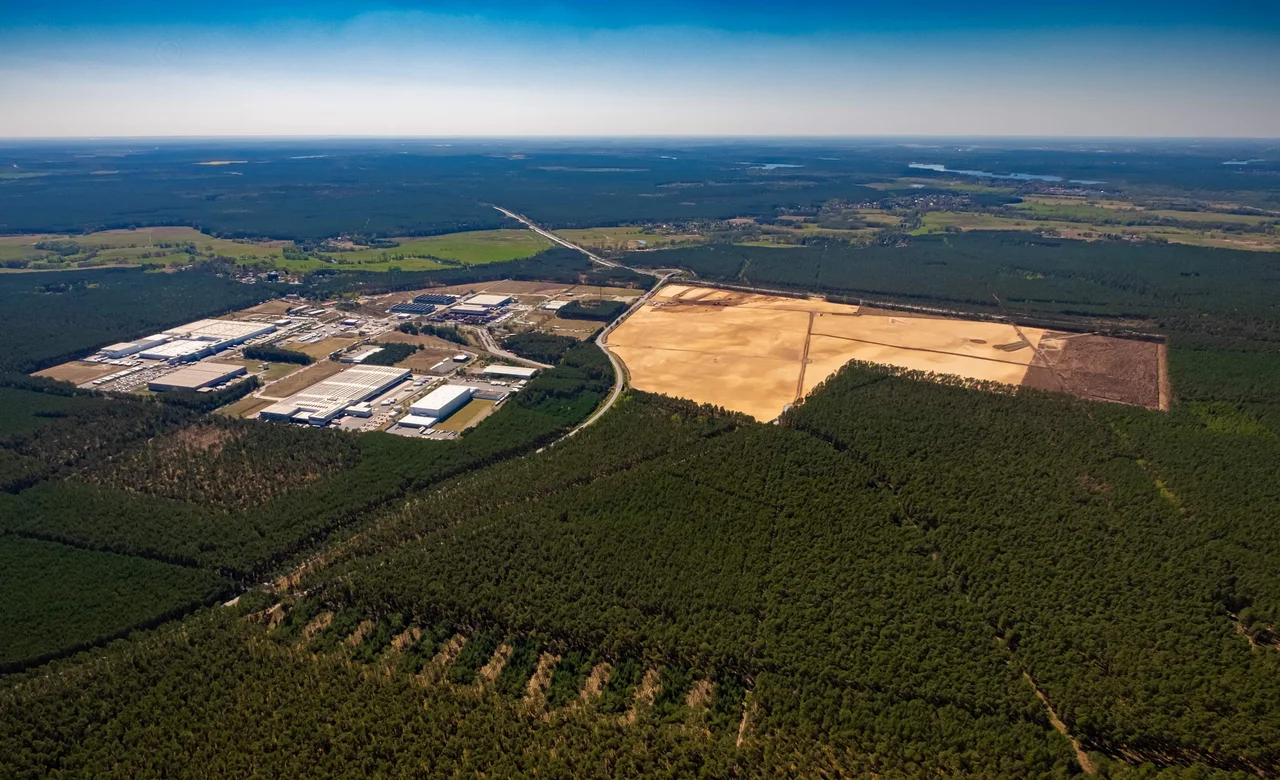

Gigafactory Berlin-Brandenburg
In January 2017, Lithuania's gaming community got Tesla's attention by rebuilding the hypothetical European gigafactory in Minecraft. It was one of the stranger entries in a contest that ran for years and involved more than ten countries and several national governments. France offered a nuclear power station it was about to close. Portugal offered the largest lithium reserves in Europe. Estonia offered 140 megawatts of renewable power on the Pakri peninsula with total control over the price. What won was a pine plantation in Brandenburg, 35 km southeast of Berlin, that BMW had looked at around the year 2000 and turned down.
The Auction
The bidding ran for years before there was anything to bid on. Sigmar Gabriel, then Germany's economy minister, was in talks with Tesla as early as 2015. The Dutch pushed several sites, arguing for synergy with Tesla's European headquarters and finishing plant already in the Netherlands. The Czech Republic floated a location near Prague, backed by a 330,000-tonne lithium deposit nearby. In Lower Lusatia, 100 km southeast of Berlin, authorities, companies and more than 100,000 citizens signed on to a campaign for the region.
Underneath the enthusiasm was a strategic worry. As of early 2018, Asia accounted for 88 per cent of global battery manufacturing capacity, and one report that year estimated the world would need at least twenty-five more gigafactories by 2025. 'We would be naïve to think we can handle battery technology as a commodity that can be bought anywhere in the world,' said Matthias Machnig, state secretary at the German economy ministry. Musk announced the Brandenburg site on 12 November 2019, from the stage of the Das Goldene Lenkrad car awards.
Seven Bombs and a Monoculture
The land was a designated industrial zone that had never been built on: three square kilometres of greenfield extending north from the GVZ Freienbrink logistics centre, bordered by the Berlin-Wrocław railway to the north and the A10 motorway to the west. Tesla paid €13.50 per square metre for 300 hectares — about €41 million — with the contract notarised on 29 January 2020.
What stood on it was a state-owned pine monoculture, harvest-ready and low in ecological value, ringed by much larger conservation pine meadows. Roughly 160 hectares were cleared; by 2022, 265 hectares of mixed-species forest had been planted elsewhere in compensation. The ground turned out to be valley sand with some heavy-metal contamination, which forced a change of foundation design in 2020. And there were bombs, as there are almost everywhere in German soil: seven of them, 85 kg in total, blown up in a controlled detonation in January 2020, with more turning up during the 2024 expansion works.
Impossible-Seeming Speed
Musk promised the build would come together at 'impossible-seeming speed' using prefabricated construction, and by May 2020 the first foundations and four cranes were in and trainloads of pillars and beams were arriving. In October 2021 Tesla threw a county fair on the site for 9,000 local guests. Final environmental approval came from the Brandenburg government in March 2022, and on 22 March the factory formally opened, with protesters outside the gates.
Production started on 29 April 2022 with the Model Y Performance. On 17 June that year the plant reported a run rate of 1,000 cars a week; by 25 March 2023 it hit 5,000. Then the curve bent the other way — the target was cut to 4,350 a week over July and August 2023. On 19 July 2024 the global CrowdStrike software failure stopped the plant for a few hours; the security software was afterwards removed from its computers.
Treehouses in the Compensation Forest
Opposition arrived early and did not leave. Local citizens' initiatives and the Strausberg-Erkner water board raised concerns about water supply, wastewater and wildlife from the first public hearing. In 2021 the left-wing group Vulkangruppe claimed an arson attack on a transmitter tower at the construction site; in March 2024 it claimed another, on a nearby electricity substation, which halted production. In February 2024 a Stop Tesla camp formed in the adjacent woodland and activists built treehouses; during a planned five-day protest that May, Tesla closed the factory in advance and dozens of activists stormed the grounds and clashed with police.
The workforce had its own campaign. IG Metall reported that more than 1,000 employees jointly demanded better conditions, describing extreme workloads, short cycle times, understaffing and sickness rates running as high as around 30 per cent. When the union put up stickers in 2023 reading 'Our health is more important than the next billion to Elon,' Tesla warned of disciplinary action up to dismissal without notice.
Half a Factory
Strip out the noise and the plant is a substantial industrial success and a substantial disappointment at once. It casts, stamps, paints and assembles; it builds batteries, packs, powertrains and seats; it cost around €4 billion and employs roughly 12,000 people. A free 400-seat shuttle train has run from Fangschleuse station to the gates since September 2023.
But the design capacity is 500,000 cars a year, and the interim goal was 250,000. As of August 2025, German media reported that Tesla had still not reached even that halfway figure, and that plans to expand toward a million vehicles a year were on hold pending better market conditions. Brandenburg won an auction against ten countries for a factory currently running at less than half of what it was built to do.
From the Air
Located at 52.395 N, 13.79 E at Grünheide (Mark), Oder-Spree, Brandenburg, about 35 km southeast of central Berlin. It is unmistakable from the air — one of the most conspicuous single structures in the region: a block of enormous pale flat-roofed halls, roughly 3 km² of cleared and built ground, punched out of continuous dark pine forest with a hard rectangular edge on every side. The A10 Berlin ring motorway runs along the western boundary and the Berlin-Wrocław railway along the northern, between Erkner and Fangschleuse stations. Recommended viewing altitude 2,000-3,000 ft AGL. Note the airspace: Berlin Brandenburg (EDDB) is only about 20 km west and its approach and departure paths dominate this sector — check the TMA and expect restrictions. Strausberg (EDAY) is about 22 km north, Schönhagen (EDAZ) about 48 km west-southwest. The lake country around the Müggelspree and the Dämeritzsee to the northwest gives the best run-in line. Overcast flattens the site badly; low sun morning or evening picks out the halls' shadows and the raw geometry of the clearing.
Nearby Stories
- Natur-Park Südgelände 1.2 km away
- Sperenberg Airfield 8.3 km away
- Oranienburg 8.5 km away
- Niederfinow Boat Lift 13 km away
- Eisenhüttenstadt 16 km away
- Wikipedia Monument 17 km away
- Tropical Islands Resort 21 km away
- St. Mary's Church, Chojna 25 km away