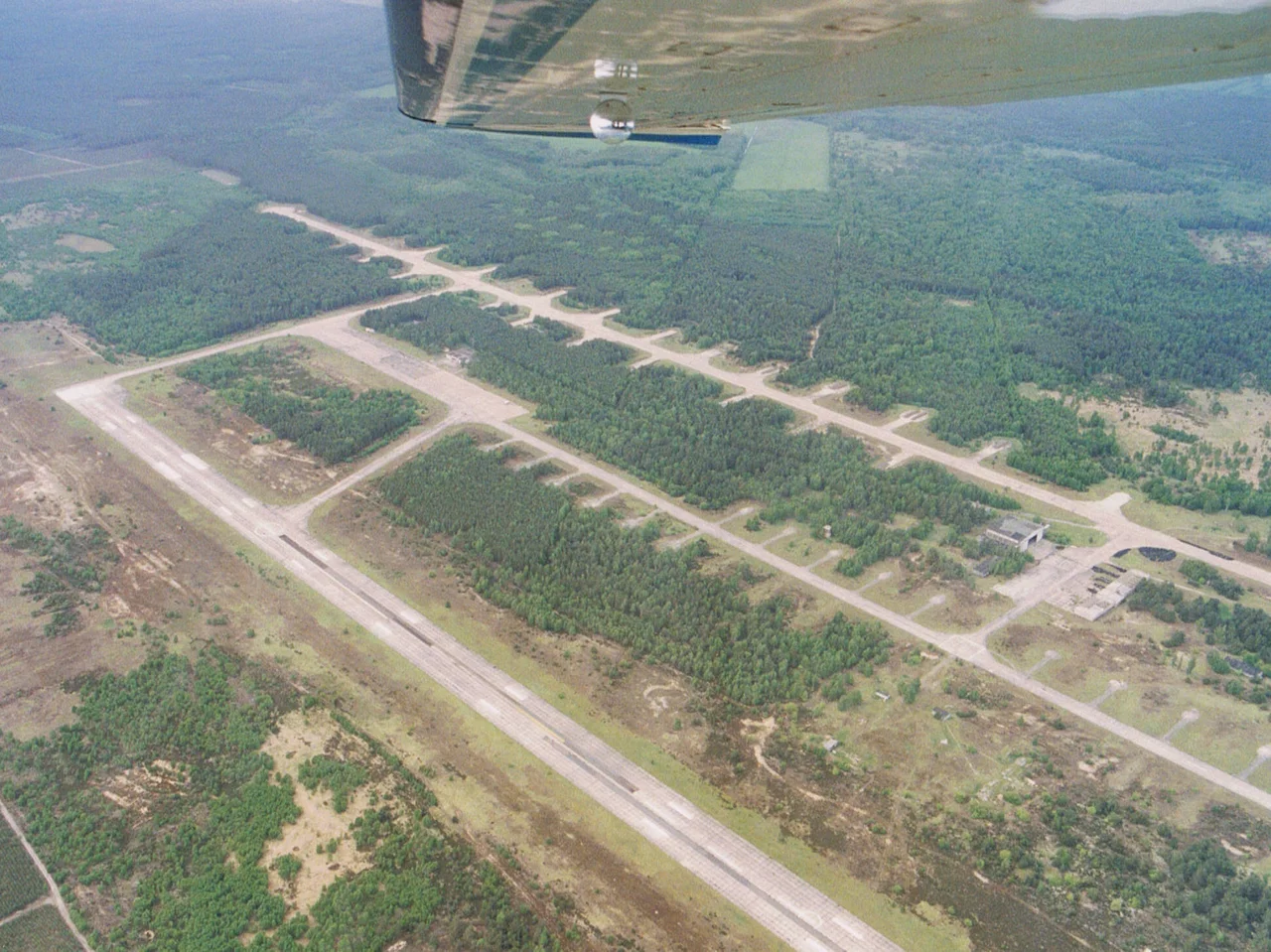

Sperenberg Airfield
In 1991, with German arrest warrants out for him, Erich Honecker spent his last night on German soil in a forest south of Berlin and flew to Moscow the next morning. The place he left from does not appear on ordinary maps of the period. Sperenberg was a Soviet air base buried in pine woods, its 2,500-metre runway invisible from any public road, and for more than thirty years it was the logistical throat of the Soviet military presence in East Germany - the place where the heavy transports came in. The former head of state of the German Democratic Republic left the country through a door most of his citizens never knew existed.
Gypsum, Gunnery, and a Very Deep Hole
The ground here was already spoken for long before the Soviets arrived. The Prussian Army used the forest as a military laboratory and testing site, part of the Kummersdorf complex a few kilometres away - the artillery range and weapons development centre where, on 21 December 1932, Wernher von Braun's team fired their first liquid-fuelled rocket motor, work that moved to Peenemünde in May 1937. The village itself had a different distinction. Its 80-metre gypsum hill was quarried for generations, and in 1867 a borehole drilled into it reached 1,271.6 metres - the first hole in the world to pass a thousand metres, and the first measurement of how fast the earth warms with depth, roughly three degrees per hundred metres. Quarrying ended in 1958 when salt water flooded the workings and the ground began to subside. The pits are lakes now, inside a nature reserve.
Built in Three Phases
In the late 1950s the Soviet Army went looking for an airfield that could take heavy transport aircraft. Drewitz, Rangsdorf and Sperenberg were all considered; Sperenberg won, and East Germany was brought to the table on cost-sharing, in part because a dedicated military field removed any need to expand Schönefeld for dual use. Phase one, from 1958 to 1960, laid out the base - work done by the state construction enterprise VEB Spezialbau Potsdam using selected inmates from Brandenburg-Görden Prison, men whose labour built a runway they would never be told the purpose of. Soviet troops added a command bunker of 28 by 16 metres through the 1960s. The last phase, 1972 to 1974, brought civilian contractors, new hangars and parking ramps, and by May 1974 a concrete runway extended to 2,500 metres with a parallel grass strip, six taxiways and an enlarged passenger terminal.
A Town With No Address
What grew alongside the runway was not a barracks but a small city. More than 5,000 people lived at Sperenberg, and the Soviet military town acquired a theatre, a cinema, shops, a bakery, schools, a kindergarten and hospitals. A daily train ran to Potsdam and onward, directly, to Moscow. The flying was heavy: Ilyushin Il-76 and Antonov An-22 transports, out-stationed and transiting bombers, attack helicopters for local defence, and one unique aircraft - an Antonov An-26L, tail number 14 Orange, the sole example operating from here, used to calibrate airfield navigation aids. In 1990 the resident units included a reconnaissance detachment flying Il-20s and Il-22s, a helicopter squadron with Mi-6, Mi-8, Mi-9 and Mi-24s, and the 226th Independent Mixed Aviation Regiment of the 16th Air Army, flying An-12s, An-24s, An-26s and Tu-134s.
The Airport That Wasn't
The Soviet Army agreed to hand back all its bases by the end of 1994, and the helicopter squadron flew out to Vorotinsk in Kaluga Oblast in July of that year. Almost immediately Sperenberg became the centre of a national argument. With a runway, a terminal and 2,400 hectares of forest already in place, it was the obvious candidate to replace Berlin's cramped airports, and supporters pointed to the isolation - nobody living under the approach to complain about noise. The commissioned studies, including an extensive environmental impact assessment, came down clearly in Sperenberg's favour. The federal parliament chose Schönefeld anyway, persuaded that the distance from the capital was too great and wary of competing with an expanding Leipzig/Halle. Berlin Brandenburg Airport opened at Schönefeld, eventually, at famous cost.
Crash Tests in the Woods
The federal government passed the land to the state of Brandenburg in 2009 - all 2,400 hectares of it. The site is open, which means it has been comprehensively vandalised, and it is now rented to companies that need somewhere large and empty: TÜV and DEKRA have both installed rail-based test tracks here for crash testing. The books make sobering reading. In December 2007 Brandenburg valued the site at 8.75 million euros against annual income of half a million, and estimated that full redevelopment - demolition, remediation, marketing, administration - would run to about 45.3 million euros and lift the land value to 9.25 million. The state applied for 36 million euros in federal development funding. In the meantime the pines are doing the redevelopment themselves, slowly, through the concrete.
From the Air
Sperenberg lies at 52.140 N, 13.305 E, roughly 40 km south of central Berlin in flat pine forest. The field is derelict and closed - there are no services, no lighting and no maintained surfaces, and it must not be treated as a landing option - but from 2,000-4,000 ft it is one of the most legible abandoned airfields in Brandenburg: a 2,500-metre concrete runway running roughly east-west, a parallel grass strip, a full taxiway grid and the pale rectangles of hangar aprons, all cut into unbroken dark forest with no road network to explain them. The gypsum quarry lakes sit just west near the village. Schönhagen (EDAZ) is about 12 km northwest and is the practical base for a look; Berlin Brandenburg (EDDB) is 28 km north-northeast, and its controlled airspace should be checked before any transit. Terrain is flat and featureless, so the runway itself is the landmark.
Nearby Stories
- Stahnsdorf South-Western Cemetery 0.7 km away
- Gigafactory Berlin-Brandenburg 5.5 km away
- Brandenburg an der Havel 7.8 km away
- Tropical Islands Resort 9.4 km away
- Wendish-German double church 26 km away
- Lichtenburg Concentration Camp 28 km away
- Wittenberg 28 km away
- Bauhaus Dessau 30 km away