
Stahnsdorf South-Western Cemetery
In July 2015 someone broke open a grave in a pine wood south-west of Berlin and took the skull of the man who directed Nosferatu. Wax residue was found at the scene, as though candles had been burned. F. W. Murnau's head has never been recovered, and after a run of similar disturbances the cemetery's managers have considered sealing the grave for good. It is a strange thing to happen anywhere, and stranger here, because the Südwestkirchhof at Stahnsdorf is not some quiet churchyard where a night's work might go unnoticed. It runs to 206 hectares — the largest church-owned Christian cemetery in Germany, the country's second largest after Hamburg's Ohlsdorf, and by area the tenth largest on earth. It is easier to picture as a forest that happens to hold 120,000 graves.
Berlin Ran Out of Room
By the later nineteenth century the arithmetic had become obvious. Berlin was industrialising and swelling, and the parish burial grounds inside the city could not keep pace with the death rate. The Berlin City Synodal Association went looking beyond the boundary and bought roughly 156 hectares of partly wooded ground between the Parforceheide forests to the north and west, the new Potsdamer Landstrasse to the south, and the village of Stahnsdorf to the east. The site was consecrated on 28 March 1909. The first burial followed eleven days later, on 8 April — a retired teacher named Elisabeth Wenzlewski. Then the old city cemeteries began emptying into it: some 33,000 graves were lifted from six Schöneberg parish grounds and moved out here, headstones and all. Within twenty-five years the new cemetery had taken more than 35,000 interments, close to a third of everything it holds today.
The Widow Railway
Getting a coffin from Berlin out to Stahnsdorf was no small undertaking, so in 1913 a railway was run down from Wannsee and a station was opened on the cemetery forecourt itself. It carried the dead, and it carried the mourners with them. Officially it was the cemetery railway; Berliners called it the Witwenbahn, the widow railway. It ran for just under five decades. When the Wall went up in 1961 the line was cut, and with it the whole logic of the place — the graves stayed in the East, the families who visited them stayed in the West, and a burial ground built to serve a metropolis found itself severed from it. Keeping the site from vanishing back into the pines became a long, patient job. Since 1991 the church has put more than six million euros into it.
A Stave Church in a Pine Wood
The chapel is what you see first and remember longest: a timber church of steep dark gables modelled on the stave churches of Norway, built between 1908 and 1911 to plans by the church architect Gustav Werner. Inside, Art Nouveau glass throws colour across the woodwork and a pipe organ by Wilhelm Sauer still sounds; the building holds funerals and services, and now and then a concert. Werner himself lies in the row of graves directly in front of it. Around the chapel the ground opens into something closer to parkland than graveyard, which was the intention — Stahnsdorf was among the first rural cemeteries in Germany. Film crews find their way here constantly. Roman Polanski shot a scene of The Ghost Writer in the Lietzensee block in March 2009, Julian Rosefeldt filmed the eulogy from Manifesto here with Cate Blanchett, and the chapel turns up in the Netflix series Dark.
The Names Under the Pines
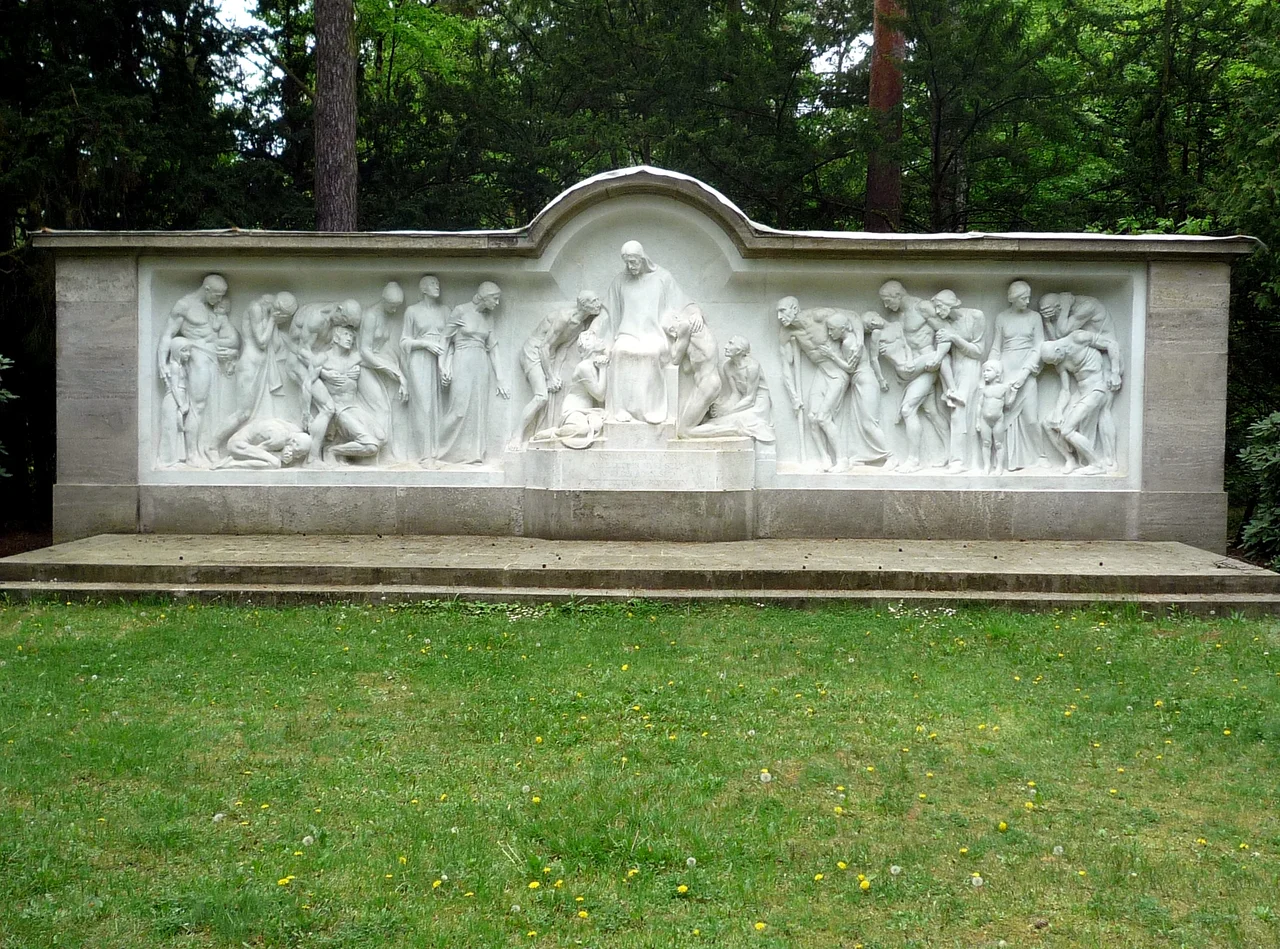
Each parish received its own block, and the blocks filled with the people who built modern Berlin. Werner von Siemens is here. So is Gustav Langenscheidt, whose name is still stamped on dictionaries, and Heinrich Zille, who drew the city's poor with more affection than anyone before him. The composer Engelbert Humperdinck, the painter Lovis Corinth, the geographer Ferdinand von Richthofen, the polyglot Emil Krebs. And F. W. Murnau, interred on 13 April 1931, a month after a car overturned on the Pacific Coast Highway and killed him a week before Tabu premiered. The mausoleums between them amount to an open-air museum of German funerary sculpture — the Caspary family tomb of 1911, the Langenscheidt vault, figures by Kurt Kroner, Ludwig Manzel, August Kraus. Murnau's is the one people come looking for, and in 2015 someone came for more than a photograph.
Two Hectares of Foreign Ground
After the First World War the British and Italian governments each acquired about a hectare inside the cemetery to gather their own dead. The Commonwealth plot holds 1,177 men, the Italian one roughly 1,650. Most were young, and all of them died a long way from anyone who knew them; the Commonwealth War Graves Commission still tends the British section, listed on its books as Berlin South-Western Cemetery. Queen Elizabeth II came to lay a wreath there on 3 November 2004. A German memorial to the war dead stands elsewhere in the grounds, so that within a few hundred metres you can stand among men who were sent to kill each other and are now kept by the same gardeners. Around all of it the forest has simply carried on — more than 200,000 trees, forty species of bird, two hundred kinds of butterfly, and four species of bat roosting in the crypts.
From the Air
52.3889°N, 13.1806°E, in the municipality of Stahnsdorf in Potsdam-Mittelmark, just outside Berlin's southwestern boundary. From the air it reads as a large, unusually regular block of dense woodland with pale ride-lines cut through it in a radiating pattern — nothing else nearby has that texture, and the dark timber chapel sits near the northern edge with its forecourt beside it. Use the water for orientation: the Wannsee and the Havel lakes lie 4 to 7 km north, the Glienicke Bridge about 7 km northwest, and Potsdam's centre roughly 8 km west. Berlin Brandenburg (EDDB) is about 12 nm east and Schönhagen (EDAZ) about 11 nm south. The site sits under Berlin's controlled airspace close to EDDB's western approach corridors, so coordinate and plan a lateral offset. Late autumn and winter, once the deciduous cover is down, give by far the clearest view of the ride pattern and the mausoleums.
Nearby Stories
- Silvio Gesell 3.3 km away
- Brandenburg an der Havel 9.4 km away
- Gigafactory Berlin-Brandenburg 10 km away
- Sperenberg Airfield 11 km away
- Eberswalde Hoard 13 km away
- Tropical Islands Resort 19 km away
- Wittenberg 38 km away
- Battle of Wittstock 49 km away