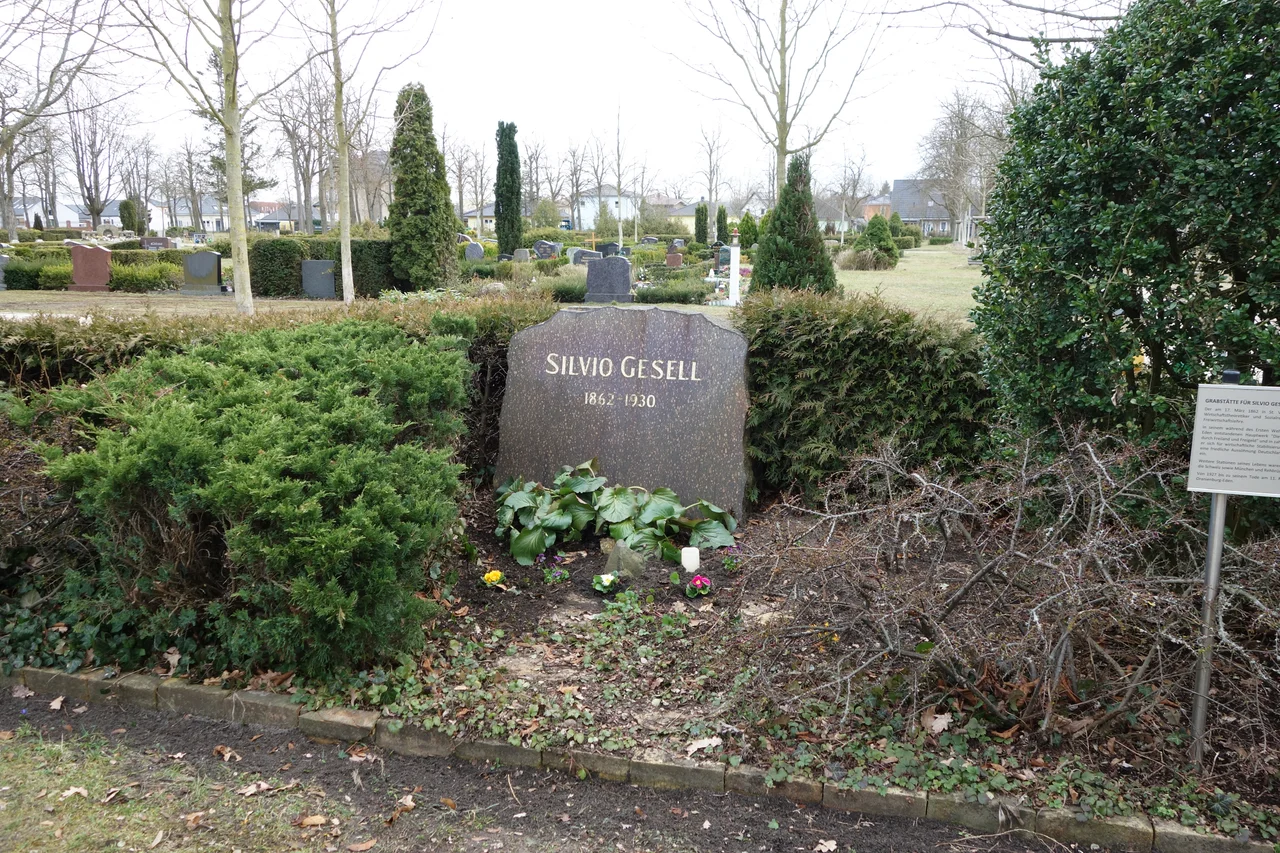

Silvio Gesell
For eight days in April 1919, the finances of a revolutionary republic in Munich were entrusted to a retired import merchant from Buenos Aires who had never been to university and believed, sincerely and in great technical detail, that money ought to rot. Silvio Gesell was fifty-seven. He had made and lost a business in Argentina, taught himself economics from the wreckage, and worked out a theory that would earn him a serious hearing from John Maynard Keynes and a treason charge from a Bavarian court in the same year. He spent his last decade growing fruit at Oranienburg.
The Merchant Who Could Not Afford a University
Johann Silvio Gesell was born on 17 March 1862 in Sankt Vith, then in the Prussian Rhine Province and today in Belgium — the seventh of nine children. His father Ernst, from Aachen, worked as a secretary; his mother was Walloon. There was no money for higher education, so after school in Malmedy the boy went to work for the Reichspost, disliked it, and apprenticed himself instead to his merchant brothers in Berlin. Two years followed in Málaga as a correspondent, then compulsory military service, then trade in Braunschweig and Hamburg.
In 1887 he sailed for Buenos Aires and opened an Argentine branch of the family firm. The depression of 1890 crushed it. He handed the business back to his brother and began asking why an economy full of goods and full of willing workers could seize up simply because money had stopped moving. His first pamphlet on currency appeared in 1891, published at his own expense.
Money That Rusts
Gesell's core observation was simple enough to explain over dinner and awkward enough to argue with for a century. Goods decay. Grain spoils, iron rusts, houses need roofs. Money does none of these things, which gives whoever holds it a permanent advantage over whoever must sell perishable things to live. That advantage, he argued, shows up as interest — and interest, not greed or malice, is what periodically strangles trade.
His remedy was Freigeld, free money: currency that loses a fixed percentage of its face value on a schedule, kept valid by periodically buying and affixing a stamp. Hoarding becomes pointless; the note in your pocket is worth more spent today than kept. He was careful to distinguish this from a mere negative interest rate, where face value stays intact and savers can simply move to cash — Japan's experiment with negative rates sent safe sales climbing, precisely the response Freigeld was designed to make impossible.
Alongside it came Freiland: nationalise the land, compensate owners with twenty-year bonds, and fund the bonds from competitive leasing. He admired Henry George's diagnosis and rejected his cure.
Eden
Gesell settled at Eden, a vegetarian fruit-growing cooperative on the edge of Oranienburg — one of the reform-minded settlements that grew up around Berlin in the years before the First World War, where meat was off the table and the residents raised their own orchards. It suited him. Here he founded the journal Der Physiokrat with Georg Blumenthal, and here he wrote.
Wartime censorship closed the magazine. In 1916 he published the book that carried his name furthest, Die natürliche Wirtschaftsordnung durch Freiland und Freigeld — The Natural Economic Order — laying out the whole system: free money, free land, free trade, and an international currency association to keep exchange honest between nations. He also insisted that economics abandon the theory of value entirely, which he considered a metaphysical dead end that had kept the discipline from becoming a science. It did not endear him to professional economists.
Eight Days
When the Bavarian Soviet Republic was proclaimed in April 1919, the anarchist writers Gustav Landauer and Erich Mühsam jointly proposed Gesell for finance. Landauer had praised his currency proposals as far back as 1911, calling him one of the very few who had truly learned from Proudhon; Mühsam thought him the most knowledgeable man alive on money and noted, approvingly, his anarchist streak. Gesell took the post of People's Representative for Finance and held it for roughly a week.
The republic was crushed by Freikorps troops within weeks. Landauer was killed in the suppression. Gesell was arrested and charged with high treason, defended himself in person before a Munich court, and was acquitted that July — then expelled from Bavaria. He went straight back to campaigning. Two years later, at a party congress in Linz, early National Socialist circles that had entertained both Gesell's and Gottfried Feder's monetary schemes settled decisively on Feder's.
What Outlived Him
Gesell died of pneumonia at Oranienburg on 11 March 1930, six days short of his sixty-eighth birthday, and was buried in the town cemetery. Erich Mühsam spoke at the funeral. Four years later, in a converted brewery in the same town, Nazi guards murdered Mühsam.
In 1936 Keynes took Gesell's work seriously in The General Theory, adopting his concept of basic interest and renaming it liquidity preference — the term economists still use. Every modern argument about negative rates, demurrage currencies and the problem of hoarded cash circles back to the question he first asked in Buenos Aires in 1890. He remains, depending on whom you ask, a crank who happened to be right about one enormous thing, or an economist whose only real failure was never attending a university.
From the Air
The Eden settlement sits at 52.75°N, 13.23°E on the northwestern edge of Oranienburg, about 35 km north of central Berlin. From the air the district still reads as what it was — a regular pattern of long narrow garden plots and orchard rows quite unlike the surrounding suburban blocks, laid out west of the town centre near the Havel and the Oranienburg Canal. Schloss Oranienburg and its formal garden mark the town core to the southeast; the Sachsenhausen memorial's distinctive triangle lies about 2 km north. Fly at 1,500–2,500 ft AGL to pick out the allotment geometry. This is controlled airspace beneath Berlin Brandenburg's northern structure — check current charts. EDDB (Berlin Brandenburg) is roughly 45 km south-southeast; EDAV (Eberswalde-Finow) about 30 km east-northeast. Spring blossom gives the orchards away most clearly; in winter the plot boundaries still show as bare hedge lines.
Nearby Stories
- Eberswalde Hoard 2.8 km away
- Spandau Citadel 2.8 km away
- Ravensbruck concentration camp 12 km away
- Friesack Camp 12 km away
- Battle of Wittstock 14 km away
- Brandenburg an der Havel 18 km away
- Gigafactory Berlin-Brandenburg 19 km away
- Battle of Prenzlau 28 km away