
Eberswalde Hoard
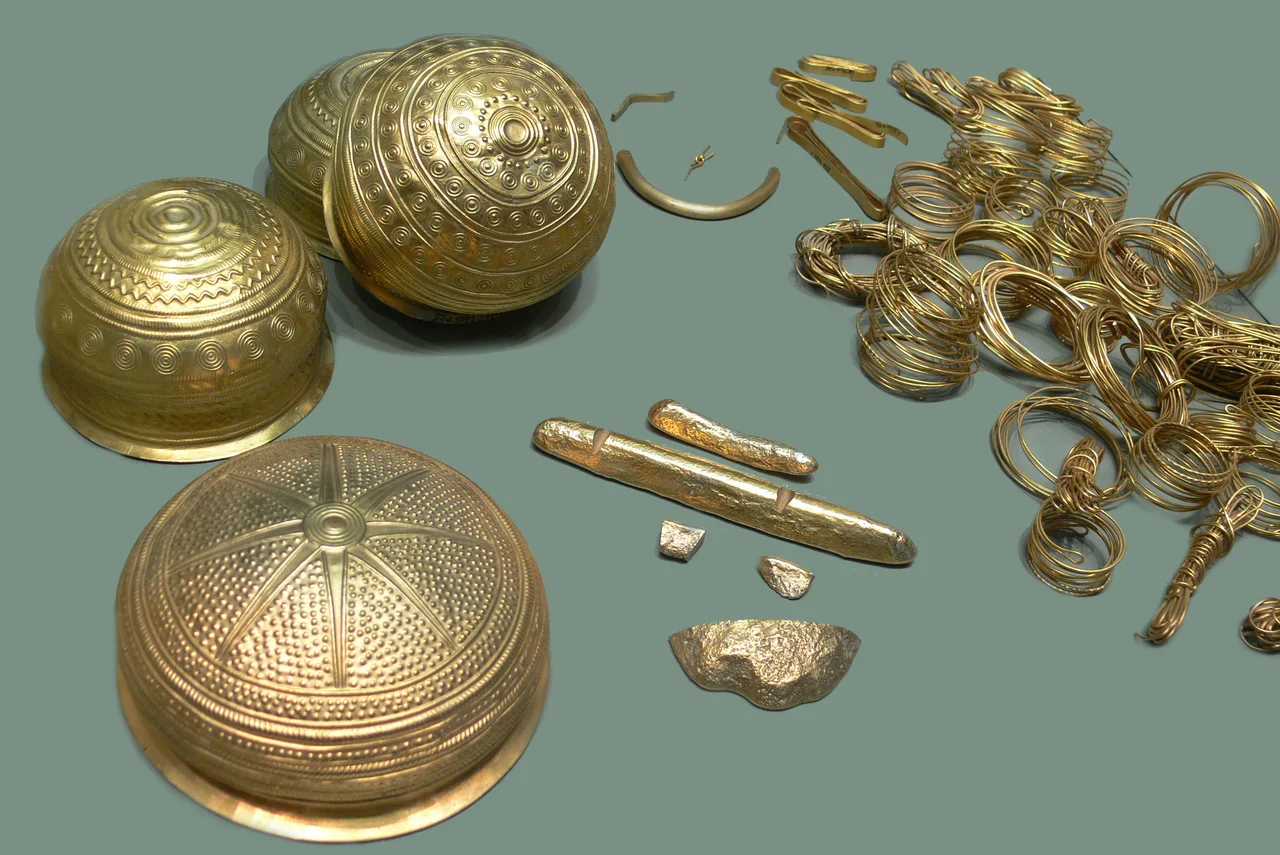
They were digging a house foundation in the yard of a brass works when the spades struck clay. A metre down, on 16 May 1913, workmen at the Messingwerk in Finow — a factory settlement on the edge of Eberswalde, northeast of Berlin — uncovered a lidded pot. Inside were eight gold bowls, and inside those, seventy-three more gold objects: neck rings, bracelets, sixty spiralled wire arm-rings, an ingot, a lump of metal shaped like a crucible. Eighty-one pieces in all, 2.59 kilograms of gold, buried in the ninth century BC and undisturbed for something like 2,800 years. It remains the largest prehistoric assembly of gold objects ever found in Germany. It has not been in Germany since 1945.
Eight Bowls, Nested
The bowls are why archaeologists rank this find where they do. They are thin-walled and chased — worked from behind with punches so the ornament stands out in relief on the outer face — and covered edge to edge in decoration of a kind that turns up across Bronze Age Europe. The style is classed as Villena-type, named for a comparable treasure found at Villena in Spain, and closely related bowls have been recovered in Denmark. Whoever hammered these was working in a design vocabulary shared from Iberia to the Baltic, three thousand years before anyone drew those borders.
Not everything in the pot was finished work. The ingot, the crucible-shaped lump and two smaller fragments are raw stock — gold on its way to becoming something else. Whoever put this in the ground was a goldsmith, or had access to one's workbench.
Merchant's Stock or Offering?
For most of the twentieth century the standard reading was commercial: a trader's stock, buried for safekeeping by someone who never came back for it. The mixture of finished ornaments and raw metal fitted that story neatly enough.
More recent scholarship leans the other way, toward religious deposit — gold surrendered deliberately rather than stashed. Bronze Age Europe is full of hoards placed in bogs, rivers and boundary ground where their owners plainly never intended to retrieve them, and in those cases the burial itself was the act. Two and a half kilograms of gold is a great deal to give up. Whichever reading holds, the pot went into the sandy Brandenburg soil around the ninth century BC and stayed there while the Iron Age, Rome, the Slavs, the Margraviate of Brandenburg and the Kingdom of Prussia all came and went overhead.
1945
Carl Schuchhardt, who directed the Prehistoric Department of the Royal Museums in Berlin, was alerted by the factory supervisor and brought the hoard into the Berlin collection almost immediately. He published it the following year as 'Der Goldfund vom Messingwerk bei Eberswalde.' The gold stayed in Berlin for three decades.
In 1945 it vanished, together with the Trojan gold known as Priam's Treasure. Both had been in Berlin before the war ended; neither was there afterwards. The Soviet Union denied taking them for close to fifty years, and the denials held until the 1990s, when Boris Yeltsin acknowledged that Priam's Treasure was in Russian hands. After that the explicit denials about Eberswalde quietly stopped. In 2004 a reporter for Der Spiegel finally traced the hoard to a closed depot inside Moscow's Pushkin Museum, where it had sat unlisted for nearly sixty years.
Two Legal Systems, One Pot of Gold
The dispute since has been a standoff between two positions, each internally consistent. Germany argues the hoard is stolen cultural property and asks for its return. Russia points to a federal law signed on 15 April 1998 — passed over Yeltsin's veto — which declares cultural valuables moved to the USSR after the Second World War to be Russian federal property, held as compensation for the museums, libraries and cities destroyed during the German invasion. Russia's Constitutional Court upheld that law in 1999. Nothing has moved since, and the question surfaces periodically as friction between the two governments.
The gold did at least come out of storage in 2013, put on public display at the Hermitage in St. Petersburg for the first time since 1941. In Germany you can see it only in copy. Replicas stand in the Museum für Vor- und Frühgeschichte in Berlin and in the Stadt- und Kreismuseum in Eberswalde, a short distance from the yard it came out of. The Eberswalde set was made by local craftsmen — metalworker Eckhard Herrmann and goldsmith Wilfried Schwuchow — a town commissioning a facsimile of its own most famous possession, because the original is 1,600 kilometres east.
From the Air
Coordinates 52.846°N, 13.723°E, at Eberswalde in the Barnim district of Brandenburg, about 50 km northeast of central Berlin. The findspot was the Messingwerk brass factory at Finow, on the western side of town; from the air the giveaway is the dead-straight line of the Oder-Havel Canal running east–west through the Finow valley, with the town strung along its northern bank and the wooded Barnim plateau rising on either side. Best viewing altitude is 2,000–3,000 ft AGL. Eberswalde-Finow (EDAV) sits directly beside the canal on the town's western edge and makes an obvious visual anchor; Strausberg (EDAY) lies about 30 km south, and Berlin Brandenburg (EDDB) around 60 km southwest. Follow the canal 15 km east and it delivers you to the Niederfinow boat lifts. Airspace here is largely uncontrolled below the Berlin TMA. Autumn haze can flatten the valley; clear spring mornings show the canal as a bright ruled line across the forest.
Nearby Stories
- Afrikanisches Viertel 1.5 km away
- Oranienburg 11 km away
- Hohenlychen Sanatorium 13 km away
- St. Mary's Church, Chojna 16 km away
- Battle of Cedynia 19 km away
- Gigafactory Berlin-Brandenburg 19 km away
- Wikipedia Monument 25 km away
- Templin 26 km away