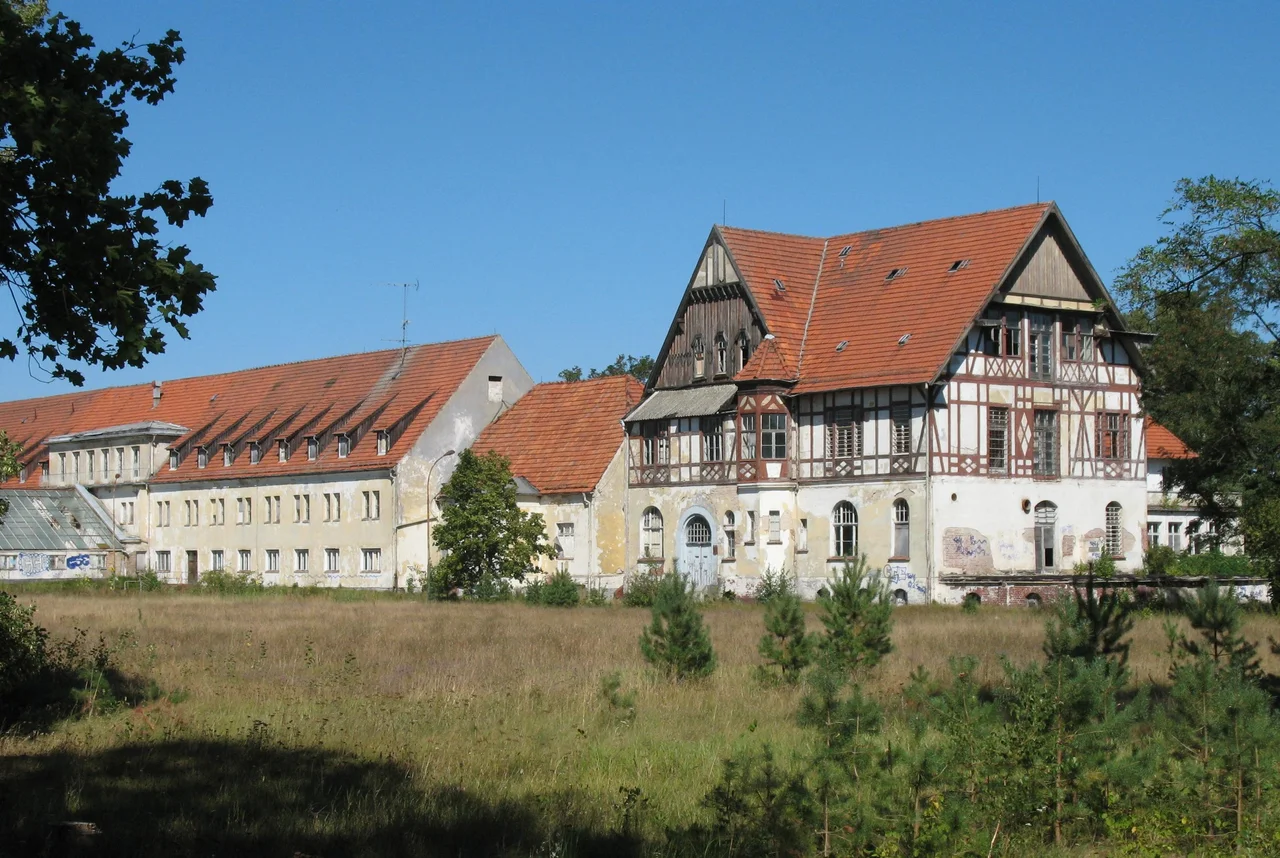

Hohenlychen Sanatorium
Karl Gebhardt was the surgeon German athletes went to. He ran a clinic in the pine forest above Lychen where footballers and Olympians had their joints rebuilt and where the guest book filled with the signatures of the Nazi leadership. In the summer of 1942 he began having women carried into an operating theatre at Ravensbruck concentration camp, eleven kilometres west, so that his staff could cut down to the bone of their legs, pack the wounds with bacteria and ground glass, and record whether the drugs worked. He called it research. A Nuremberg court sentenced him to death for it in August 1947.
Sixteen Girls and Sixteen Boys
Hohenlychen began as an ordinary good idea. Once German social insurance law made the state responsible for treating tuberculosis - which then meant sunlight, clean air, food and rest - sanatoriums went up across Prussia by the dozen. In 1902 Gotthold Pannwitz bought about a hectare from the town of Lychen for the German Red Cross and ran a trial season of three months: two barracks, sixteen girls, sixteen boys, meals taken at a restaurant down the road. By the mid-1920s the site covered sixteen hectares and forty-seven buildings, its children's clinic was the first in Prussia to offer surgery and orthopaedics, and its results in bone and joint tuberculosis were known well enough that the League of Nations health commission met here in 1927.
The Schoolfriend
Gebhardt had been at school with Himmler in Landshut. After the Nazis took power he reintroduced himself, joined the SS, and was installed as Hohenlychen's medical director in 1935 on the understanding that the place would become a centre for sports medicine and a military hospital for the SS. Money arrived: a heated pool with a roof that opened on warm days, a gymnasium that doubled as a cinema, more than five hundred beds. Heinrich Himmler, Albert Speer and Rudolf Hess came often, and Hitler signed the book. From 1938 Gebhardt was Himmler's personal physician.
What Was Done to the Women
In May 1942 Reinhard Heydrich was wounded in Prague. Gebhardt took the case, thought little of sulphonamide antibiotics, and gave him too little; Heydrich died of the infection. Gebhardt's judgement was now in question, and Ernst-Robert Grawitz had already been pressing him to test the drugs on concentration camp prisoners. With Himmler's approval he agreed. The women were prisoners at Ravensbruck, the camp the SS had built for women on the Schwedtsee. Eighty-six were operated on without consent from the summer of 1942, and seventy-four of them were Polish political prisoners. Gebhardt's doctors cut through to the bone of their legs, opened the muscle, and packed the wounds with cultures of staphylococcus, gas gangrene and tetanus, adding splinters of wood and fragments of glass to imitate a battlefield injury. They severed nerves. They broke bones on purpose. Then they withheld treatment from some of the women to see whether the drug made a difference. Gebhardt presented his first results on 29 August 1942, drawn from a group of thirty-six women, three of whom were by then dead. Of the seventy-four Poles, five died of what was done to them and six were shot because their wounds would not heal and they were therefore evidence. The rest carried the damage for the rest of their lives, among them Wanda Poltawska, a Polish prisoner arrested for resistance work at nineteen, who survived the operations, went on to train as a psychiatrist, and remained a close friend of Pope John Paul II until her death in 2023 at 101. They named themselves: kroliki in Polish, Kaninchen in German, lapins in French. Rabbits.
The Wards at Hohenlychen
Ravensbruck was not the only site. Ludwig Stumpfegger, who worked under Gebhardt and later became Hitler's second personal physician, performed transplantation experiments on bone, nerve and muscle at Hohenlychen itself. Kurt Heissmeyer, another of Gebhardt's staff, set out to prove that tuberculosis was a disease of racially inferior people and injected live tubercle bacilli into prisoners at Neuengamme. Twenty Jewish children, ten boys and ten girls, were picked out for him at Auschwitz by Josef Mengele and shipped to Hamburg. On the night of 20 to 21 April 1945 the SS hanged all twenty of them in the basement of a school on Bullenhuser Damm, along with four adults who had cared for them and about thirty Soviet prisoners. Heissmeyer buried his notes in a zinc box at Hohenlychen. It was dug up in March 1964.
Verdicts, and Afterwards
In the spring of 1945 Himmler met Count Folke Bernadotte of the Swedish Red Cross here, in the negotiation he believed would save him, and agreed the White Buses that carried thousands of prisoners out of the camps. Red crosses on the roofs kept the bombers away until a raid on 27 April 1945 killed thirty-two soldiers; two days later the hospital was handed over without a shot. Gebhardt was sentenced to death at the Doctors' Trial on 20 August 1947 and hanged at Landsberg on 2 June 1948. Fritz Fischer's life sentence was cut to fifteen years and he was out by March 1954, licence restored, employed in industry until he retired. Herta Oberheuser, the only woman in the dock, was released in April 1952 and practised as a village family doctor until a Ravensbruck survivor recognised her in 1956; her licence was revoked in 1958. Stumpfegger left the Fuhrerbunker hours after Hitler's suicide and killed himself near Lehrter station. Soviet forces ran Hohenlychen as a hospital and maternity unit until the last detachment left on 31 August 1993. In 2009 an engineer bought nine of the buildings from Brandenburg, and his family has been restoring them since his death in 2019. The lake water is clear, the pines run down to the shore, and some of the buildings are now let by the week.
From the Air
The Hohenlychen site lies at 53.201 N, 13.326 E just outside Lychen in the Uckermark, about 108 km north of Berlin, set among the Lychen lakes at the eastern edge of the Uckermark Lakes Nature Park. From 2,000-3,500 ft AGL the cluster of large early-twentieth-century blocks stands out clearly against dense pine forest, on a neck of land between the Zenssee and the Grosser Lychensee. Ravensbruck Memorial is about 11 km west on the Schwedtsee at Furstenberg/Havel, and the two sites are best understood together. Rechlin-Larz (EDAX) lies roughly 45 km west-northwest, Eberswalde-Finow (EDAV) about 50 km south, and Berlin Brandenburg (EDDB) about 95 km south. The lake country here is low and flat with few navigational anchors beyond the water; autumn and spring bring persistent haze.
Nearby Stories
- Eberswalde Hoard 7.2 km away
- Battle of Wittstock 11 km away
- Oranienburg 18 km away
- Battle of Prenzlau 19 km away
- Friesack Camp 21 km away
- Historical Technical Museum, Peenemünde 78 km away
- Lilleø 181 km away
- Copenhagen City Hall 252 km away