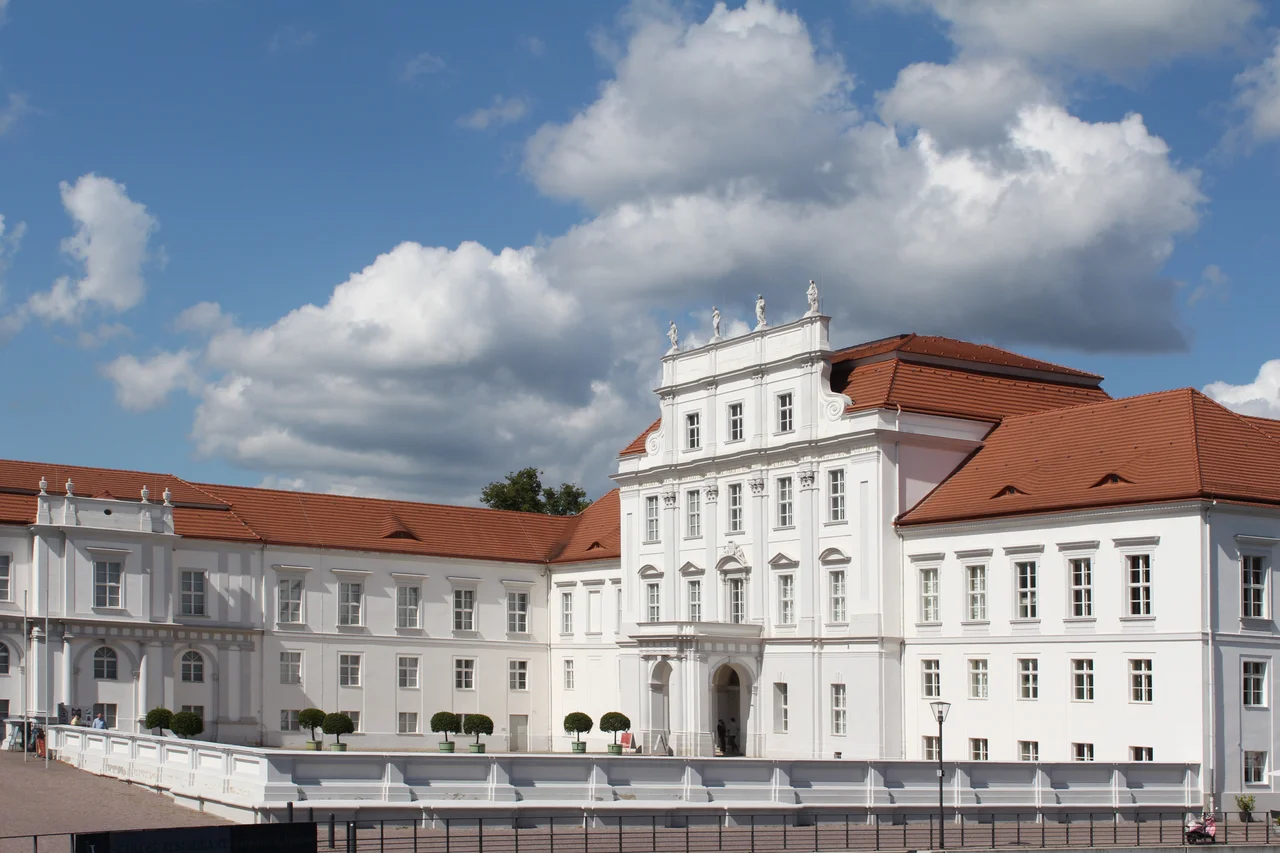

Oranienburg
Somewhere under the streets and gardens of Oranienburg, between 350 and 400 unexploded bombs are still waiting. About 200 have been found and defused; the town runs a search programme unlike any other in Germany, working from wartime aerial photographs and sweeping the ground with magnetometers and radar. When a big one turns up, the town empties — one evacuation moved 12,000 people out of their homes for a day. This is an ordinary commuter town of 49,000 people, an hour north of Berlin, and it is still, quite literally, at war with 1945.
A Princess, a Palace, and a Uranium Plant
The place was called Bötzow when it first appears in the records in 1216. In 1646 Frederick William of Brandenburg — the Great Elector, who would beat the Swedes at Fehrbellin thirty years later — married Louise Henriette of Orange-Nassau and gave her the district. She built a palace in the Dutch manner, and in 1653 Bötzow was renamed Oranienburg in her honour. The palace still stands at the town's heart, beside the Havel.
The twentieth century gave Oranienburg a different kind of importance. Heinkel built aircraft here, and the Auergesellschaft ran Germany's uranium production plant. That made it one of the most heavily bombed small towns in Germany. On 15 March 1945 the USAAF Eighth Air Force struck with a raid that historians including Antony Beevor have argued was aimed less at a war already being won than at keeping the uranium works out of Soviet hands. Those are the bombs the town is still finding.
Sachsenhausen
The first camp came fast. In March 1933 the SA took over a disused brewery on the Berlin road and turned it into one of the very first Nazi camps, holding Communists and Social Democrats from the capital. Among them was the anarchist poet Erich Mühsam. On the night of 9 July 1934 guards tortured and murdered him and hung his body in a latrine. The authorities called it suicide. His widow described a face too swollen to recognise and the back of his skull shattered.
The camp that replaced it in 1936, in the quiet suburb of Sachsenhausen, was built as a model: an isosceles triangle with 600-metre sides, barracks fanned in a half-circle around the gatehouse called Tower A, and a strip of ground inside the wall that any prisoner who stepped onto it was shot for entering. Over the gate, Arbeit Macht Frei.
More than 200,000 people passed through. Jews were held in large numbers, particularly before 1942, but most prisoners were political — Communists, Social Democrats, and men and women the regime simply found inconvenient. Jehovah's Witnesses. Roma and Sinti. Homosexual men. People classed as 'asocial', a category elastic enough to swallow the homeless and the unemployed. Every prisoner, children included, was tattooed.
The Work
Sachsenhausen was principally a labour camp, and the labour was designed to consume the people doing it. At the Klinkerwerk brickworks, prisoners made bricks for Albert Speer's rebuilding of Berlin. On the Schuhprüfstrecke — the shoe-testing track — men walked between 25 and 40 kilometres a day in military boots across sections of concrete, gravel, sand and cinder so German manufacturers could see how the soles held up. In a sealed barracks the SS ran Operation Bernhard, forcing imprisoned printers, engravers and bankers to forge British banknotes on a scale meant to wreck the British economy.
In the autumn of 1941, more than 10,000 Soviet prisoners of war were shot here within weeks. A small gas chamber and crematorium, known as Station Z, was built afterwards so that killing could continue in smaller batches.
At least 30,000 wartime deaths are documented; Anton Kaindl, the last commandant, admitted to 42,000 during his tenure alone. Most died of starvation, disease, exhaustion and beatings rather than by execution. Among those held here were Georg Elser, whose bomb in a Munich beer hall in 1939 detonated thirteen minutes after Hitler left the room; the pastor Martin Niemöller; and Yakov Dzhugashvili, Stalin's eldest son, who did not survive the camp.
The Road North
As the Red Army closed in during April 1945, the SS drove roughly 33,000 prisoners out of the gates and northwest on foot, heading for the Baltic. They were already starving, and anyone who fell behind was shot at the roadside. Thousands died. The route is still marked — the crossing at the Straße der Nationen, on the walk from the station to the memorial, carries a death march monument.
When Soviet troops arrived, they found the prisoners too ill to have been marched anywhere. They documented the site and put the responsible SS men on trial in Berlin. Then they kept the camp.
An Argument About Memory
From 1945 to 1950 Sachsenhausen operated as Soviet Special Camp No. 7, holding former Nazi functionaries alongside people the occupation considered politically dangerous. Some 60,000 were imprisoned; about 12,000 died. In 1952 the East German police blew up the building containing the gas chamber and crematorium, and the site was left to rot.
When the GDR reopened it in the 1960s, it commemorated the Anti-Fascist Struggle and almost nothing else — Jewish, Roma, homosexual and religious victims went unmentioned until Israeli protest forced the opening of a Jewish museum on the grounds. After 1990 the Soviet camp was excavated and added to the exhibition. In 1992, weeks after Yitzhak Rabin visited, neo-Nazis set fire to the Jewish barracks. They were rebuilt.
The memorial is two kilometres from Oranienburg station, an easy signposted walk, or buses 804 and 821 to the Gedenkstätte stop. It is worth staying long enough to notice how completely the town has gone on around it: a palace, a lake, restaurants by the station, and underneath it all, the bombs.
From the Air
Oranienburg lies at 52.75°N, 13.24°E on the Havel, roughly 35 km north of central Berlin. From the air, look for the river threading through town, the long rectangular block of Schloss Oranienburg and its formal garden, and — about 2 km north — the Sachsenhausen memorial, whose triangular perimeter wall and radiating barracks footprints are unmistakable from above and read most clearly at 1,500–2,500 ft AGL. The Oranienburg Canal and the Lehnitzsee sit just north of town, with the Berlin–Copenhagen cycle route following the water. The area falls under Berlin Brandenburg's northern airspace structure, so check current charts and expect controlled airspace: EDDB (Berlin Brandenburg) is about 45 km south-southeast, EDAV (Eberswalde-Finow) roughly 30 km east-northeast. Active bomb-disposal operations occasionally close roads and rail lines here — a ground hazard rather than an air one, but the reason the town's streets sometimes empty on a weekday morning. Clear, low winter light gives the best definition on the memorial's geometry.
Nearby Stories
- Eberswalde Hoard 2.8 km away
- Spandau Citadel 2.8 km away
- Ravensbruck concentration camp 12 km away
- Friesack Camp 12 km away
- Battle of Wittstock 14 km away
- Brandenburg an der Havel 18 km away
- Gigafactory Berlin-Brandenburg 19 km away
- Battle of Prenzlau 28 km away