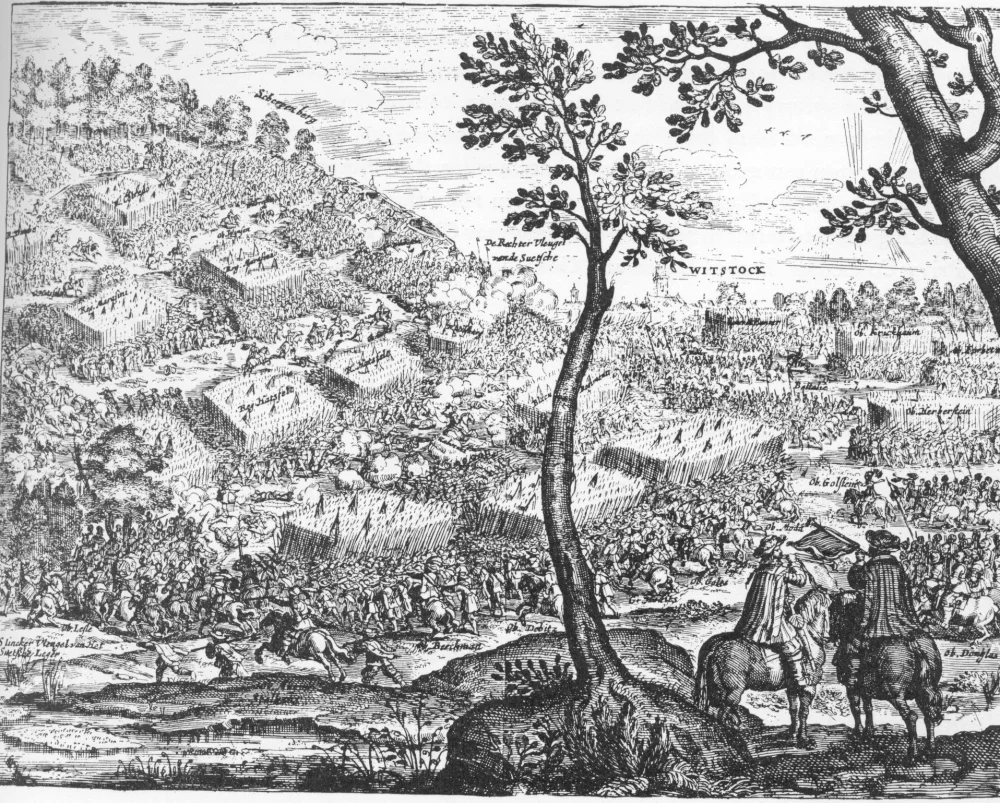

Battle of Wittstock
In April 2007, work near Wittstock uncovered a pit with bodies in it. There were roughly 125 of them, laid in together, and 88 were lifted and studied in detail. They had been in the ground since 4 October 1636. What the anthropologists could read from the bones was not the battle but the lives that preceded it — where these men had come from, how healthy they had been, how they had been injured before and how they were injured at the end. Almost nothing else survives of them. No muster roll gives their names, and the reports written by the generals who commanded them are concerned with credit rather than with the dead. The pit is the closest thing to a record they have.
Down to One Army
Sweden had been losing for two years. The defeat at Nördlingen in 1634 broke the confidence of the Protestant princes of the Holy Roman Empire, and one by one they made their peace with the emperor — the Elector of Saxony signing the Peace of Prague with Ferdinand II in May 1635, which turned Saxon regiments from allies into opponents. France was forced into open intervention to stop a Habsburg hegemony. In northern Germany what remained was a single significant Swedish field army, screened behind the river Dosse by an Imperial force while a separate corps under General Klitzing overran Brandenburg. Johan Banér commanded the Swedes. Alexander Leslie brought up the Army of the Weser, made up of German, Scottish and at least one English regiment, and the two crossed the Dosse in a surprise march that put them in the wooded hills just south of Wittstock.
The Scharfenberg
The Imperial and Saxon commanders, Melchior von Hatzfeld and John George I of Saxony, chose their ground well: a range of sandy hills called the Scharfenberg, with part of the front strengthened by six ditches and a wall of wagons chained together. They were the larger force, roughly 18,000 to the Swedish 17,000, though as much as a third of it consisted of Saxon units nobody trusted. Swedish artillery was much heavier — 60 guns against 32 — which is precisely why the Imperials meant to sit still and let the Swedes come across open ground. The Swedes declined the invitation. Instead they worked round the Imperial left, screened by a chain of hills, and the whole defensive line had to be pulled apart and re-formed to face a new direction.
The Long Way Round
Banér and Leslie sent a quarter of their army — under Lieutenant-General James King and Major-General Torsten Stålhandske — on a wide detour around the Imperial right. The ground defeated them. The march was slow and difficult, and while it dragged on, the men holding the main line had to absorb everything the Imperials could throw at them. Banér's troops took severe losses and began to give way. Leslie fed in five of his own regiments to hold the collapse, and the Scottish and English units were mauled doing it. They held long enough. When King's cavalry finally came round the flank, the Imperial line broke. Major-General Vitzthum, commanding the reserve, refused to engage; his role fell instead to Major-General John Ruthven, Leslie's son-in-law, who had been posted for exactly that contingency. Attacked from two directions and stripped of every gun, the Imperial army ran, covered by dusk.
Who Won It
The Swedes lost around 3,500 dead and wounded, the Imperial-Saxon army about 5,000 killed, wounded or captured. Three accounts of the day survive in the National Archives of Sweden and they do not agree comfortably. Banér credited the victory to Leslie. Leslie, writing privately to Chancellor Axel Oxenstierna, was appalled at what the battle had cost his army and hinted broadly that there had been an argument beforehand about the wisdom of Banér's plan. A third report by James King backs Leslie's version and adds detail. All three have since been transcribed, translated and published in English, which makes Wittstock unusually well documented from the top and no better documented at all from the ranks.
The Winner Who Gained Nothing
Wittstock kept Sweden in the war. It saved the last field army, restored a reputation shredded at Nördlingen, and encouraged Hesse-Kassel and the Guelphs to go on resisting. Yet the emperor's position improved. George William, Elector of Brandenburg, had fled to East Prussia when the Swedes occupied his lands, and he now had every reason to deal: he expected nothing from Sweden and feared losing his claim to Pomerania, the one territory the emperor and the Saxons could dangle to buy peace. He opened negotiations in November, backed the uncontested election of Ferdinand III as King of the Romans on 22 December 1636, and on 22 June 1637 promised to reinforce the new emperor with his own army under Klitzing. Even with imperial money, Brandenburg never managed more than 11,000 men. The finds from the mass grave are now held at the Museum des Dreißigjährigen Krieges in Wittstock, which opened on 24 September 1998 in the seven-storey tower of the old bishop's castle and was the first museum in Europe devoted to this war. In 2011 it mounted an exhibition about the men from the pit and called it 1636 — Their Last Battle.
From the Air
The battlefield lies south of Wittstock an der Dosse at approximately 53.164°N, 12.486°E, in the Ostprignitz-Ruppin district of northern Brandenburg. Best viewed at 2,000-4,000 ft AGL. The ground is gently rolling sandy hill country broken by pine plantation and marshy hollows — the marsh that slowed the Swedish reinforcements is still legible in the drainage pattern. Navigational anchors: the town of Wittstock with the tower of the Alte Bischofsburg, the Dosse river running south-east towards the Havel, and the large lakes of the Mecklenburg lake district beginning about 25 km north. Nearest airports: Berlin Brandenburg (EDDB) about 110 km south-south-east, Hamburg (EDDH) about 160 km west-north-west, Hannover (EDDV) about 190 km south-west. Terrain is unobstructed; expect ground haze on still autumn mornings, when the battlefield anniversary falls.
Nearby Stories
- Ravensbruck concentration camp 11 km away
- Friesack Camp 21 km away
- Oranienburg 23 km away
- Holy Blood of Wilsnack 24 km away
- Gardelegen Massacre 55 km away
- Historical Technical Museum, Peenemünde 93 km away
- Lilleø 166 km away
- Copenhagen City Hall 249 km away