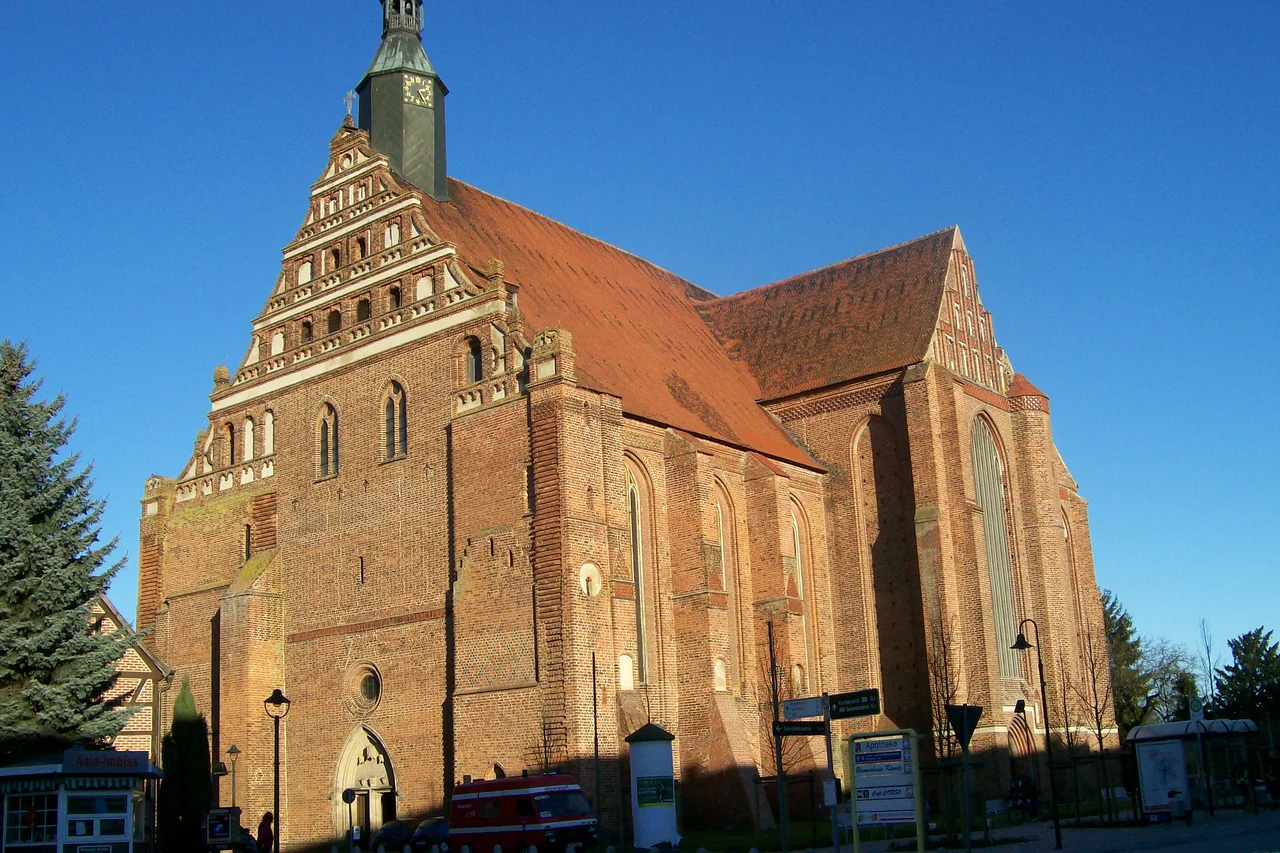

Holy Blood of Wilsnack
Heinrich von Bülow had a quarrel with the Bishop of Havelberg, and on 16 August 1383 he took it out on one of the bishop's villages. Wilsnack burned to the ground, church included. When the parish priest, Johannes Calbutz, picked his way into the ruins he found three communion hosts still lying in the sacrarium on the altar — unburned, and marked with red. Bishop Dietrich came to consecrate them, meaning to head off any accidental worship of unconsecrated bread. The story that spread said he never got the words out: the middle host welled with blood while he stood over it. Within a generation this scorched village in the Prignitz was pulling pilgrims from across Europe, and its knight-arsonist had unintentionally founded an industry.
The Road from Berlin
Reconstruction of the church began in 1384, funded by a papal indulgence, and finished around 1400: a three-aisled cruciform hall church in north German brick Gothic, far too big for the place, which is how you can still tell what happened here. Pilgrims came in numbers that made Wilsnack one of the great destinations of fifteenth-century Christendom, spoken of alongside Santiago de Compostela. A recognised route ran from the Marienkirche in Berlin north-west across the plain. Others walked from much further. From 1396 pilgrim badges were being cast in Havelberg — small lead tokens in the shape of three hosts, bought at the shrine, worn on the hat, dropped in rivers and lost in ditches all over northern Europe. Archaeologists are still finding them.
Two-Thirds to the Bishop
The Prignitz had been poor. Then, quite suddenly, it had a revenue stream that arrived on foot and paid for lodging, food, candles and badges. In 1395 Johann III Wöplitz, Bishop of Havelberg, folded the Wilsnack church into his own episcopal household, an arrangement under which two-thirds of the income flowed directly to the bishopric. This is the detail that Luther and others would seize on more than a century later, and it is hard to argue with the logic: a church that profits from a wonder has an interest in the wonder continuing. Nobody at the time claimed the money was irrelevant. The dispute was over whether the blood was real.
The Doubters
Objections started early and came from serious people. Jan Hus attacked the cult in 1403, which mattered because Bohemians were among the pilgrims. In 1405 Zbyněk Zajíc of Hazmburk, Archbishop of Prague, appointed a commission to examine the shrine; it reported that the miracles were fraudulent, and the archbishop forbade anyone under his jurisdiction to make the journey. Later Nicholas of Cusa, as cardinal-legate, tried to stop the pilgrimage outright. The compromise came from Pope Eugene IV, and it was a small masterpiece of institutional face-saving: the shrine could stay open, but a freshly consecrated host had to be displayed beside the relics, so that whatever the pilgrims were venerating, at least one item on the altar was unambiguously the real thing. The argument ran on for more than a century.
Children on the Road
The crowds did not always behave the way the church wanted. Around 1475 groups of children set off for Wilsnack on their own, a wave of youthful pilgrimages that drew in vagabonds and drifters and alarmed every town along the way; Erfurt dealt with it by locking its gates. Four decades earlier the English mystic Margery Kempe had reached Wilsnack in 1433 — one of the very few pilgrims to this shrine who left a written account of herself. Over roughly 170 years, hundreds of thousands of people made the journey — most of them leaving no record beyond a lost lead badge and the size of the church their money built.
5 June 1552
The end came from inside. Wilsnack had turned Protestant, and its evangelical pastor, Joachim Ellefeld, regarded the hosts as an offence that his own congregation was still walking past every week. On 5 June 1552, against the explicit orders of the town council, he broke open the monstrance and burned the three wafers. The Havelberg cathedral chapter had him imprisoned at Plattenburg; Elector Joachim II then had him released and exiled. Nothing of the relics survives, and the pilgrim routes emptied. What remains is the church, still enormous, still known locally as the Wunderblutkirche, standing over a spa town now called Bad Wilsnack — a building whose scale is the only surviving evidence of what once happened inside it.
From the Air
Bad Wilsnack lies at 52.956°N, 11.946°E, in the Prignitz of north-western Brandenburg, a few kilometres east of the Elbe. Best viewed at 1,500-3,000 ft AGL. The church of St Nicholas dominates the town from the air — a long brick hall church with a squat west tower, out of all proportion to the settlement around it, which is the point. Navigational anchors: the Elbe running north-west to south-east a short distance west, Wittenberge on the river to the north-west, and the flat Prignitz farmland with its scattered woodlots in every other direction. Nearest airports: Berlin Brandenburg (EDDB) about 115 km south-east, Hamburg (EDDH) about 140 km north-west, Hannover (EDDV) about 150 km south-west. Terrain is flat and obstacle-free; morning fog over the Elbe floodplain is common in autumn.
Nearby Stories
- Stones Fan Museum 7.2 km away
- Friesack Camp 18 km away
- Ludwigslust Palace 21 km away
- Battle of Wittstock 22 km away
- Tangermünde 25 km away
- Fusion Festival 29 km away
- Autostadt 46 km away
- Scharnebeck Twin Ship Lift 51 km away