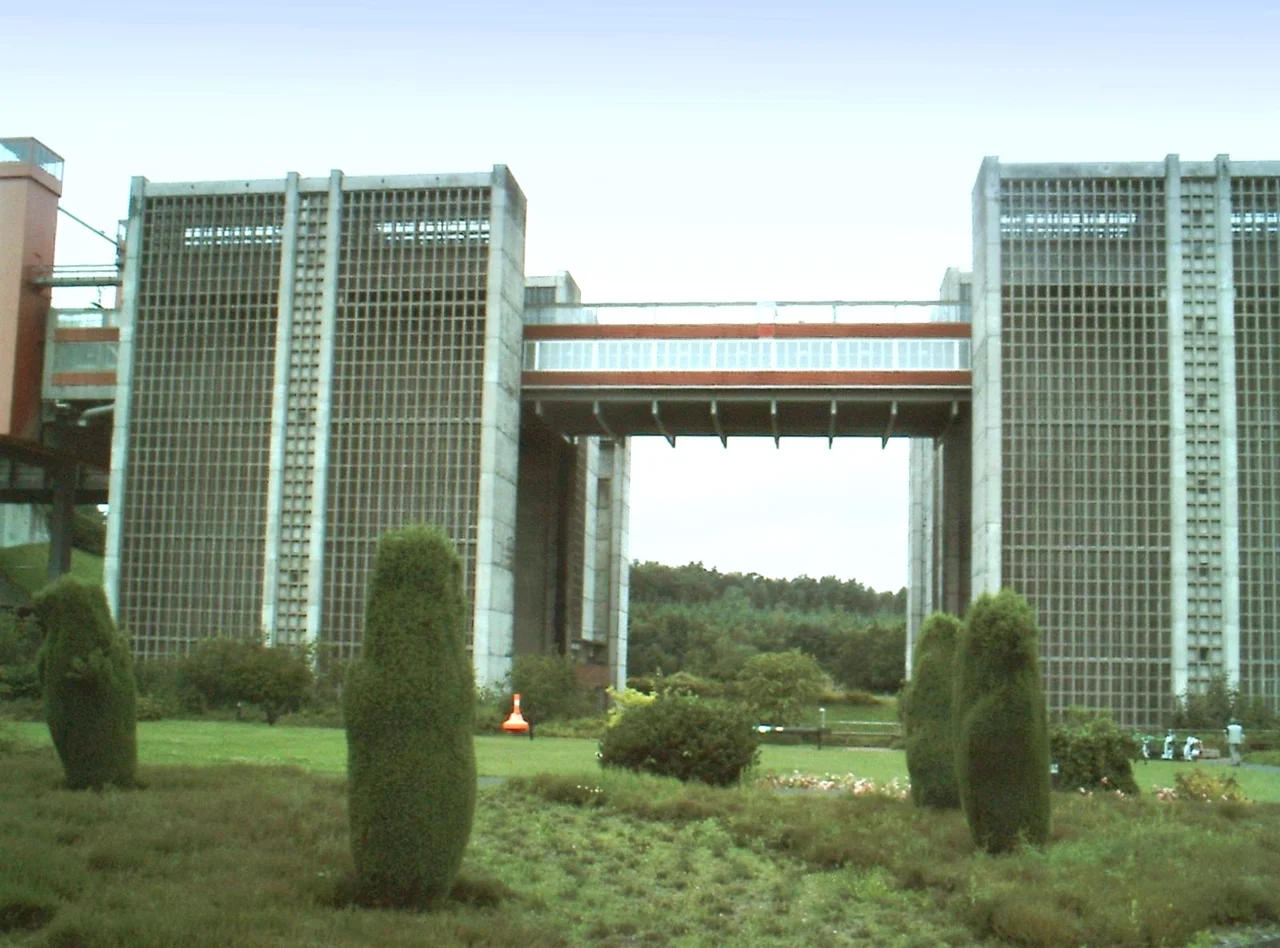

Scharnebeck Twin Ship Lift
A hundred-metre barge entering the trough at Scharnebeck adds nothing to the load. It cannot: floating, it displaces exactly its own weight in water, and that water goes out over the weir before the gates close behind it. Loaded or empty, the trough weighs the same 5,800 tonnes. That is why the whole apparatus can be balanced rather than lifted, and why four electric motors totalling 640 kilowatts - not much more than a couple of road-going lorries - can move around 11,800 tonnes of steel and water through 38 vertical metres in three minutes. It is one of the finest pieces of 1970s civil engineering in Germany, sitting more or less unremarked in flat country northeast of Lüneburg.
How to Balance Eleven Thousand Tonnes
Each of the two independent troughs hangs from steel cables 54 millimetres thick, running up over sheaves at the top of the guide towers and down the far side to counterweights. There are 224 heavy-concrete discs per trough, each around 26.5 tonnes, adding up to 5,936 tonnes of ballast for every trough - close enough to the moving weight that the motors are effectively only overcoming friction and trimming the balance. Usable trough dimensions are about 100 metres long, 11.8 metres wide and 3.38 metres deep, and catch ropes at the gates, fitted to stop a vessel running away inside, cost five metres of that length. The vertical travel takes three minutes. Getting a boat right through, gates and manoeuvring included, takes fifteen to twenty.
Why the Canal Needed a Cliff
The lift exists because of the Elbe Lateral Canal, a 115-kilometre cut begun on 6 May 1968 to join the Mittelland Canal near Calberlah to the Elbe at Artlenburg, giving Hamburg an inland route that did not depend on the river itself. Between those two ends lies 61 metres of height. It is taken in two bites: a pair of lock chambers at Uelzen, each 185 metres long, absorb 23 metres of it, and Scharnebeck takes the remaining 38 in a single vertical move, the exact figure varying with the level of the Elbe below. Construction of the lift came to 152 million Deutsche Mark. When it was finished it was the largest ship lift in the world, and the first vessel passed through on 5 December 1975 - half a year before the canal it was built to serve officially opened.
Thirty-Three Days After the Ribbon
The canal was inaugurated on 15 June 1976 by the federal transport minister Kurt Gscheidle, alongside Hamburg's mayor Hans-Ulrich Klose and Lower Saxony's minister-president Ernst Albrecht. Thirty-three days later, on 18 July, an embankment gave way near Lüneburg. Close to four million cubic metres of water went out across roughly fifteen square kilometres of surrounding country. The lift itself was undamaged and had nothing whatever to do with the failure, but traffic did not resume permanently until June 1977, which meant the machine spent its first two summers as the showpiece of a waterway that had just emptied itself into the fields.
The Record, and the Reason It Will Go
The world record did not survive; Scharnebeck now ranks as the second-highest vertical ship lift in Europe. The more consequential problem is length. The trough takes vessels up to a hundred metres, and modern push-tow convoys are longer than that, which turns a lift built to unblock a waterway into the thing obstructing it. Germany's federal transport plan for 2030 lists the replacement: a lock at Lüneburg with 225 metres of usable length, taking the same 38 metres in one step. When it is built, the twin lift will have been outgrown rather than worn out - a particular and rather dignified kind of engineering fate.
Watching It Work
Around half a million people a year come to look, which is a startling figure for a piece of freight infrastructure in the Lower Saxon countryside. There is a museum on site and viewing points on the structure, and the appeal is uncomplicated: very large things moving quietly. The two troughs work independently, so with reasonable luck one descends while the other climbs, and eleven and a half thousand tonnes passes eleven and a half thousand tonnes in mid-air with nothing to hear but cable, gearing and water.
From the Air
The lift stands at 53.292 degrees N, 10.488 degrees E, at canal kilometre 106 of the Elbe Lateral Canal, about 10 km northeast of Lüneburg in Lower Saxony. From the air it is one of the easiest structures in northern Germany to identify: the canal runs dead straight across flat farmland, and at one point the water simply stops at a block of concrete towers with a visible step of nearly forty metres in the waterway either side of it. The Elbe lies about 12 km further north, the town of Lüneburg to the southwest. Nearest airports: EDHG (Lüneburg, 980 m grass) about 6 km southwest, EDDH (Hamburg) about 50 km northwest, EDDV (Hannover) about 95 km south. Recommended viewing altitude 1,500 to 3,000 feet. Low sun across the flat land throws the towers' shadows a long way and makes the height difference legible from above, which it otherwise is not.
Nearby Stories
- Ebstorf Abbey 6.7 km away
- Stones Fan Museum 22 km away
- Hurricane Festival 30 km away
- Sieben Steinhäuser 32 km away
- Ludwigslust Palace 39 km away
- Großer Knechtsand 101 km away
- Scharhörnbake 134 km away
- Lilleø 149 km away