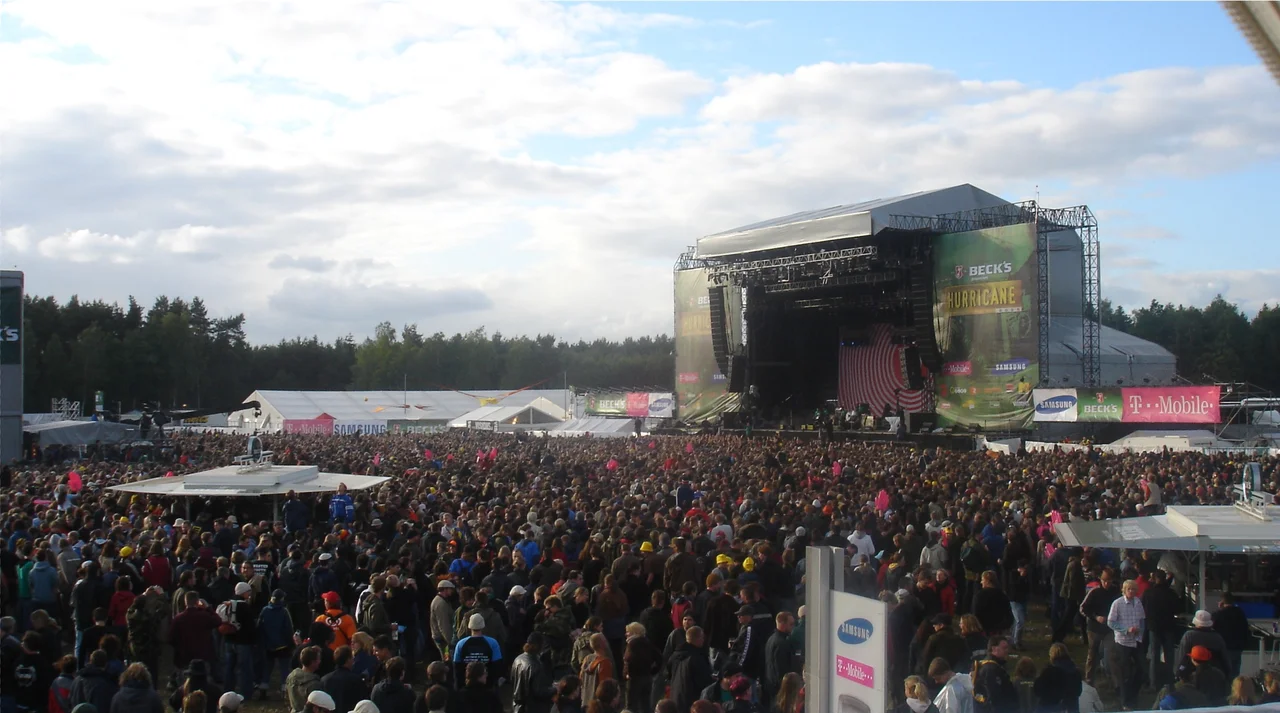

Hurricane Festival
The man who booked the bands for the 1977 festival at Scheeßel was a twenty-five-year-old bank clerk, and by the second night it was obvious he had already spent the money. Acts that had been announced never arrived — some because their travel costs were never guaranteed, some because they had been paid in full up front and saw no reason to come. The Hells Angels hired as stewards walked off the job when their own pay failed to appear. In the small hours, fans who felt cheated and stewards who had been cheated set fire to the stage and to the organiser's trailers. Instruments burned. People were injured by falling sections of steel scaffolding. The mayor shut the festival down, and for twenty years nothing rocked in the heath.
It Rocks in the Heath
The first festival here ran on 8 and 9 September 1973 under the name Es rockt in der Heide — It's rocking in the heath. For a village of farms between Bremen and Hamburg, the bill was absurdly good: Chuck Berry, Jerry Lee Lewis, Chicago, Manfred Mann's Earth Band, Lou Reed. The bands were enjoying themselves enough that the music carried on through Monday night.
Four years later the sequel arrived under a name nobody could love. First Rider Open Air took its title from the packaging of a new rolling tobacco; the Dutch manufacturer Douwe Egberts had put up DM 140,000 on the condition that the brand got its name in lights. The Dutch group Long Tall Ernie & The Shakers opened on 3 September 1977, and Golden Earring closed the first night with Radar Love. Van der Graaf Generator, Colosseum II and Camel played. Klaus Schulze was standing by, ready to go on, when the fire started. The damage came to DM 1.5 million.
Break-Even at Twelve Thousand
It took a new mayor and a persistent promoter to bring the music back. Folkert Koopmans, working with a local company, talked the Scheeßel administration round, and on 21 and 22 June 1997 the festival returned under the name Hurricane — thirty-six bands over two days on two stages, both of them pitched inside tents.
Koopmans had done the arithmetic and knew he needed twelve thousand people to break even. Around twenty thousand came, for Rammstein, INXS and Bad Religion. Nine thousand more than expected wanted to sleep on site, and a neighbouring farmer's land was turned into a campground at the last minute. Despite the crowd, the weekend made no profit at all. The following year attendance doubled.
A Sand Track in Open Country
The site is the Eichenring, a motorcycle sand track — a speedway oval ringed by trees and, for one weekend a year, by tens of thousands of tents. Nothing about the surrounding country suggests it should work. The heath is flat, agricultural and quiet; the nearest thing to a skyline is a line of poplars.
Growth came fast anyway. Forty thousand in the second year, a record 52,000 in 2002, and from 2003 the programme stretched from two days to three. By 2014 all 73,000 combi-tickets were gone before the weekend even started. The one stumble came in 2015, when about 65,000 attended — the organisers blamed a crowded festival calendar, a weaker headline bill of Placebo, Florence + the Machine and Materia, and a contactless payment system that replaced cash on site.
The Night They Pumped the Field Dry
The 2016 edition sold out on 23 February. Then the weather arrived. Day one lost two hours to a thunderstorm warning, and the organisers were in no mood to gamble: a lightning strike had injured dozens of people at Rock am Ring, fifteen of them seriously, and the festival was abandoned early. On day two the gates opened late and were then closed entirely for the evening.
Overnight on 25 June, specialist crews from the THW — Germany's federal civil-protection agency — joined the fire service and festival staff to drain the ground. They pumped the water off and spread straw and gravel across the churned field until it would take weight again. On Sunday the site opened as normal.
The Animal on the Screen
Since 2013 the Spanish artist Dani Blázquez has drawn a new animal for Hurricane every year: a pink owl, a blue wolf, a green boar, a red fox, a green bear, a purple lynx, a green racoon. It fills the stage screens between sets, papers the app, and hangs on banners across the grounds. The same creature turns up at Southside, the sister festival that runs the same three days with largely the same line-up several hundred kilometres to the south — the only difference is the colour of its eyes.
The pandemic cancelled 2020 and 2021 outright. The return in 2022 drew more than 80,000 people, the largest crowd in the festival's history and one of the biggest in Germany. Numbers have eased since — 78,000 in 2023, 75,000 in 2024, 65,000 in 2025 — but the arithmetic of that first anxious weekend in 1997 now looks like a rounding error.
From the Air
The Eichenring sits at 53.1594°N, 9.5225°E, on the northern edge of Scheeßel in the Rotenburg district, roughly midway between Bremen and Hamburg on the flat farmland at the western fringe of the Lüneburg Heath. From 2,000-3,000 ft the oval of the sand track is the only geometric feature for miles; in late June it is surrounded by an enormous grid of tents and vehicle rows that shows up far more clearly than the village itself. The Wümme river winds east of the site and the Bremen-Hamburg autobahn and railway run to the west. Bremen (EDDW) is about 45 km southwest, Hamburg (EDDH) about 60 km northeast, and Hannover (EDDV) about 80 km south — expect to be threading between three sets of controlled airspace. The terrain is uniformly low and visibility is usually excellent in summer; ground haze and morning fog over the Wümme lowland are the main nuisance in autumn.
Nearby Stories
- Sieben Steinhäuser 15 km away
- Worpswede 15 km away
- Lüneburg 17 km away
- Eschede train disaster 20 km away
- Wildeshausen 48 km away
- Butjadingen 55 km away
- Großer Knechtsand 97 km away
- Lilleø 184 km away