
Eschede train disaster
Jörg Dittmann was riding in the first coach of a Hamburg-bound express when a piece of steel came up through the floor of the carriage. It punched through an armrest between the seats where his wife and his son were sitting. He got them out of the coach and walked back through the train to find a conductor, and was about to show the man what had happened when the crash began. It was 10:59 on the morning of 3 June 1998. The train was doing 200 kilometres an hour. In the next few seconds, 101 people died.
The Cost of a Quieter Ride
The ICE 1 was the flagship of German railways, and it rolled originally on monobloc wheels — single castings, wheel and running surface in one piece. Those wheels transmitted vibration, and the complaints were serious enough that engineers went looking for something smoother. What they adopted was a resilient wheel: a wheel body wrapped in a rubber damper roughly 20 millimetres thick, with a relatively thin steel tyre shrunk on outside it. The arrangement had worked on trams the world over. It had never been tested in Germany at 200 kilometres an hour.
Several consequences were missed. Under load the tyre flattened into an ellipse once per revolution, half a million times in a normal day's service. Unlike a monobloc wheel, this design let cracks begin on the inside of the tyre, where no inspection could see them, and as the tyre wore thinner the forces on it rose and made those cracks grow faster. The design, investigators concluded afterward, lacked an adequate margin of safety.
Six Kilometres
Trainset 51 was working ICE 884, the "Wilhelm Conrad Röntgen" from Munich to Hamburg, and had left Hanover at half past ten. About 130 kilometres short of Hamburg and six kilometres south of Eschede, the fatigue crack in the tyre finally ran through. The tyre peeled off, flattened, and was flung upward through the floor of coach one — the steel Dittmann found in the armrest.
The train kept running with the loose tyre riding inside it. At the Eschede switches, roughly two minutes later, the embedded steel struck the guide rail of the points and tore it out of the sleepers. The guide rail came up through the floor in turn, lodged in the carriage and lifted a bogie clear of the track. A derailed wheel then hit the lever of the second switch and threw it, and coach three was steered off the alignment into the piers of the road overpass. The bridge dropped onto the train. Coaches five and six were crushed beneath it; coach seven, coaches ten to twelve and the rear power car drove into the wreckage. Two of the dead were railway workers standing under the bridge. Eighty-eight people were severely injured.
Eight Complaints
None of this arrived without warning. At Deutsche Bahn's Munich depot, technicians were checking tyres with ordinary flashlights rather than metal fatigue detection equipment; the advanced testing machines had been in use earlier, but threw so many false positives that staff judged them unreliable and stopped.
In the week before the disaster, three separate automated checks flagged a defective wheel. Investigators later pulled the train's on-board maintenance log and found that over the previous two months, conductors and other staff had filed eight separate complaints about noise and vibration from the bogie that carried it. The wheel stayed on the train. Deutsche Bahn's position afterward was that its inspection regime had been proper for the time and no engineer could have predicted the fracture.
Cutting Into the Wreck
The rescue crews who reached Eschede could barely open the train. Its aluminium framework and pressure-proof windows, both designed for strength at speed, resisted cutting equipment in ways nobody had anticipated, and reaching trapped passengers took far longer than it should have.
The technical response was fast. Within weeks every wheel of that design in the fleet was replaced with monobloc wheels, and the entire German network was checked for switches sitting close to bridge piers or other obstacles. All trains were refitted with windows carrying deliberate breaking seams and a hammer beside them; the small marked panel now standard in German carriages dates from that morning. The legal response was slower and thinner. Deutsche Bahn paid 30,000 Deutsche Marks per fatality at first, later settling with survivors and families for more than 30 million US dollars, and the criminal case ended in an April 2003 plea bargain, dismissed without a verdict. The engineers each paid 10,000 euros.
A Hundred and One Cherry Trees
Udo Bauch survived the crash and was left disabled by it. He built a memorial chapel near the site with his own money; it receives five to six thousand visitors a year. A year later an official memorial partly funded by Deutsche Bahn opened beside the line.
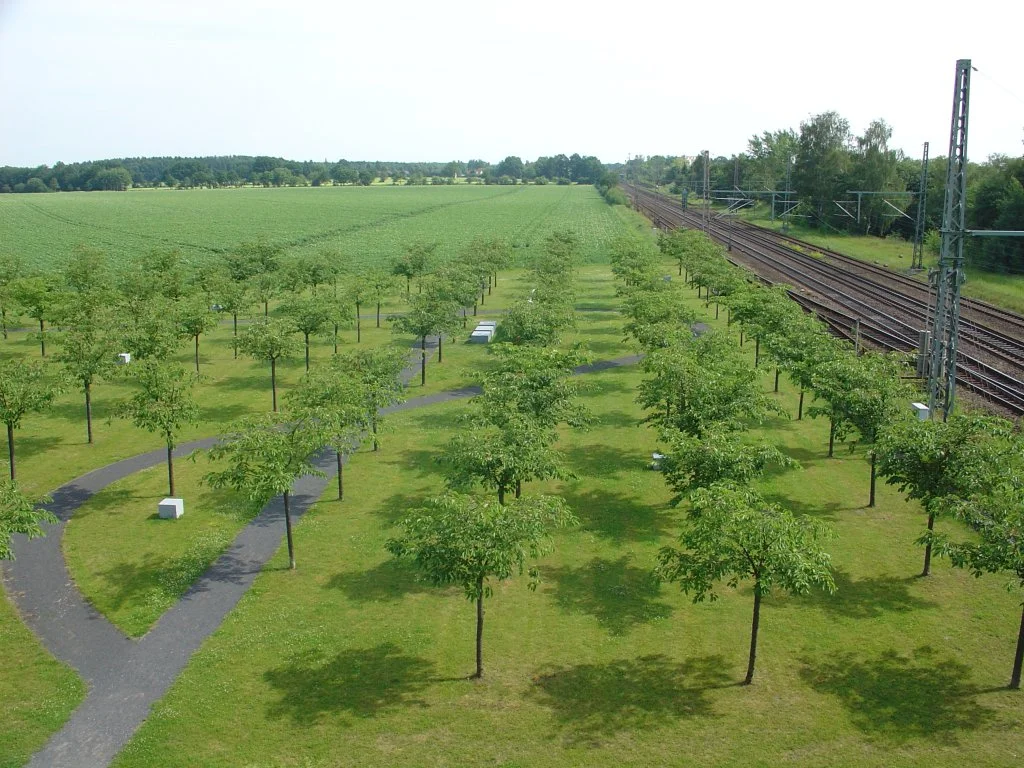
It is a field of wild cherry trees — 101 of them, one for each person killed, planted along the rails near the bridge, the switch itself in front. A stone gate carries an inscription. At the centre of the trees stands a wall listing the names of the dead, renovated in 2012. From the field a staircase climbs to the road, and in 2013, fifteen years after the crash, Deutsche Bahn's chief executive Rüdiger Grube stood here and apologised to the victims and their families.
On the far side of the road, a second flight of steps climbs the bank and stops. There is nothing at the top.
From the Air
The crash site is at 52.7344°N, 10.2203°E, immediately south of Eschede on the Hanover-Hamburg main line in Lower Saxony. From 2,000-3,500 ft the railway is unmistakable: a dead-straight double-track alignment cutting northeast through pine plantation and heath, with the rebuilt road overpass crossing it and the memorial's block of cherry trees standing out as broadleaf against conifer — most obvious in white blossom in spring and in colour in autumn. Nearest airfields are Celle (ETHC) 16 km southwest, Faßberg (ETHS) 21 km north, Hannover (EDDV) 47 km southwest and Hamburg (EDDH) 100 km north. The Bergen-Hohne training area and the Bergen-Belsen memorial lie about 21 km west; check NOTAMs for active restricted airspace before routing that way.
Nearby Stories
- Sieben Steinhäuser 3.9 km away
- International Wind- and Watermill Museum 14 km away
- Lüneburg 19 km away
- Herrenhausen Gardens 21 km away
- Hurricane Festival 23 km away
- Stones Fan Museum 24 km away
- Gardelegen Massacre 36 km away
- Ludwigslust Palace 47 km away