.jpg)
Herrenhausen Gardens
On 8 June 1714 an eighty-three-year-old woman was caught by a sudden downpour while walking in her garden, ran for shelter, and died in the arms of her granddaughter-in-law. Sophia, Electress of Hanover, was at that moment the heir presumptive to the throne of Great Britain, named in the Act of Settlement as next in the Protestant line. Queen Anne died on 1 August, less than two months later. Sophia had always been sceptical about the whole business - "What Parliament does one day, it undoes the next," she said of her own succession - and she turned out to be right, though not in the way she had feared. Had she outlived Anne she would have been the oldest person ever to take the British throne. Instead the crown went to her son, and what she left behind was fifty hectares of hedges.
Fifty Hectares of Geometry
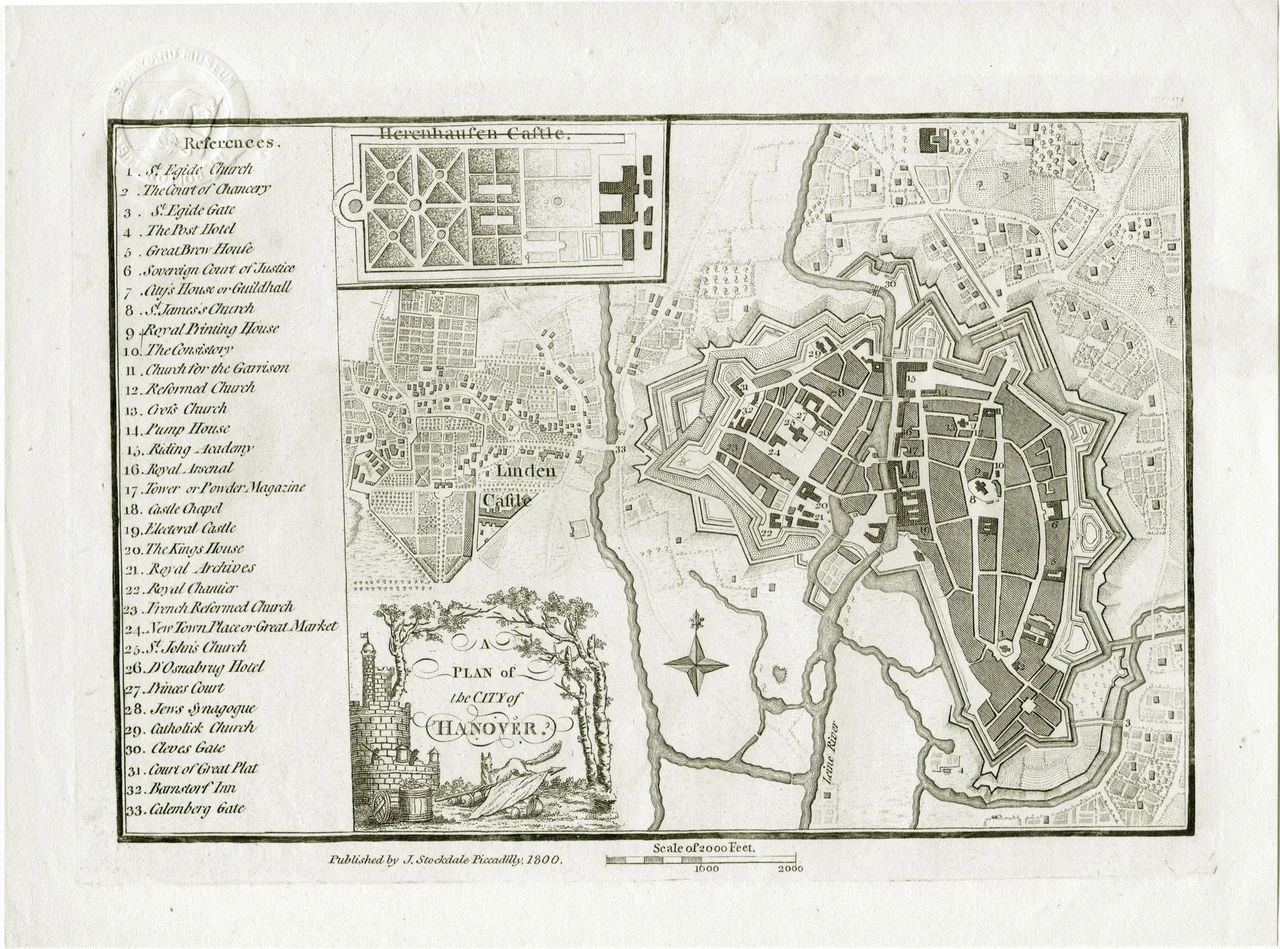
Sophia commissioned the French gardener Martin Charbonnier in 1683 to enlarge an existing plot at Herrenhausen, a few kilometres outside the city. The family's real residence was the Leine Palace downtown; this was the summer place. What Charbonnier and his successors produced runs to fifty hectares of lawn, hedge, gravel walk and statuary laid out in strict geometry, one of the most distinguished baroque gardens in Europe and one of very few never softened into an English park when fashion turned. Three more gardens grew up around it over the following centuries: the Hill Garden, which started as a vegetable plot and became a botanical collection; and the Georgen Garden and Guelf Garden, both laid out in the English manner and used by Hanoverians today the way any city uses its parks. The palace at the head of the Great Garden is almost apologetically small.
Water Instead of a Palace
Sophia's husband, Ernest Augustus, intended to replace that modest house with a proper baroque palace and got as far as building the grand Gallery nearby. Their son George Louis - who in 1714 succeeded to the British throne as King George I - abandoned the project and spent the money on water instead, a decision that shaped Herrenhausen more than any architecture would have. The Great Fountain was built on ideas supplied by Gottfried Wilhelm Leibniz and inaugurated in 1719. By 1721 it was throwing a jet some thirty-five metres up, the highest fountain at any court in Europe; in good conditions it now reaches eighty. George II drew up his own plans for a grander palace and never proceeded either. George III, who never visited Herrenhausen once in a sixty-year reign, settled for having the old building modernised in neoclassical style by Georg Ludwig Friedrich Laves.
The Philosopher on the Payroll
Leibniz arrived in Hanover at the end of 1676 to serve the House of Brunswick - running the library, writing the dynasty's history, and from 1677 holding the post of privy counsellor of justice, which he kept for the rest of his life. He stayed forty years. Sophia was among the very few people in northern Germany who took him seriously, and he was in turn her correspondent, adviser and friend, as he was to her daughter Sophia Charlotte. Then the court moved to London and he did not. When he died in November 1716, no courtier attended the funeral except his personal secretary, despite George I being near Hanover at the time. A small classical temple now stands in his honour in the Georgen Garden, which is a handsome apology, arriving well after the man had stopped needing one.
1943, and 2013
The British royal family asked the RAF not to bomb Herrenhausen Palace, which still belonged to the House of Hanover. It was hit anyway during an air raid in 1943. What remained was almost entirely cleared after the war, though someone pulled the outdoor staircase out of the debris and set it beside the Orangerie, where it survives as a flight of steps leading nowhere. The garden recovered; the building at its head stayed a gap for six decades. In 2009 the decision was taken to rebuild, construction began in 2010, and the reconstructed palace opened on 18 January 2013. Sophia lies a short walk away in the mausoleum in the Hill Garden, alongside Ernest Augustus and George I - a King of Great Britain, buried in a suburb of Hanover, in the grounds his mother laid out.
Eight Rooms and Six Hundred Roses
Along the central axis running from the palace to the Great Fountain, eight themed gardens sit inside hedged compartments like rooms without ceilings, each one demonstrating a different stage in the history of garden design. One of them is the Low German Rose Garden, laid out during the 1936-37 restoration on sixteenth-century principles: gravel paths dividing squares of bedding roses, boxwood cubes marking the corners, standard roses in circles at the centre, and a low lattice fence around the whole enclosure to make it read as a secluded garden of love. Four corner pavilions carry climbing roses and offer shade. Around 650 rose varieties grow here, among them cultivars bred on site and named for the people who made the place - Kurfürstin Sophie, and King George. In summer the garden fills with festivals, and six nights a year the international fireworks competition goes up over the parterres Sophia commissioned.
From the Air
The Herrenhausen Gardens lie at 52.3917N, 9.6983E in the Herrenhausen district, about 4 km northwest of Hanover's city centre in the flat Leine valley. From the air the Great Garden is unmistakable: a hard-edged green rectangle of roughly 50 hectares, hedged into geometric compartments, with the small pale rectangle of the rebuilt palace at its northern head and the Great Fountain plume at the southern end of the central axis - in still air the jet can rise 80 m, making it visible as a white smudge from several kilometres. The Berggarten glasshouses sit immediately north across Herrenhäuser Strasse, and the Georgengarten's tree-lined avenue runs southeast toward the university's Welfenschloss. Hannover-Langenhagen (EDDV) is roughly 8 km northeast, so the gardens sit close under its traffic pattern; expect controlled airspace and coordinate before low-level overflight. A viewing altitude of 1,500 to 2,500 feet AGL shows the full parterre geometry. Fireworks competition nights between May and September bring temporary restrictions and heavy evening traffic on the ground.
Nearby Stories
- Eschede train disaster 1.7 km away
- Lengede 7.7 km away
- Ahlden House 7.9 km away
- Battle of Idistaviso 8.4 km away
- M'era Luna Festival 19 km away
- Minden 23 km away
- International Wind- and Watermill Museum 24 km away
- Schnoor 44 km away