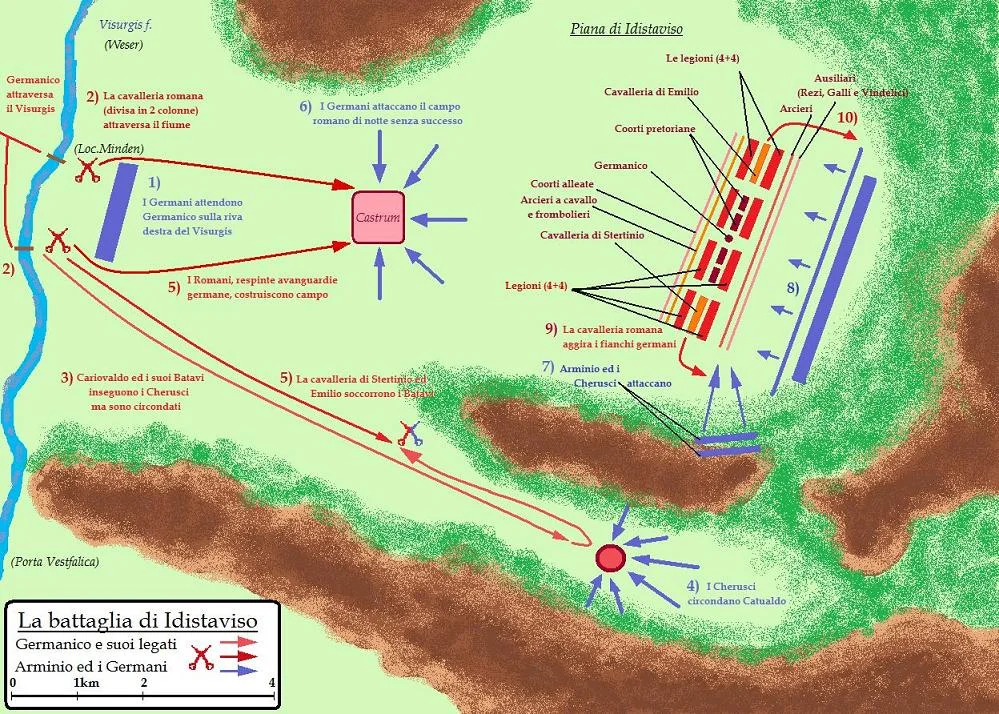

Battle of Idistaviso
In the summer of 15 CE, Roman soldiers walked back into the forest where three legions had been destroyed six years earlier and buried what was left of them. The bones were still lying where the men had fallen. Germanicus, the adopted son and heir of the emperor Tiberius, was leading the army, and his soldiers gathered the remains of comrades and strangers alike and covered them, and recovered the eagle standard of the annihilated Nineteenth Legion. The next year he found the man responsible and beat him in open battle on a plain by the River Weser. Where exactly that plain was, nobody now knows.
A Field Nobody Can Find
The ancient sources call the place Idistaviso and put it somewhere between the modern towns of Minden and Hamelin, on the flat ground along the Weser. That is as precise as the evidence gets. No archaeology has ever fixed the site, and the proposals have moved around for well over a century: Theodor Mommsen suggested the broader Bückeburg district in 1904, Hans Dobbertin argued for Evesen in 1983, and others have favoured the ground near the Porta Westfalica, where the Weser cuts its gap through the hills. The name is no more settled than the location. Jacob Grimm read Idistaviso as the meadow of the Idisi, female figures from Germanic myth; later scholars have argued for a plainer reading — an Idis-dwelling meadow, or simply an unusually fertile one. A famous battle, a named place, and no map reference that anyone can defend.
Why Rome Came Back
The reason for the campaign was Teutoburg. In 9 CE, three legions marching west to winter quarters had been ambushed and wiped out in the forests of western Germania, in an operation Arminius helped organise. He knew how Roman armies worked because he had served in one. The defeat lodged in the Roman psyche in a way few military disasters have, and Germanicus's campaigns were an attempt to work it out of the system: revenge, and the removal of Arminius as a threat. In 15 CE he marched first against the Chatti and then against Arminius's own people, the Cherusci. Skirmishing was constant. Open battle was not — the Germanic tribes had no interest in meeting a legion on ground of the legion's choosing, and for two seasons they simply refused to be caught.
The Day on the Weser
What finally forced the issue was pressure. By driving deep into Germanic territory again and again, Germanicus made it impossible for Arminius to hold his coalition together without fighting, and in 16 CE the coalition came out to fight. It was a large alliance and a fractious one. On the Roman side were eight legions and auxiliary troops, including warriors of the Chauci, who fought for Rome. The Romans won and inflicted heavy losses. Arminius and his uncle Inguiomer were both wounded and both got away. Almost everything we know comes from Tacitus, writing a century later from the Roman side, and he reports ten miles of ground strewn with the dead. There is no Germanic account, no casualty list, and no name recorded for any of the men who died there. The soldiers on the field hailed Tiberius as imperator and stacked captured weapons into a trophy with the names of the beaten tribes cut beneath it.
No Prisoners
That trophy was a provocation, and it worked. Within days the Germanic forces attacked Roman positions at the Angrivarian Wall, and the Romans, expecting it, routed them a second time. Germanicus stated that he wanted no prisoners taken, because he saw no end to the war short of the extermination of the tribes. Then the army went to work on the country itself. Caius Silius was sent against the Chatti with 3,000 cavalry and 33,000 infantry to lay their territory waste, while Germanicus invaded the Marsi for the third time and destroyed what he found. These were farms and villages and stores of grain, and the people who lost them are not named in any source either. The Romans raised a mound with an inscription claiming they had thoroughly conquered the tribes between the Rhine and the Elbe, dedicated to Mars, Jupiter and Augustus.
Recalled
Germanicus pulled back behind the Rhine for the winter, convinced that one more summer would finish the job, and Tacitus records that the tribes were thought to be considering terms. Tiberius recalled him instead. The emperor's letter granted that Germanicus had fought victorious battles on a great scale, but told him to remember the losses inflicted by winds and waves, which were no fault of his and grievous all the same — and that since the vengeance of Rome had been satisfied, the Germans might now be left to their internal feuds. It reads like praise and functions like a leash. Rome never permanently held the country east of the Rhine. The plain where the battle happened is farmland today, somewhere along a stretch of the Weser, unmarked and unidentified. It kept one strange afterlife: in Bulgakov's The Master and Margarita, Pontius Pilate claims to have fought here.
From the Air
The coordinates conventionally attached to the battle, 52.1900°N, 9.0207°E, put it on the Weser plain south of Minden — but treat the position as a marker, not a battlefield, since the site has never been established. The landscape itself is the point of interest. About 10 km north, at the Porta Westfalica, the Weser breaks through a ridge of hills in a narrow gap that has channelled every army, road and railway in this corner of Germany; the Kaiser Wilhelm monument sits on the eastern shoulder of that gap and is an excellent visual fix. South of it the river meanders across open agricultural flats toward Hamelin, roughly 30 km upstream. Sightseeing altitudes of 2,000-4,000 ft AGL show how completely the terrain funnels movement here. Nearby airports include EDDV (Hannover) about 50 km east, EDDG (Münster/Osnabrück) to the west and EDDW (Bremen) to the northwest. The Weser valley holds morning fog readily in autumn and winter.
Nearby Stories
- Halle (Westfalen) 8.4 km away
- Hunteburg 13 km away
- Herrenhausen Gardens 14 km away
- Lippstadt Airfield 17 km away
- Paderborn Cathedral 21 km away
- PS Speicher 26 km away
- GEO600 26 km away
- Dümmer 44 km away