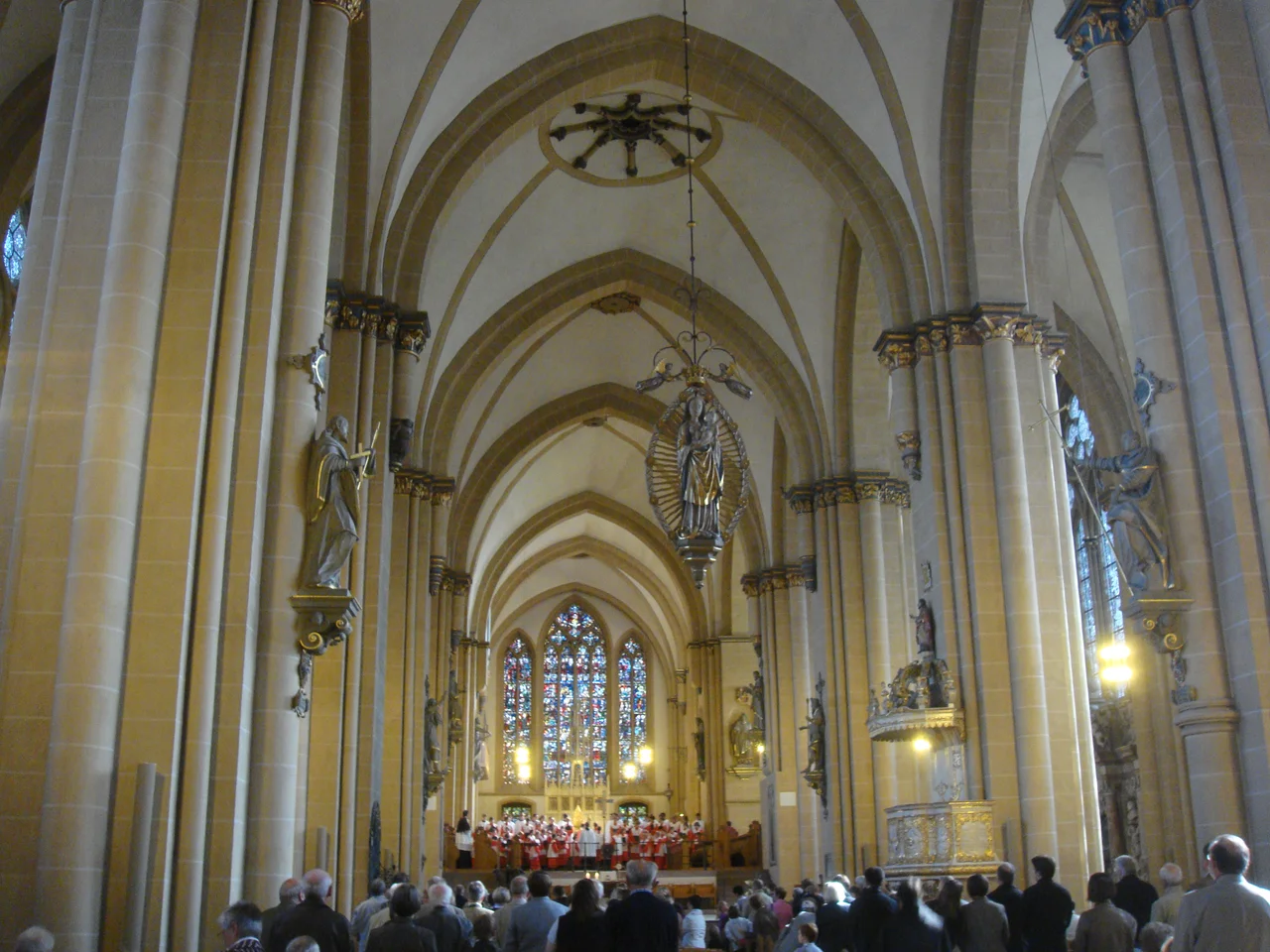

Paderborn Cathedral
Count the ears. Three hares run in a circle in the tracery of a small window, each plainly equipped with two ears, and the total number of ears cut in the stone is three. Every hare borrows from its neighbours, and no hare goes short. The Dreihasenfenster was carved from red Weser sandstone in the early sixteenth century and sits in the inner courtyard of the cloister at Paderborn Cathedral, and the city has never let it go: the hares turn up on buildings and shopfronts all over the centre, a medieval optical trick adopted as a municipal logo. What it signifies has never been settled. The Trinity, three in one, is the usual reading. Eternity is the other, since a circle of hares has no beginning and no end.
The Water Underneath
Everything here starts with the springs. More than two hundred karst springs rise within a few hundred metres of the cathedral and immediately form the Pader, at roughly four kilometres one of the shortest rivers in Germany - it barely gets going before it joins the Lippe. The town took its name from the water: Pader, plus born, the old word for a source. Charlemagne built a Kaiserpfalz beside those springs, and by 777 the palace had a church attached, dedicated to Christ the Saviour and to Brigit of Kildare, an Irish saint a very long way from home. It served as court chapel and as the forward base for missionary work among the Saxons - a religious building with a military function, and the Saxons treated it accordingly. They destroyed it more than once.
The Year a Crown Was Decided
In 799 Pope Leo III fled his enemies in Rome and travelled north until he reached Paderborn, where Charlemagne was. He stayed three months. In the course of that visit the two men laid the groundwork for what would happen in Rome the following year - the imperial coronation that made Charlemagne emperor and remade the political order of western Europe - and Leo consecrated an altar here to Saint Stephen, depositing relics inside it. A frontier palace built to subdue a pagan region was briefly the centre of European politics. The bishopric followed: administered at first from Wurzburg, it got its own bishop in 806, when Hathumar took the office. His successor Badurad wanted something more durable than authority, and in 836 a delegation from Paderborn came back from Le Mans carrying the remains of Saint Liborius. Twelve centuries later the city still throws him a festival every July.
Five Cathedrals on One Spot
The building you see is the fifth attempt. Fire took the first in the year 1000. Bishop Ratherius began rebuilding; his successor Meinwerk looked at the work, demolished it and started again - a three-aisled church with a transept and an eastern crypt, consecrated in 1015 and burnt in a city fire in 1058. Meinwerk's nephew rebuilt it far larger, with two transepts, in close to the shape standing today; the present crypt dates from around 1100, and Greek monks added a Saint Bartholomew chapel after 1015. A fire in 1133 damaged but did not destroy it, and Bernhard I von Oesede strengthened the fabric for a reconsecration in 1144 or 1145. Then, in the thirteenth century, came a rebuild for no reason but fashion. Nothing had burnt; the clergy simply wanted a modern church. Work started at the west end in late Romanesque before 1220, and the nave went up as a hall church - three aisles all carried to the full height of the roof - in early Gothic, finished late in the century with High Gothic detail. Four centuries later the prince-bishops stripped the Gothic interior out and put in Baroque.
22 March 1945
Paderborn lost around 85 per cent of itself to Allied bombing, and the cathedral was gutted. Every historic window was destroyed, along with works of art that cannot be replaced or even described, because nobody photographed most of them properly first. On 22 March 1945 a blockbuster bomb fell into the cloister and killed fourteen people. The three hares are in that cloister's inner courtyard. Reconstruction ran into the 1950s; a major restoration followed from 1978 to 1981. Some things came back: the Reliquienrentabel, a light sandstone altarpiece made around 1420 to hold the shrine of Saint Liborius, had been displaced by a Baroque high altar that the bombing then destroyed, and it stands in the choir again after five centuries of being moved around.
What Is Still In There
The west tower runs to 93 metres and the church to 104 metres in length, impossible to lose from the streets below. Go in through the Paradise Portal, cut in the first third of the thirteenth century, where late Romanesque and early Gothic statuary sit awkwardly and beautifully side by side. A Pieta from about 1360, probably made in Hesse. A double Madonna hanging from the nave ceiling, around 1480. An alabaster relief of the Magi, carved in Nottingham, that somehow ended up here. The tomb of Prince-Bishop Dietrich IV von Furstenberg, dead in 1618, a Mannerist pile of black and white stone climbing almost eighteen metres. Down in the crypt - 32 metres long, among the largest in Germany - the relics of Liborius rest in an ebony shrine, with the archbishops of Paderborn buried to the west and Bishop Meinwerk's thirteenth-century tombstone set into the antechamber floor. Meinwerk is the one who tore down his predecessor's half-built cathedral. It seems right that people still walk over him.
From the Air
Paderborn Cathedral stands at 51.719N, 8.755E in the centre of Paderborn, eastern North Rhine-Westphalia. The 93-metre west tower is the tallest thing in the old town and the obvious visual fix from the air; the 104-metre nave runs alongside it, and immediately west lie the Pader springs and the small park around them, where more than 200 karst springs surface and the river begins. Best worked at 1,500-3,000 ft. Paderborn Lippstadt (EDLP) lies southwest of the city and puts you overhead in minutes; Dortmund (EDLW) is west, Hanover (EDDV) northeast and Kassel-Calden (EDVK) southeast. Note the Eggegebirge ridge running north-south a few kilometres east of town, and the wind farms on the open Paderborn plateau to the south, both worth respecting at low level. Ceilings drop quickly on easterly flow when moist air lifts over the ridge.
Nearby Stories
- Möhne Reservoir 2.6 km away
- Battle of Villinghausen 13 km away
- Bad Iburg 15 km away
- Hamelin 17 km away
- Halle (Westfalen) 18 km away
- Eresburg 18 km away
- Princely Abbey of Corvey 19 km away
- Hercules Monument 27 km away