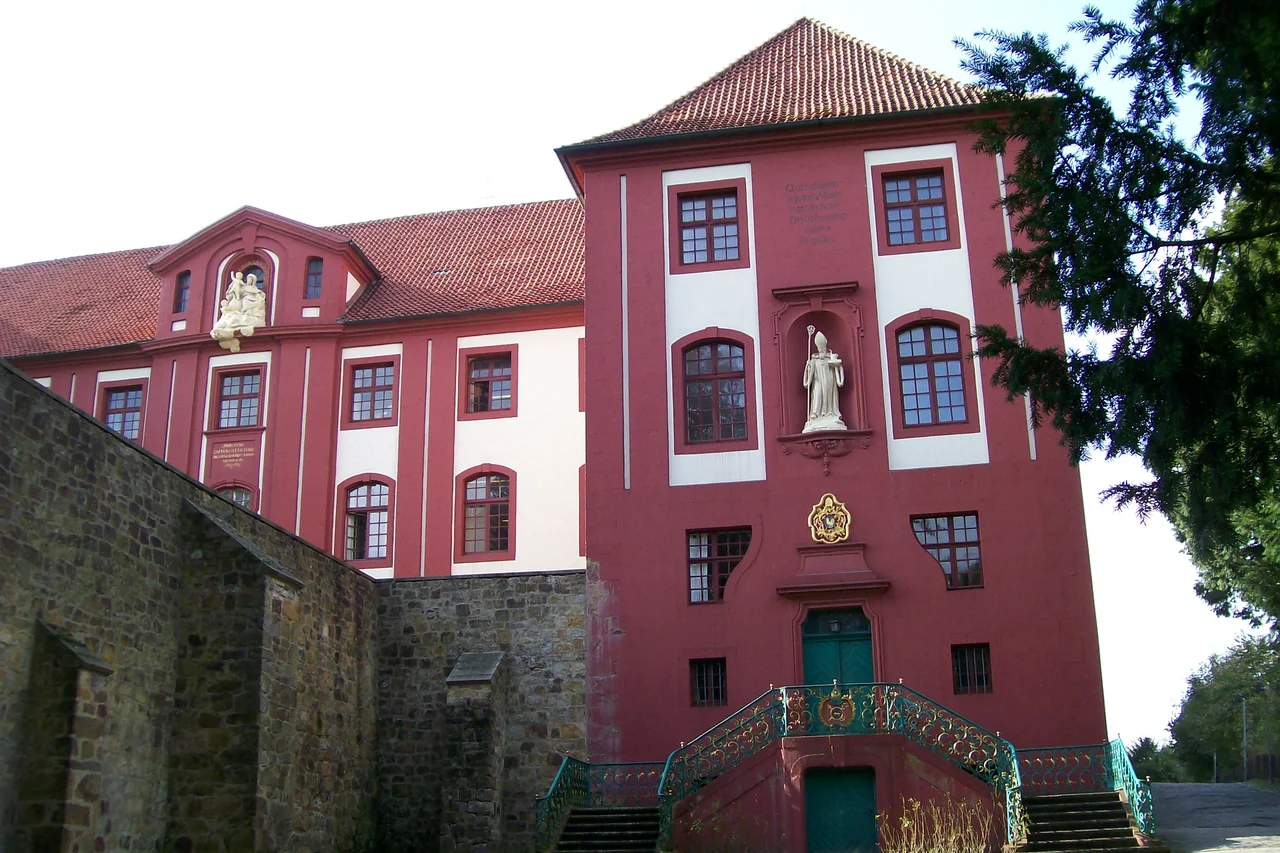

Bad Iburg
Sophia Charlotte was born in Schloss Iburg on 30 October 1668. Forty years later she would be dead, having spent the intervening time becoming the first Queen of Prussia, a serious philosopher of considerable correspondence with Leibniz, and the most cultivated court in early eighteenth-century Germany. But on the day of her birth she was simply the only daughter of Ernest Augustus, the Protestant Prince-Bishop of Osnabrück, who had taken up residence at this old episcopal castle in the Teutoburg Forest because it was where the bishops had lived for six hundred years. The castle is still there. The room she was born in is part of the Schlossmuseum tour.
Charlemagne's Border Castle
The Iburg has been a place of strategic importance since before there was a Germany. Documentation first mentions it in 753 as a Frankish stronghold. In 772 the Frankish king Charlemagne captured it from the Saxon leader Widukind, his great antagonist in the decades-long war to subdue the pagan Saxons of northern Europe. The fortress changed hands repeatedly. Frankish troops took it back in 783. By the eleventh century it had become an episcopal seat: Bishop Benno I built a new castle on the old ruins around 1052, and his successor Bishop Benno II - founder of the Benedictine monastery that occupies the same complex - rebuilt the castle again after 1068 and brought twelve monks from Mainz to staff the new monastery. Benno II was buried in St. Clemens, the monastery church, in 1088, where his tomb remains.
The Hagioscope
Inside the Church of St. Clemens there is a small angled window cut through the wall called a hagioscope. Its purpose was to allow people forbidden from entering the church - specifically, lepers - to see the elevation of the host during Mass from outside. Medieval theology held that watching the consecration of the bread and wine, even from a distance, conferred spiritual benefit. So the architects cut a sightline through the stone for those whose disease made them untouchable. The hagioscope at St. Clemens was lost for centuries, hidden behind plaster, and rediscovered during later restoration work. It remains one of the few surviving examples in northern Germany of how the medieval Church accommodated - while still excluding - its most stigmatized members.
Six Anabaptists in the Bennoturm
In 1534 the radical Anabaptist takeover of the nearby city of Münster was reaching its most violent phase. The Anabaptist leader John of Leiden had declared the city a New Jerusalem and was attempting to extend the movement outward. Six emissaries traveling from Münster toward Osnabrück were captured and brought to Iburg, where they were imprisoned in the octagonal tower called the Bennoturm. Five of them died there. They were tortured, then executed - the standard treatment for heresy in sixteenth-century Catholic Germany. The sixth saved himself by betraying the plans of John of Leiden to his captors, providing intelligence the authorities used in the subsequent siege and recapture of Münster. The Bennoturm still stands. It looks, from outside, like an unremarkable round tower. The stones inside remember more.
The Day the Zeppelin Crashed
On 28 June 1910, just after five in the afternoon, the airship LZ7 Deutschland crashed into Mount Limberg above Bad Iburg. The vessel was nine days into its career - it had made its maiden voyage on 19 June - and was on a publicity flight intended to popularize commercial Zeppelin travel. Aboard were nineteen journalists, including correspondents from two prominent British newspapers. Bad weather closed in over the Teutoburg Forest. The crew tried to make Osnabrück. They did not. The airship struck the wooded slope and was destroyed, but nobody was injured. A monument was put up on Mount Limberg afterward, bearing a portrait of Count Ferdinand von Zeppelin and the inscription Trotzdem vorwärts - Ahead nevertheless. Fifty-two years later, in January 1962, a British RAF aircraft crashed nearby on the Dörenberg, killing both pilots. A separate monument marks that wreck.
The Spa That Came Late
Bad Iburg is a Bad - a designated spa town - only since the modern era. The medieval and early modern town was first a fortress, then an episcopal residence, then a market town and Benedictine monastery. The kurhaus built in 1967 was torn down again in 2010 after years of local debate, and the site is now an open lawn used for community events including the local Schützenfest. What remains is the castle complex looming over the town center, the Benedictine monastery buildings designed by Johann Conrad Schlaun, the Rittersaal with its painted pseudo-architectural ceiling by Andrea Alovisii, and the Hermannsweg long-distance hiking trail that passes through on its 156-kilometer route along the Teutoburg crest. Hikers stop at Bad Iburg overnight. Some of them know about Sophia Charlotte. Few know about the hagioscope.
From the Air
Bad Iburg sits at 52.16 N, 8.05 E in the Teutoburg Forest, 16 km south of Osnabrück. The castle and monastery complex is the dominant landmark, standing on a wooded ridge above the town. From the air the ridge of the Teutoburg Wald runs northwest-southeast through this region, providing a clear navigational feature. Mount Limberg, site of the 1910 Zeppelin crash and the surviving Trotzdem vorwärts monument, rises to the north of the town. Nearest airport is Münster Osnabrück (EDDG) about 30 km south. Visibility is generally good in the forested uplands compared with the flat country to the north.
Nearby Stories
- Steinfurter Bagno 3 km away
- Osnabrück Canal 3.2 km away
- Bielefeld conspiracy 13 km away
- RAF Nordhorn 13 km away
- Hamm (Westfalen) Hauptbahnhof 21 km away
- Heinz Nixdorf MuseumsForum 25 km away
- Henrichenburg Boat Lift 27 km away
- Schnoor 81 km away