
Hamelin
There is a street in Hamelin where you are not supposed to play music. Bungelosenstrasse — "drumless street" — runs a short way through the old town, and the rule has held for centuries: no drums, no dancing. The reason is not on a signpost. It is cut into the sandstone flank of a house at the corner, in Low German, in 1602: in the year 1284, on the day of John and Paul, the twenty-sixth of June, a piper dressed in many colours led away one hundred and thirty children born in Hamelin, and near the koppen they were lost.
The House With the Inscription
The building is called the Rattenfängerhaus, the Rat-Catcher's House, and it has nothing to do with the story except those words on its wall. It went up in 1602 and 1603 in the ornate Weser Renaissance style — scrolled gables, a projecting bay, bands of carved stone marching across the facade. The town has owned it since 1917; there is a restaurant inside. Visitors photograph the inscription, then walk on down the quiet street.
Hamelin has leaned into all of this. Actors perform the tale in the town centre every Sunday in summer. The glockenspiel on the Hochzeitshaus, the old wedding house on the market square, chimes it out. A golden rat crouches on a footbridge over the Weser. What almost nobody notices is that the oldest versions of the story contain no rats at all.
What the Oldest Records Say
The earliest known account was not a text but a picture. A stained-glass window was installed in Hamelin's Market Church around 1300, a generation after the event it commemorated, showing a piper in coloured clothes leading children out of the town. The window was destroyed in 1660, but people who had seen it left written descriptions between the fourteenth and seventeenth centuries.
The oldest surviving written version turned up in the city archives in 1936, found by the historian Heinrich Spanuth: a manuscript from Lüneburg written around 1440. It begins flatly, the way a chronicle records a hailstorm. "Here follows a marvellous wonder, which transpired in the town of Hamelin in the diocese of Minden, in this Year of Our Lord, 1284, on the Feast of Saints John and Paul." Then the children follow the piper out and are lost near the koppen, a hill somewhere outside the walls.
No plague of rats. No unpaid fee. No revenge.
Rats, and Other Explanations
Rats enter the story in a version from around 1559, some two hundred and seventy-five years after the date on the wall. Once they arrived they stayed, because they supplied what the older accounts left out: why a stranger came, what he was owed, why he took the children. A bare record of loss became a fable about paying your debts. The Brothers Grimm gave that fable its standard German form, Goethe wrote a poem on it, and Robert Browning's version of 1842 is the one most English speakers carry in their heads.
Behind the fable, historians have been guessing for centuries. The most popular explanation is emigration — in the thirteenth century, recruiters worked the towns of northern Germany signing up settlers for new land in the east, and "the children of Hamelin" may mean simply the town's young people, who left with a well-dressed agent and did not come back. Others read the piper as Death and the loss as plague, or as one of the dancing manias documented elsewhere in the period. Each theory fits part of the evidence. None fits all of it.
Gibraltar of the North
Hamelin's other history rarely gets told. A monastery stood on this bend of the Weser as early as 851, and the settlement around it was a town by the twelfth century; in the fifteenth and sixteenth it was a minor member of the Hanseatic League. Its wealthiest stretch began in 1664, when it became the fortified border town of the Principality of Calenberg. Four forts eventually ringed it, the first built between 1760 and 1763 and the last in 1806, and the town collected the nickname "Gibraltar of the North."
The nickname outlived the guns. Later in 1806, after Napoleon broke the Prussian army at Jena-Auerstedt, Hamelin surrendered without a shot fired, and French troops pulled down the walls, the towers and the forts across the river. In 1843 the townspeople hauled the rubble of Fort George up the Klüt hill and built a lookout tower out of it — a sightseeing platform made from a fortress that never fought.
The Building That Is Now a Hotel
Hamelin's prison is the part of town the guidebooks skip. Under the Nazi regime it held Social Democrats, Communists and other political prisoners. Around two hundred died inside, and more died in April 1945, when the guards marched them out ahead of the Allied advance.
The British occupation forces then used the same building to hold Germans accused of war crimes, and roughly two hundred were hanged there after conviction. Among them were Josef Kramer and Irma Grese of Bergen-Belsen, more than a dozen men involved in the murder of recaptured Allied airmen from Stalag Luft III, and, on 8 October 1946, several of the men who had hanged twenty Jewish children in the basement of a Hamburg school in April 1945. The executed were buried in the prison yard until it was full. In March 1954 the German authorities exhumed ninety-one of them and reburied them in individual graves at the Am Wehl cemetery. The building is now a hotel.
From the Air
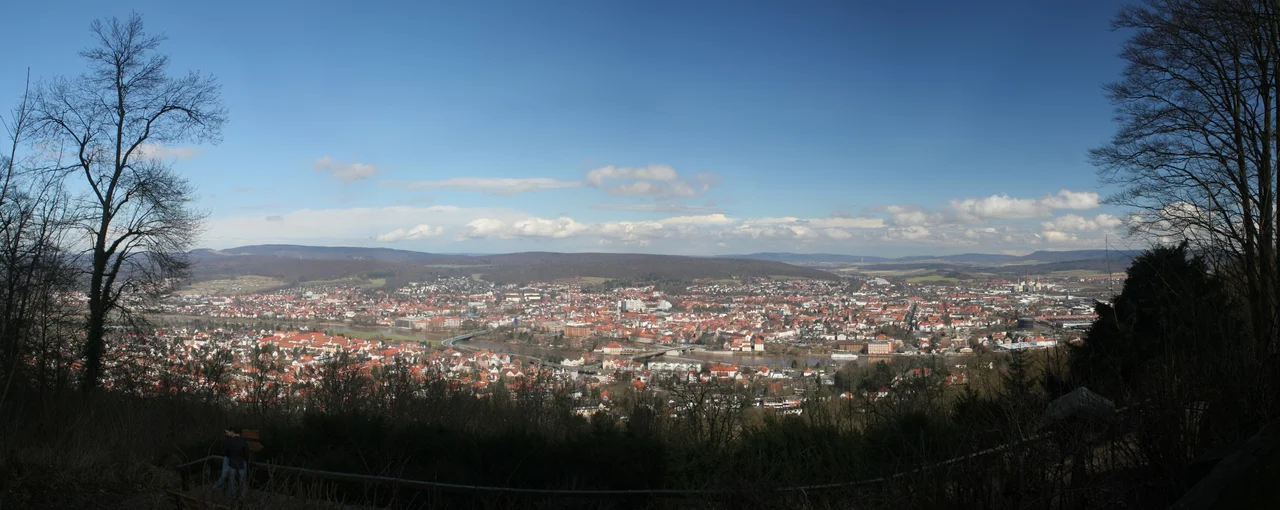
Hamelin sits at 52.1031°N, 9.3600°E on the Weser, where the river cuts through the wooded ridges of the Weserbergland about 45 km southwest of Hannover. From 2,500-4,000 ft the town reads clearly: a tight red-roofed old town on the east bank, the river swinging around it, and the wooded Klüt hill rising immediately west with the stone Klütturm on its crown — the most reliable visual fix in the valley. Ridge lines run northwest-southeast on both sides and generate mechanical turbulence and rotor in strong westerlies. Nearest airports are Hannover (EDDV) about 45 km northeast, Paderborn-Lippstadt (EDLP) about 60 km southwest and Kassel-Calden (EDVK) about 90 km south; expect Hannover terminal airspace to the northeast. Valley fog forms readily along the Weser on calm autumn mornings and usually burns off by mid-morning.
Nearby Stories
- PS Speicher 4.2 km away
- Bernward Doors 7.7 km away
- Holzminden prisoner-of-war camp 10 km away
- Heinz Nixdorf MuseumsForum 14 km away
- Bielefeld conspiracy 21 km away
- Herrenhausen Gardens 26 km away
- Celle State Stud 30 km away
- Dümmer 33 km away