
Heinz Nixdorf MuseumsForum
In 1977 Nixdorf Computer AG turned twenty-five, and the people who did business with it did what people do at a company anniversary: they gave the boss presents. A lot of them were antique office machines - mechanical calculators, typewriters, the obsolete brass-and-lever ancestors of the equipment the company actually sold. It was a joke with a compliment folded inside it, and Heinz Nixdorf took it seriously. Instead of putting the machines in a corridor he started thinking about a museum. That thought, arriving as a pile of gifts nobody had planned for, became the Heinz Nixdorf MuseumsForum in Paderborn - which describes itself, with reasonable confidence, as the biggest computer museum in the world.
The Collector
Nixdorf had started with almost nothing. Born in 1925, he set up the Labor fur Impulstechnik in Essen in 1952 - a laboratory for pulse technology, which in the early fifties meant building electronic calculating equipment for companies that had never owned any. He took over the old Wanderer works in 1968 and put his own name on the result, and Nixdorf Computer AG became one of the significant European computer manufacturers of its era, in a market that was mostly American. The museum idea firmed up in 1983 and 1984, when he began buying seriously with the help of Uwe Breker, a Cologne dealer who knew historic office machines better than anyone. In 1985 he commissioned an exhibition concept from Professor Ludwig Thurmer and his partners. What he had not decided was where to put it.
Died at the Trade Fair
On 17 March 1986 Nixdorf was at CeBIT in Hanover, the enormous computing fair that his industry had built and that he had helped make matter, when he suffered a heart attack. He was sixty. The museum existed at that point as a collection, a concept document and no address. What happened next is the part of the story that gets skipped: an employee named Willi Lenz, a member of the company's Computermuseum working group, kept it alive. He took the idea to the city of Paderborn and argued it through, and in 1990 the city council voted in favour. It took another six years to build. The museum opened on 24 October 1996, with Chancellor Helmut Kohl in attendance, funded through the Westphalia Foundation and the Heinz Nixdorf Foundation formed out of his estate. Ten years after his death, the presents finally had a building.
Five Thousand Years, Two Floors
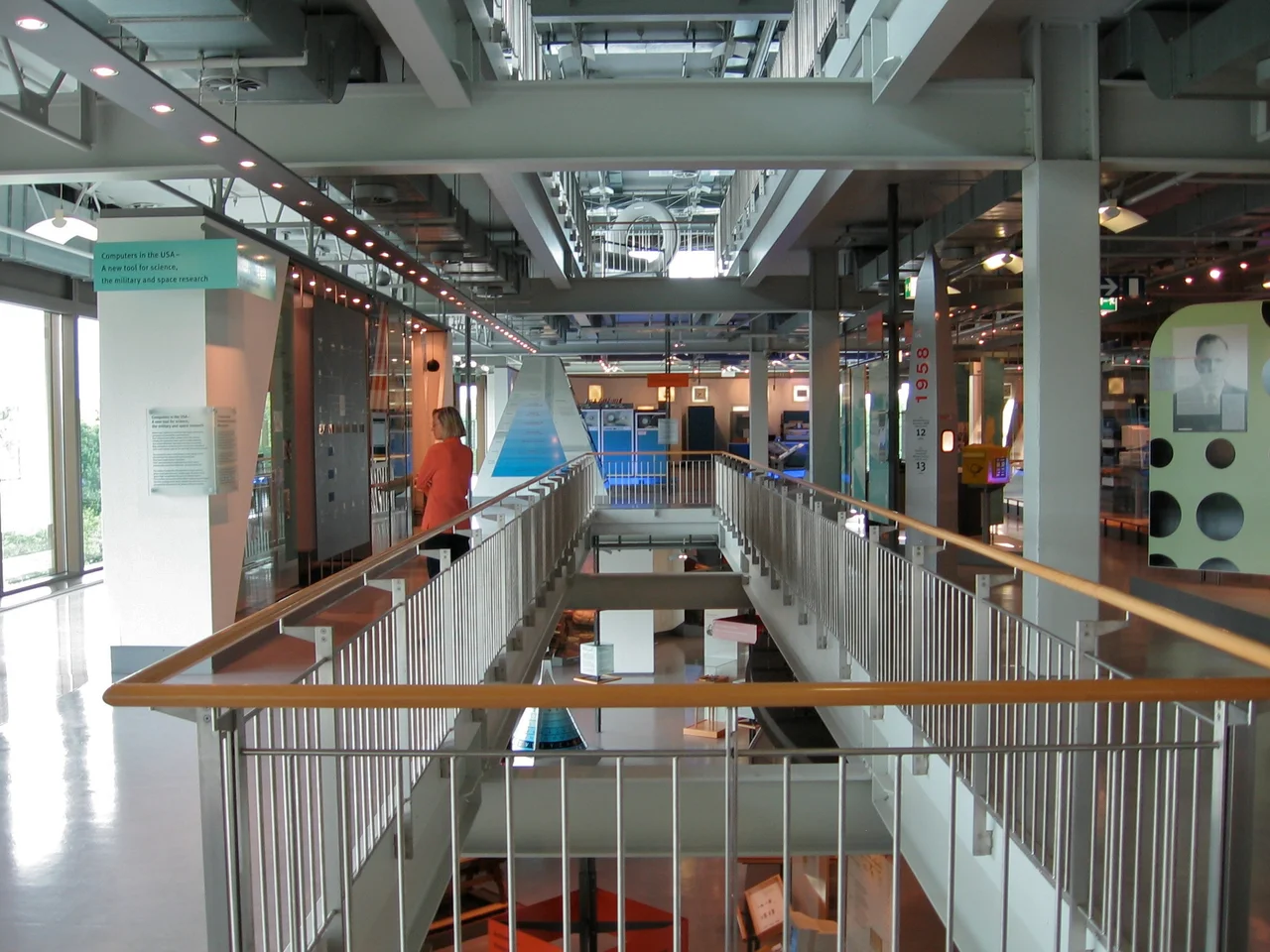
The permanent exhibition does not begin with computers. It begins in Mesopotamia around 3000 BC, with the invention of writing - the first technology for getting information out of a human head and into storage - and works forward from there through counting devices, mechanical calculation, telegraphy and the machines of the war, arriving at the computer only about halfway through. The second half runs from the 1950s to the present: the Internet, artificial intelligence, robotics. Six thousand square metres across two floors, plus space for temporary shows. Presenting five millennia in one building is a bold framing, but it earns its argument, because a visitor who walks the whole thing arrives at a smartphone having watched the same problem being solved for fifty centuries. The institution runs lectures, workshops and conferences on what all of it has done to society, and parts of the collection are searchable in an online database. It draws an average of more than 110,000 visitors a year.
A Fifteen-Minute Walk
There is something quietly pleasing about where this ended up. Paderborn's other defining building sits about a kilometre and a half southeast: a cathedral whose predecessors burned down in 1000, 1058 and 1133, holding relics carried up from Le Mans in 836 and a crypt from around 1100. Between the two you can walk in a quarter of an hour, from the oldest information technology anyone in this valley had - stone, relic, script, a bell tower telling a town what time it was - to a hall of machines that made those functions instant and invisible. The museum carries the name of a local man who died before it opened, in a city better known for a saint's bones. Both buildings are in the business of keeping things that would otherwise be lost.
From the Air
The Heinz Nixdorf MuseumsForum stands at 51.731N, 8.736E on the northwestern side of Paderborn in eastern North Rhine-Westphalia, in the Fuerstenallee area near the university. It is a large, low, flat-roofed modern block without much drama from above; the reliable visual anchor is Paderborn itself, whose 93-metre cathedral tower dominates the old centre about 1.5 km southeast, with the springs of the Pader - a river only 4 km long, rising from more than 200 karst springs beside the cathedral - marking the historic core. Paderborn Lippstadt (EDLP) sits just southwest of the city and makes this an easy low-level target at 1,500-2,500 ft; Dortmund (EDLW) lies west, Hanover (EDDV) northeast and Kassel-Calden (EDVK) southeast. Terrain is gentle, but the Eggegebirge ridge runs north-south a short way east of the city and picks up cloud, so watch for lowering ceilings on easterly flow.
Nearby Stories
- Möhne Reservoir 2.6 km away
- Battle of Villinghausen 13 km away
- Bad Iburg 15 km away
- Hamelin 17 km away
- Halle (Westfalen) 18 km away
- Eresburg 18 km away
- Princely Abbey of Corvey 19 km away
- Hercules Monument 27 km away