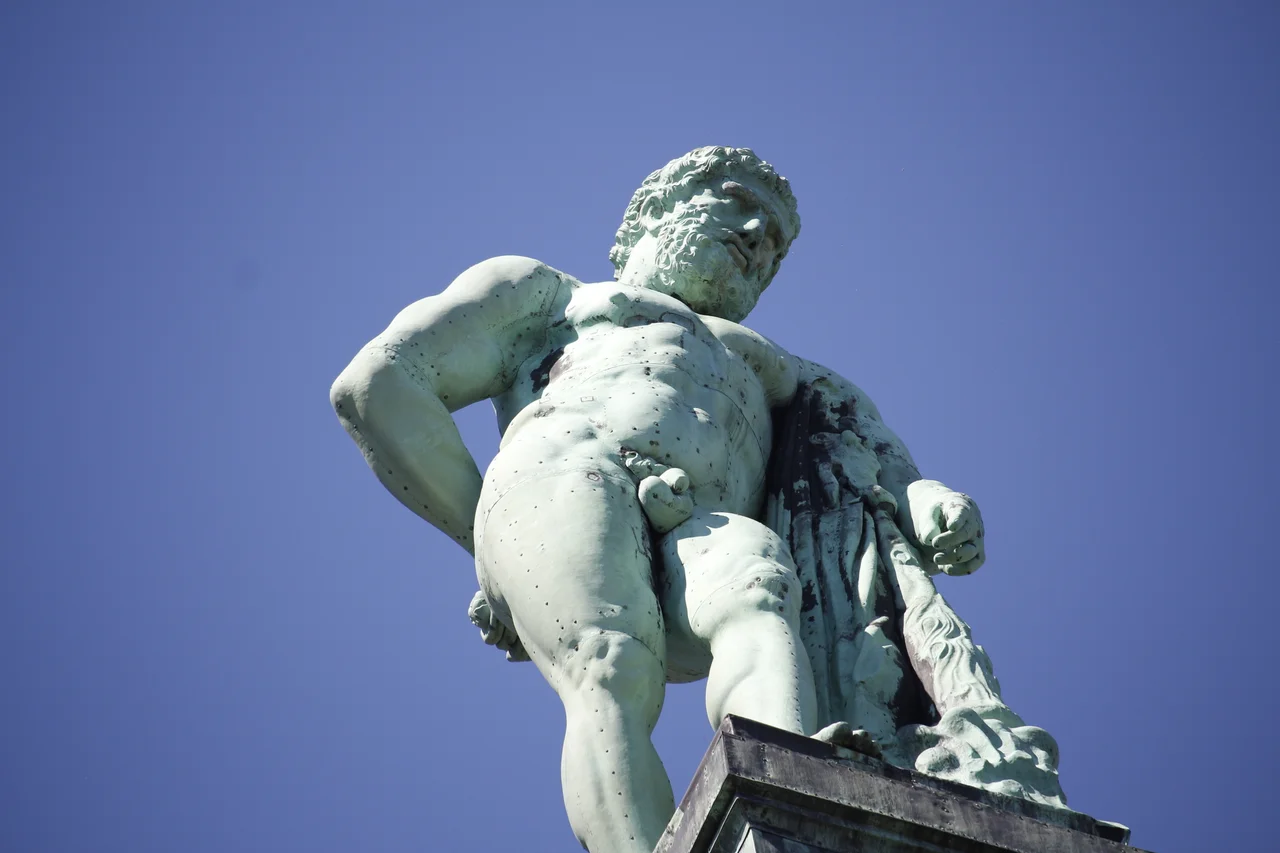

Hercules Monument
It was built out of the wrong stone. The masons used tuff - compacted volcanic ash, quarried from the hills around Kassel - because tuff is soft, cuts fast and takes detail beautifully, all of which matters enormously when the commission in front of you is the size of a small mountain. Tuff also drinks water, and water expands when it freezes. Every winter since 1717 has taken a little more of the Hercules monument away. The most recent campaign of repair started in late 2005 and was supposed to be finished by 2009; the estimate climbed past 30 million euros, and work on the cascades was finally finished in 2019, but the interior of the Octagon - found to be more damaged than first assessed - is still under repair, with a target completion in late 2026. An entire generation has climbed this hill to look at a colossus wearing scaffolding.
Guerniero's Stack
What Kassel calls Hercules is really three structures balanced on one another, built at different times and now spoken of as one thing. At the bottom is the Octagon, a squat eight-sided mass of stone 32.65 metres high. On top of that sits a stone pyramid, 29.60 metres. And on top of the pyramid stands the copper figure of Heracles, 8.25 metres from foot to head - taller than a two-storey house, and reduced by everything beneath him to something that looks, from the city, like a toy soldier on a wedding cake. Total height: 70.5 metres. The design came from the Italian architect Giovanni Francesco Guerniero, who set out the whole scheme in an engraved volume published at Kassel in 1706 under the title Delineatio Montis - the delineation of the mountain, which is a fair description of the ambition. The statue itself was made between 1701 and 1717.
Five Hundred and Twenty Steps
That is the number, and it is worth sitting with before you start. The stair runs up inside the masonry, and it is a genuine climb rather than a gesture at one - the sort of ascent where the temperature drops, the noise of the park falls away below, and you begin to understand how much stone is stacked over your head. The monument stands in an artificial dell cut into the Karlsberg, whose summit reaches 526 metres, at the western and highest end of the great sightline that runs down to Schloss Wilhelmshöhe. Come out at the top and Kassel is spread out beneath you to the east, the ridge of the Habichtswald falls away west into forest, and directly below your feet the ground drops 179 metres to the foot of the cascades. On a clear day the view runs to the far edge of North Hesse.
The Repair That Would Not End
The tuff of the Octagon and the cascades came out of quarries nearby, and its virtues and its flaws are the same property: it is soft. Softness made the thing buildable in a single lifetime. Softness also means that rain soaks in, freezes, and levers the surface apart flake by flake, season after season, and three centuries of that has been a structural problem rather than a cosmetic one - the statue included. The restoration begun in 2005 turned into one of the longest running conservation projects in Germany, with a target date that has now slipped by close to two decades and a budget that grew well beyond its original estimate. Photographs from 2006, 2007 and 2011 all show the same thing: a demigod in a cage of steel tube, or shrouded entirely. It is a peculiarly honest monument. It has spent much of its life being visibly held together.
A Hero for a Landgrave
Nobody puts Heracles on a mountaintop by accident. In the Baroque courts of Europe the labours of Hercules were the standard vocabulary of princely virtue: strength used well, monsters put down, order imposed on chaos - exactly the qualities a landgrave of Hesse-Kassel wished to be understood as possessing. German scholarship on the monument still discusses it under that heading, the hero of virtue and the ideal of the ruler. The geometry makes the argument explicit. The figure stands at the highest point of a straight line that ends at the palace, so that the demigod and the prince occupy the same axis, with the prince rather pointedly below. Whatever was intended, the city took the figure for its own: Hercules is Kassel's landmark, the thing on the postcards, the shape people picture when they hear the name. In 2013 UNESCO inscribed the monument and the park around it as a World Heritage Site.
The Valve at the Top
There is one more thing the monument does, and it is the reason it stands exactly where it stands. On display days between May and October, the water that pours down the hillside of the Bergpark starts here, at Hercules's feet, and goes the entire distance to the lake without a pump touching it. The colossus is the head of the system as well as its crown - a statue that doubles as a reservoir tap. It has watched a Napoleonic king take up residence below it, a Prussian annexation end the dynasty that raised it, an emperor of France arrive as a prisoner, two world wars, and fifteen years inside a scaffold. The copper is green now and the tuff underneath keeps needing attention. Three hundred years on, he is still up there.
From the Air
The Hercules monument stands at 51.316°N, 9.393°E, on the eastern crest of the Habichtswald ridge west of Kassel, with its base at 515 metres and the top of the statue therefore around 585 metres above sea level - a real obstruction on a ridgeline, worth planning height for rather than around. It is the single most useful visual reference in North Hesse: a pale masonry mass standing clear of the treeline, with the straight cut of the cascades running downhill east from it, past the pale block of Schloss Wilhelmshöhe, and pointing directly at the centre of Kassel about 8 km away. From 3,000-4,000 ft the axis is unmistakable and makes an excellent inbound line for the city. Kassel-Calden (EDVK) is roughly 10 km north; Frankfurt (EDDF) and Hanover (EDDV) are the alternates. Westerly wind over the ridge produces mechanical turbulence and rotor on the lee side, and the crest can be in cloud while Kassel below is clear.
Nearby Stories
- Gänseliesel 7.1 km away
- Reinhardswald 14 km away
- Niederhagen concentration camp 15 km away
- Marburg 18 km away
- Stadtallendorf 26 km away
- Observation Post Alpha 29 km away
- University of Göttingen 33 km away
- Arnsberg Forest Nature Park 35 km away