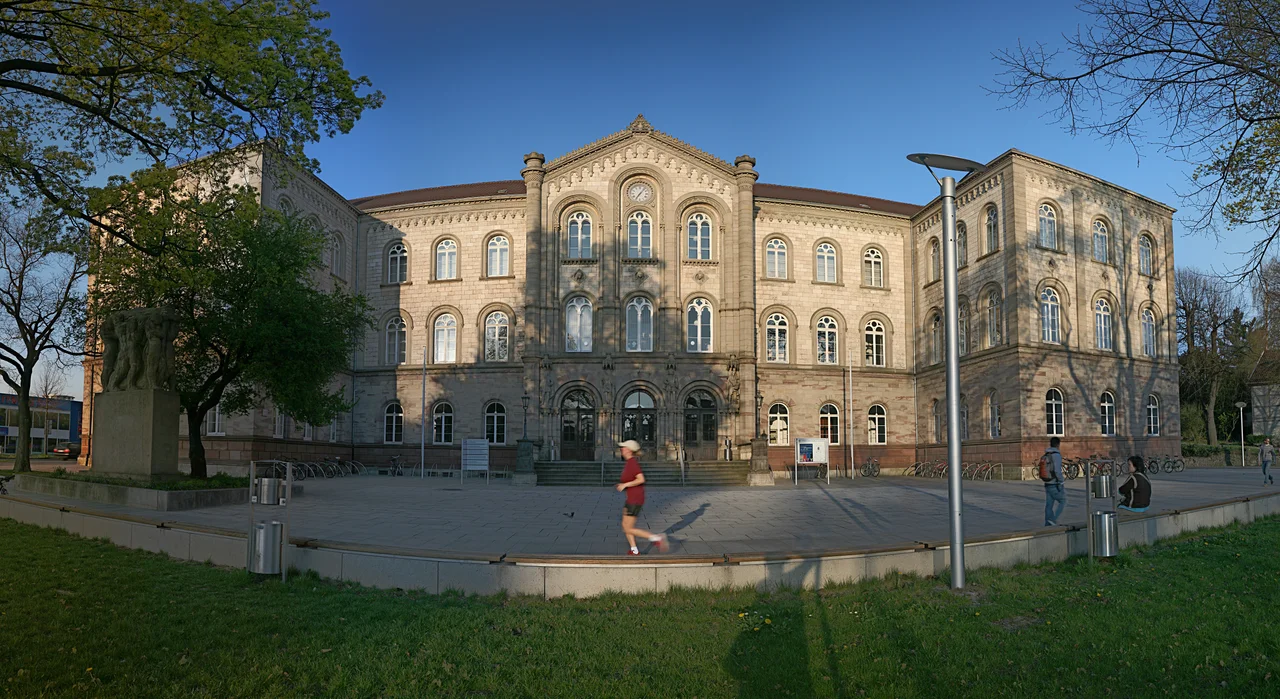

University of Göttingen
At a dinner in 1934, the Nazi education minister Bernhard Rust turned to David Hilbert and asked how mathematics was faring in Goettingen now that it had been freed of Jewish influence. Hilbert, by then the most famous mathematician in Germany, told him there was no mathematics in Goettingen any more. It was not a debating point. Within about a year the faculty that had drawn students from every continent had been dismissed, driven abroad, or frightened into silence, and a two-hundred-year run as one of the intellectual centres of the world had been shut down by its own government.
A King's Enlightenment Project
The university exists because a British king wanted one. George II, who was also Elector of Hanover, instructed his Hanoverian first minister Gerlach Adolph von Muenchhausen to found a university at Goettingen in 1734 that would spread the ideas of the Enlightenment; teaching began in 1737. The physical plant was thin to the point of comedy. The new institution owned a riding hall and a fencing house, and lectures were held in the Paulinerkirche, in a former Dominican monastery, or in professors' front rooms. No proper lecture hall was built until the nineteenth century. What it had instead was licence. Georg Christoph Lichtenberg held one of the first German chairs in experimental physics from 1769 to 1799, and by 1812 the library had passed 200,000 volumes, which mattered more than any building.
Law, Bismarck's Cottage, and the Seven
For its first century Goettingen was a law school with a university attached. Johann Stephan Puetter taught public law here for fifty years, and among the young men taking notes were Metternich, the future Austrian chancellor, and Wilhelm von Humboldt, who would later build the university in Berlin. Heinrich Heine took his doctorate in law here in 1825. Bismarck arrived to study law in 1833 and lived in a small house out on the rampart - tradition holds that his rowdiness had got him barred from lodging inside the walls. By the centenary in 1837, law students were often more than half the enrolment. That was also the year the university broke. King Ernest Augustus revoked Hanover's liberal constitution of 1833, seven professors protested, and all seven were expelled: Albrecht, Dahlmann, Ewald, Gervinus, the physicist Wilhelm Eduard Weber, and Jacob and Wilhelm Grimm, who were in the middle of compiling the first dictionary of the German language.
Where the Mathematics Was
Carl Friedrich Gauss, called the Prince of Mathematicians, studied at Goettingen and spent his working life there, and the chair passed after him to Dirichlet and then to Bernhard Riemann. By 1900 David Hilbert and Felix Klein had turned the place into a destination: if you wanted to do serious mathematics you went to Goettingen, and much of the world did. In 1903 the university had 121 teaching staff and 1,529 students, a village-sized institution with global gravity. Ludwig Prandtl arrived in 1904, worked out the boundary layer and made Goettingen the centre of the new science of aerodynamics. Edmund Husserl taught philosophy here. Max Born ran the theoretical physics group from 1921 to 1933 and was one of the three discoverers of non-relativistic quantum mechanics. Americans had been making the pilgrimage for a century - Edward Everett, George Ticknor, George Bancroft, John Lothrop Motley - and Robert Oppenheimer took his doctorate here under Born.
The Great Purge
In 1933 the campaign against what the regime called Jewish physics reached Goettingen, and the faculty was taken apart within months. Max Born, James Franck, Victor Goldschmidt, Eugene Wigner, Leo Szilard, Edward Teller, Edmund Landau, Emmy Noether and Richard Courant were dismissed or left before they could be. Behind each name is a household broken up and a life restarted in a language its owner had not expected to need. Emmy Noether, whose work reshaped modern algebra, sailed for the United States; James Franck, already a Nobel laureate in physics, went too. Most went to America, Canada and Britain, where several of them - Szilard, Wigner, Teller, and Born's student Oppenheimer - went on to build the atomic bomb for the countries that took them in. Hilbert's remark to the minister was not bitter wit. It was an accurate report.
What Came Back
Goettingen was the first university in the western occupation zones to reopen, under British control, in 1945, and it rebuilt into something substantial rather than something legendary. Jurgen Habermas studied here; so did Richard von Weizsaecker, later President of Germany, and Gerhard Schroeder, later Chancellor, and Ursula von der Leyen, who read economics and met her husband in the town. Today there are thirteen faculties and around 22,500 students, plus a dense ring of Max Planck and Leibniz institutes that makes the whole town function as one campus. The State and University Library holds roughly nine million items. The university counts 47 Nobel laureates among its affiliates. And when a new doctor is made, they are still pulled through the streets in a flower-covered cart to kiss the Gaenseliesel in the market square, beneath a Latin motto inscribed at the entrance to the town hall cellar: there is no life outside Goettingen, and if there is life, it is not life like this.
From the Air
The central university complex sits at 51.534 degrees north, 9.938 degrees east, immediately north of Goettingen's old market square. From the air the town is unusually legible: a compact medieval core ringed by the Wall, a continuous tree-planted earth rampart that draws a green oval roughly a kilometre across, with the Leine river along its western side. The old university buildings cluster inside the northern arc of that oval and around Wilhelmsplatz; the post-war science quarter, chemistry, physics, biology and the university medical centre, is the larger modern block on open ground just north of the ring. Best viewed at 1,500 to 3,000 ft AGL to hold the whole oval in frame. Kassel-Calden (EDVK) lies about 40 km south-west, Hannover (EDDV) roughly 105 km north, Paderborn-Lippstadt (EDLP) some 90 km west. The wooded ridges of the Hainberg east of town and the Leine valley to the west generate morning fog in autumn that usually burns off by late morning.
Nearby Stories
- Bergpark Wilhelmshöhe 6.5 km away
- Irminsul 15 km away
- Mittelbau-Dora Concentration Camp 15 km away
- Royal Palace of Werla 20 km away
- Princely Abbey of Corvey 21 km away
- Reich Harvest Thanksgiving Festival 23 km away
- 1st German Bratwurst Museum 30 km away
- Memorial and Education Centre Andreasstraße 51 km away