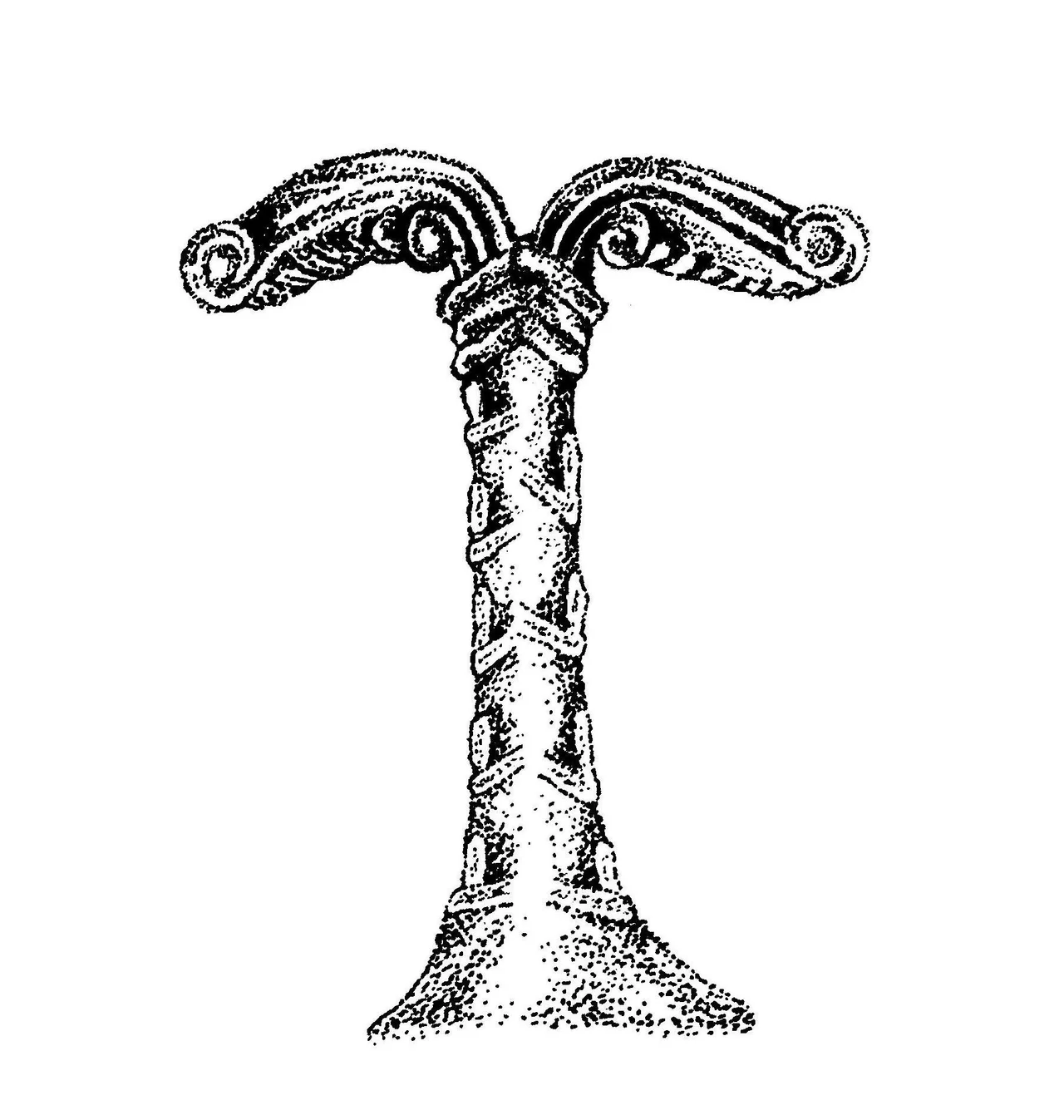

Irminsul
A stone column was dug out of the ground at Obermarsberg during the reign of Louis the Pious, carted to Hildesheim Cathedral, and set up inside as a candelabrum. Records from Hildesheim between the ninth and thirteenth centuries treat it as a trophy: this was the thing the Saxons had bowed to, now holding candles for the God who replaced it. Nobody today can say whether it was the Irminsul or a piece of Roman spolia that suited the story. That is roughly the state of the evidence for the most famous object in Saxon paganism — everything about it is secondhand, and most of it was written by the people who destroyed it.
772
The oldest account is a single entry in the Royal Frankish Annals. In 772, at the opening of what became more than thirty years of Saxon Wars, Charlemagne's army took the Saxon stronghold at Eresburg — modern Obermarsberg, on a plateau above the Diemel — and destroyed the Irminsul.
The wars that followed were fought to make Saxony Christian and Frankish, and they were fought without much restraint on either count. Destroying the pillar was not incidental damage; it was the point. You break the thing people gather around, and the gathering stops. Jacob Grimm, working nine centuries later, doubted the location and argued for a site some fifteen miles off in the Teutoburg Forest. The argument has never been settled, because there is nothing to settle it with. No excavation has produced the Irminsul, and none is likely to. It was made of wood.
A Great Pillar Under the Open Sky
What it was comes almost entirely from Rudolf of Fulda, writing around 865 in De miraculis sancti Alexandri, nearly a century after the fact. He describes a great wooden pillar, erected and worshipped in the open air, and glosses the name as the universal, all-sustaining column. Widukind of Corvey, around 970, describes the Saxons raising an Irminsul after a victory in 531 and representing their god of victory as a wooden column. The twelfth-century Kaiserchronik mentions Irminsuls three times, by then thoroughly confused with classical idols.
The name itself is Old Saxon: Irminsûl, great pillar. The first element connects to Old Norse Jörmunr, one of Odin's many alternate names, and Grimm linked it to words like iörmungrund, the great ground. Whether the Saxons understood the pillar as a world-tree, a boundary marker, a war memorial, or all three at once, they left no explanation of their own. Everything we have was written by outsiders, for readers who already knew how the story ended.
The Chair That Became a Symbol
In 1929 a German lay archaeologist named Wilhelm Teudt looked at the medieval relief carved into the Externsteine rocks near Detmold — a Descent from the Cross — and identified a bent shape at Nicodemus's feet as an Irminsul, drooping in defeat. He published a straightened-up version of the shape: a column with two curling arms. It was a drawing, not a discovery.
It spread anyway. Teudt went on to join the Ahnenerbe, the SS research organisation set up to supply the regime with a Germanic antiquity that suited its racial politics, and his symbol became part of that manufactured heritage. It survives today in neopagan use and, less pleasantly, in far-right iconography. The scholarly verdict has gone the other way. Bernard Mees, among others, rejects the reading entirely and interprets the carved object as what it plainly appears to be in context: an elaborate chair.
Irmenseul, 1996
This particular point on the map is not Eresburg. It is a village in the hills south of Hildesheim, in Lower Saxony, whose name — Irmenseul — has carried the word for centuries with no evidence that the pillar ever stood here. Place-names travel. So do claims.
In 1996 the village put up an Irminsul of its own, a modern pillar carrying the sun cross from the local coat of arms. It is a small monument to a large absence, and it is honest about being a reconstruction of something nobody has seen. Standing next to it, the question that lingers is not what the original looked like. It is how thoroughly a thing can be erased and still refuse to go away — destroyed in 772, described a century later by a monk who never saw it, invented afresh in 1929 by a man with an agenda, and raised again in a village that simply likes its name.
Reading the Gap
There is a lesson in the Irminsul that has nothing to do with paganism. Almost everything known about pre-Christian Saxony survives only in the accounts of the people who ended it, filtered through a further century or two of copying, and then interpreted by later generations with agendas of their own.
That gap is where mythmaking lives. The nineteenth century filled it with romantic nationalism, the 1930s with something far worse, and the internet has filled it again. The Saxons who gathered at the pillar are the one group in the story with no voice at all. They were not symbols or precursors or evidence for anybody's theory. They were people with a place they went to, and in 772 an army came and took it away from them.
From the Air
The coordinate here — 51.9805°N, 9.9377°E — marks the village of Irmenseul in the hills south of Hildesheim, Lower Saxony, not the Eresburg site where the pillar was destroyed, which lies roughly 100 km to the south-west at Obermarsberg. From 1,500–3,000 ft this is soft country: low wooded ridges of the Hildesheimer Wald and Vorharz separated by open arable valleys, small red-roofed villages, and no dramatic feature to lock onto. Bad Gandersheim is 13 km south, Hildesheim 19 km north, Einbeck 19 km south-west, and the Harz escarpment rises 30 km to the east with the Brocken beyond. Nearest airfields: Hildesheim (EDVM) about 22 km north, Hannover (EDDV) about 56 km north-west, Braunschweig-Wolfsburg (EDVE) about 57 km north-east, Kassel-Calden (EDVK) about 74 km south-west. Terrain is modest, but the Leine and Innerste valleys hold fog and low stratus through the colder half of the year.
Nearby Stories
- Royal Palace of Werla 11 km away
- Holzminden prisoner-of-war camp 13 km away
- GEO600 15 km away
- Bad Nenndorf Interrogation Centre 16 km away
- University of Göttingen 17 km away
- Mittelbau-Dora Concentration Camp 21 km away
- Wolfsburg 29 km away
- Bergpark Wilhelmshöhe 41 km away