.JPG)
Mittelbau-Dora Concentration Camp
On 28 August 1943, one hundred and seven prisoners were unloaded at the foot of the Kohnstein, a gypsum hill outside Nordhausen in Thuringia. They had come from Buchenwald, about sixty-five kilometres to the south, and they had been sent to dig. There were no barracks waiting, no huts, no washhouse. For the next eight months the prisoners of Dora lived inside the tunnels they were cutting, in side galleries fitted with bunks stacked four high, breathing the dust of their own blasting. Many of them never saw daylight again.
Ten Days After Peenemünde
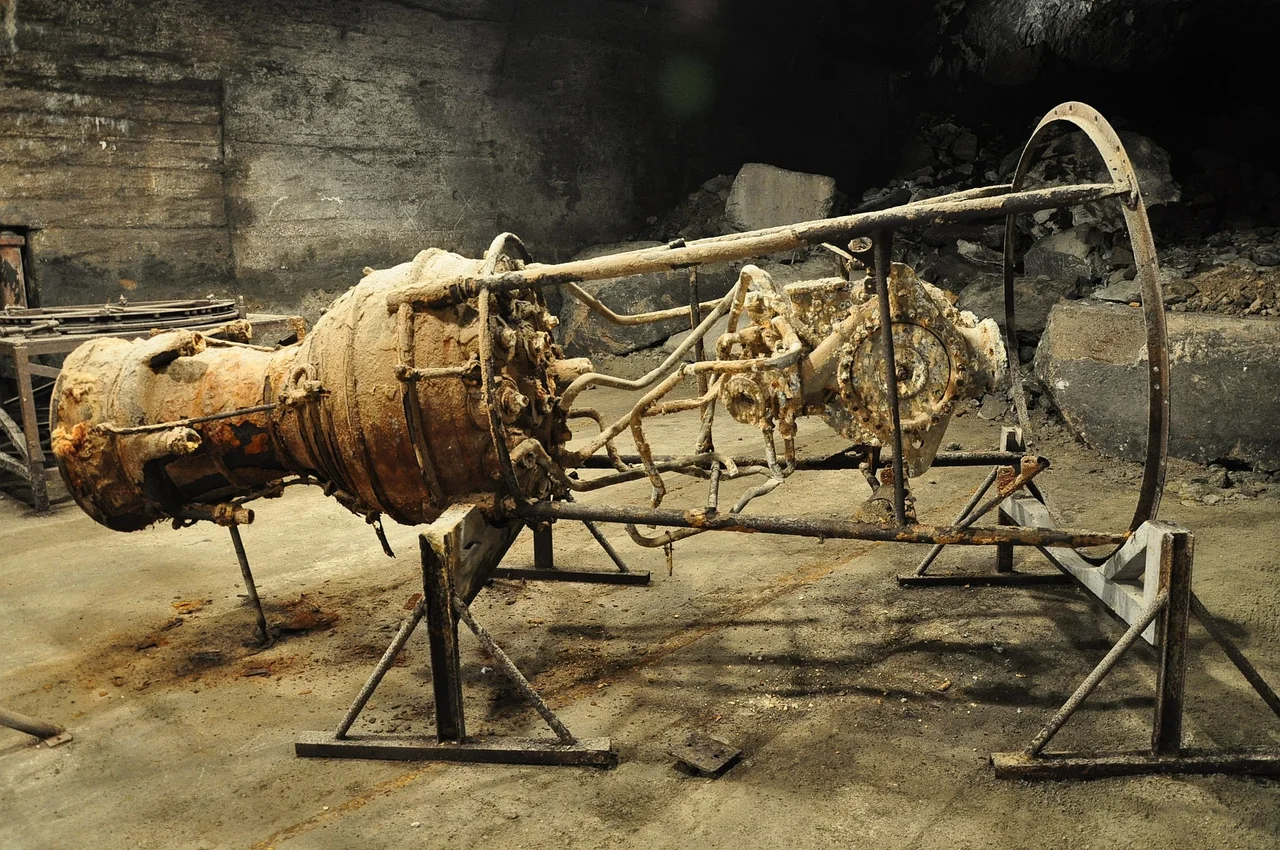
The reason for their arrival lay on the Baltic coast. On 18 August 1943, RAF Bomber Command struck the army research centre at Peenemünde in Operation Hydra and wrecked the plant where the A4 ballistic rocket - soon renamed the V-2, from Vergeltung, retribution - was being readied for mass production. Air raids had already damaged the two other assembly sites, the Raxwerke in Austria and the Zeppelin works at Friedrichshafen. The response was to go underground. Since 1936 a state company had been driving tunnels into the Kohnstein for a fuel depot, and the galleries were nearly finished. Ten days after the Peenemünde raid, the first prisoners arrived to extend them. For the SS construction chief Hans Kammler, the project became a matter of prestige. For everyone sent to build it, it became something else.
Inside the Mountain
The population climbed fast: more than 3,000 by late September 1943, 6,800 by late October, over 10,500 by Christmas. Shifts ran fourteen hours. There was no adequate food, no proper sanitation, no clean water, no relief from the cold and the noise and the ammonia stink of the sleeping tunnels. Men died of dysentery, tuberculosis, exhaustion, and injury, and the sick were not treated so much as removed - around 5,000 of them were shipped out to Lublin and to Bergen-Belsen, which for most amounted to a change of place to die. The prisoners came from across occupied Europe, and by the war's late stages included survivors evacuated from the extermination camps in the east. Yves Béon, a French survivor, later gave his memoir a title that needed no explanation: Planet Dora.
The Arithmetic of the Rocket
Around 60,000 prisoners passed through the Mittelbau camps between August 1943 and March 1945. The SS files recorded roughly 12,000 dead, and an unknown number of unregistered prisoners died or were murdered on top of that; historians place the true figure far higher, at roughly one in three of everyone sent there. Some 350 people were hanged, about 200 of them accused of sabotaging the rockets they were forced to assemble. After SS personnel from Auschwitz transferred in, the executions accelerated brutally - thirty in a day, on one occasion fifty. Between January and April 1945 the underground factory turned out at least 1,700 V-2s and more than 6,000 V-1s. The V-2 killed roughly five thousand people in the cities it fell on. Several times that number died making it. The rocket was more lethal to the people forced to build it than to the people it was aimed at.
April 1945
The end came violently for everyone in the valley. On 3 and 4 April 1945, RAF Lancasters and Mosquitos attacked Nordhausen in two waves and destroyed around three-quarters of the town, hitting the medieval centre hardest; of 40,000 inhabitants, roughly 8,800 died and 20,000 lost their homes. Among the dead were an estimated 1,300 to 1,500 Mittelbau prisoners held at the Boelcke-Kaserne. As American troops pushed into the Harz, the SS emptied the camps in haste, forcing prisoners into box cars bound for Bergen-Belsen, Sachsenhausen, and Ravensbrück, or driving them on foot into the hills and shooting those who fell behind. At Gardelegen, more than a thousand prisoners from Mittelbau and Neuengamme subcamps were locked in a barn that was set alight; those who escaped the fire were shot. US troops reached Dora on 11 April 1945. War correspondents filmed and photographed the dead and the dying, and those images went around the world.
Two Kinds of Reckoning
The Dora Trial opened at Dachau on 7 August 1947 against nineteen defendants; fifteen SS men and Kapos were convicted, one of them executed, and four were acquitted. Georg Rickhey, who had run the Mittelwerk, was acquitted. The engineers took a different road. Arthur Rudolph, the plant's production director, and Wernher von Braun - who acknowledged in later testimony that he had visited the underground factory more than a dozen times - were among several dozen Mittelwerk specialists hired by the United States government, first for missiles and jets and then for the space programme, where Rudolph managed the Saturn V. The Soviets recruited others. Meanwhile the site itself was erased: the huts were pulled down for building material, the tunnel entrances blown up in 1947, and the camp prison demolished in 1952 over the objections of former prisoners. East Germany never granted Dora national memorial status. Today the ground is a memorial and museum, and the tunnels can be entered again.
From the Air
The Mittelbau-Dora memorial lies at 51.535°N, 10.749°E, roughly 5 km northwest of Nordhausen in northern Thuringia. The defining feature is the Kohnstein itself, a pale gypsum hill scarred by quarrying that stands out sharply against the surrounding farmland and woods - the tunnel system runs through it. Nordhausen sits immediately southeast; the southern edge of the Harz uplands rises to the north, with the Brocken about 30 km north-northwest at 1,141 m. Best viewed at 2,000-4,000 ft AGL, where the quarry faces and the memorial grounds are both legible. Nearest field is Erfurt-Weimar (EDDE), about 65 km south; Leipzig/Halle (EDDP) lies roughly 95 km east-southeast and Kassel Calden (EDVK) about 85 km west. As with the whole Harz margin, expect ridge cloud and low visibility on the northern side even when the plain below is clear.
Nearby Stories
- Ströbeck 17 km away
- Memleben Abbey 19 km away
- University of Göttingen 19 km away
- Eisleben 22 km away
- Irminsul 23 km away
- Opfermoor Vogtei 27 km away
- Kulturhistorisches Museum Magdeburg 40 km away
- Kassel 49 km away