
Ströbeck
The village crest is a chessboard. Sixty-four squares in black and silver, tipped onto one corner against a red field, granted by the provincial authorities in November 1937. Heraldry is rarely this literal. But Ströbeck, a farming village of about a thousand people in the northern Harz foothills eight kilometres west of Halberstadt, has never been shy about the thing it is known for. The game is on the school timetable. It is in the museum, on the emergency banknotes the village once printed, and in the name the place gives itself: Schachdorf, the chess village.
The Prisoner in the Wartturm
The origin story is a good one, and it is a legend. Around 1011, so the telling goes, Bishop Arnulf of Halberstadt locked up Gunzelin of Kuckenburg - the deposed Margrave of Meissen - in a tower here called the Wartturm, and handed the job of guarding him to local farmers. Bored out of his mind, the margrave made himself a chess set and taught his jailers to play.
The documented village is older than the legend, and quieter. A place called Strebechi appears in 995, when King Otto III granted the estate in the Eastphalian Harzgau to his sister Adelaide, Abbess of Quedlinburg. In 1004 his successor Henry II passed it to Drübeck Abbey. Ströbeck was a fief of the Bishopric of Halberstadt, later held by the Counts of Regenstein, and from 1343 by the Counts of Wernigerode. Tithes, harvests, inheritance disputes. Nothing at all about a game.
A Peasants' Game in an Age of Princes
Chess enters the written record in a deed of 1515, and what startles is not the date but the players. Everywhere else in Europe, chess at that point belonged to nobles and clergy - a courtly accomplishment, learned alongside falconry and verse. In Ströbeck it was already a village habit, something farmers did after the fields.
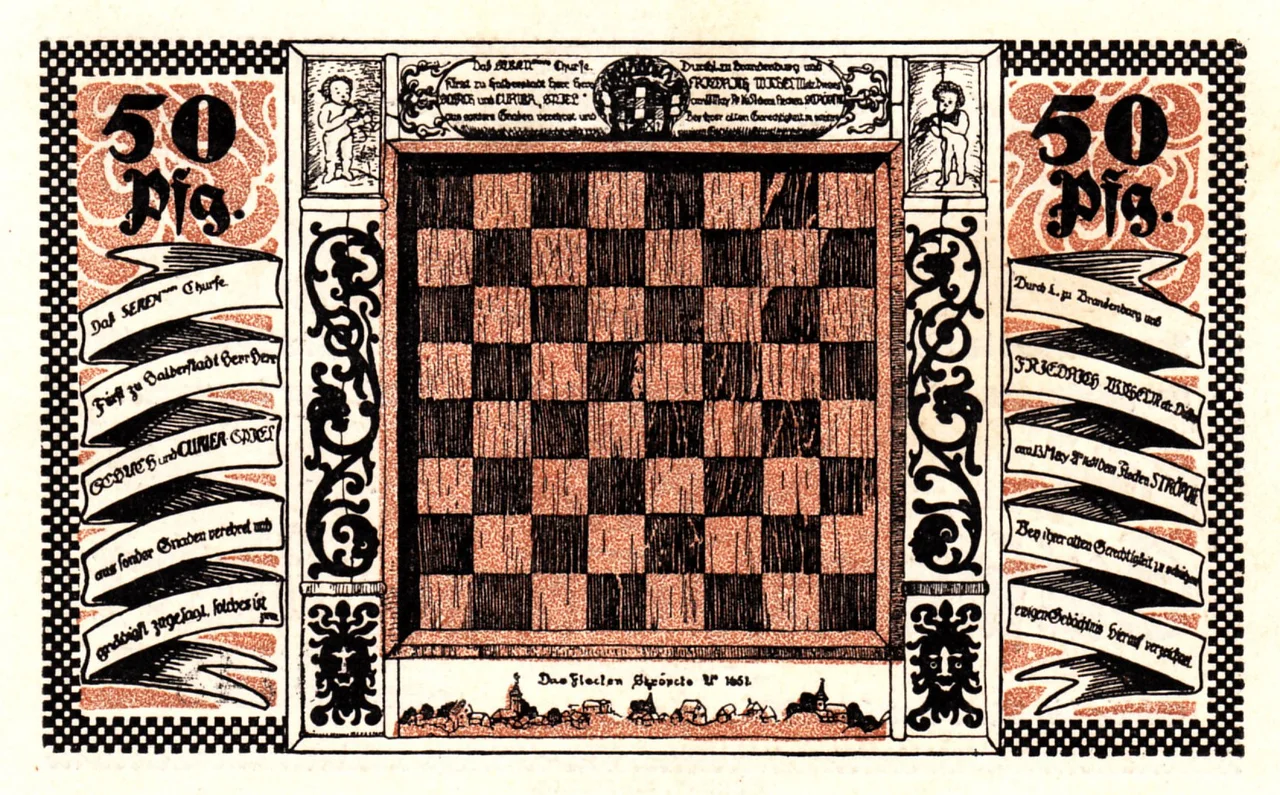
Word travelled. Duke Augustus the Younger of Brunswick-Lüneburg, writing under the pen name Gustavus Selenus, gave the village its own chapter in his 1616 book Chess or the King's Game. In 1651 Frederick William, the Great Elector of Brandenburg, came through on an inspection tour and left the villagers a board as thanks for their skill: eight squares by twelve on one face, the standard eight by eight on the other, together with sets in silver and ivory. It survives in the local museum. Nearly three centuries later H. J. R. Murray gave Ströbeck a place in A History of Chess, the 1913 volume that is still the field's foundational survey.
The Rules They Refused to Give Up
That twelve-by-eight face was not decoration. Ströbeck played Courier chess, a medieval variant on a wider board with extra pieces, long after the rest of Europe had let it go. The village's everyday game had its own stubborn grammar too. Play opened with three pawns and the queen already standing two squares up the board, and from there a pawn could only advance one square at a time. There was no castling. A pawn that fought its way to the far rank could not simply be crowned - it had to hop back to its own starting square in three Freudensprünge, or joy jumps, earning the promotion the long way round. These rules held in Ströbeck until about 1920, which means the village was still playing a recognisably medieval game while the rest of the world had moved on to modern tournament chess.
Chess, Fourth Period
Since 1823 the village school has taught chess as a subject rather than a club, and it remains the only public school in Germany to do so. It is named for Emanuel Lasker, who held the world championship from 1894 to 1921 - the longest reign the title has ever seen. The local secondary school taught chess as well until 2004, when it closed for lack of pupils. Living chess, with costumed players moving as pieces across an outsized board, has been staged here since the late seventeenth century and still is. An international tournament comes round every year. The chess museum opened in 1991, and among its exhibits are the Great Elector's board and several of those twelve-by-eight Courier boards. Grooms traditionally face the village's representative across a board before a wedding, a custom revived in 2007. In 2016 Germany entered Ströbeck's chess tradition in its national inventory of intangible cultural heritage.
What Leaves and What Stays
When shortage forced German towns to print their own emergency money during the First World War, Ströbeck's Notgeld carried chessboards; a fifty-pfennig note from 1921 survives with the pattern across its face. Two men born in this village made their names a long way from the Harz: Edward Salomon, who served as governor of Wisconsin, and Frederick Salomon, a general in the American Civil War. Ströbeck itself stopped being an independent municipality on 1 January 2010, folded into the town of Halberstadt along with dozens of other small places across Saxony-Anhalt. The administrative line moved. The chess did not.
From the Air
Ströbeck lies at 51.917 N, 10.950 E on the flat, intensively farmed Harz foreland, eight kilometres west of Halberstadt. From 2,500 to 4,000 feet it reads as a compact cluster of red roofs around a church tower, ringed by open fields with little woodland to confuse the eye; Halberstadt's twin-towered Gothic cathedral is the obvious fix to the east, and the dark wooded mass of the Harz rises to the south, with the Brocken - the range's high point at 1,141 m - about 26 km to the southwest. Nearest airfields are Magdeburg-Cochstedt (EDBC), roughly 33 km east, and Braunschweig-Wolfsburg (EDVE), about 52 km northwest; Leipzig/Halle (EDDP) lies some 105 km southeast and Hannover (EDDV) about the same distance northwest. Flying weather here is usually cooperative, but low stratus and winter fog spill off the Harz and can shut the foreland in for days at a time.
Nearby Stories
- Helmstedt–Marienborn border crossing 1.1 km away
- Rothensee boat lift 5.2 km away
- Bombing of Braunschweig (15 October 1944) 6.6 km away
- Goslar 9.1 km away
- Unicorn Cave 11 km away
- Domfelsen 20 km away
- Mittelbau-Dora Concentration Camp 28 km away
- German National Academy of Sciences Leopoldina 33 km away