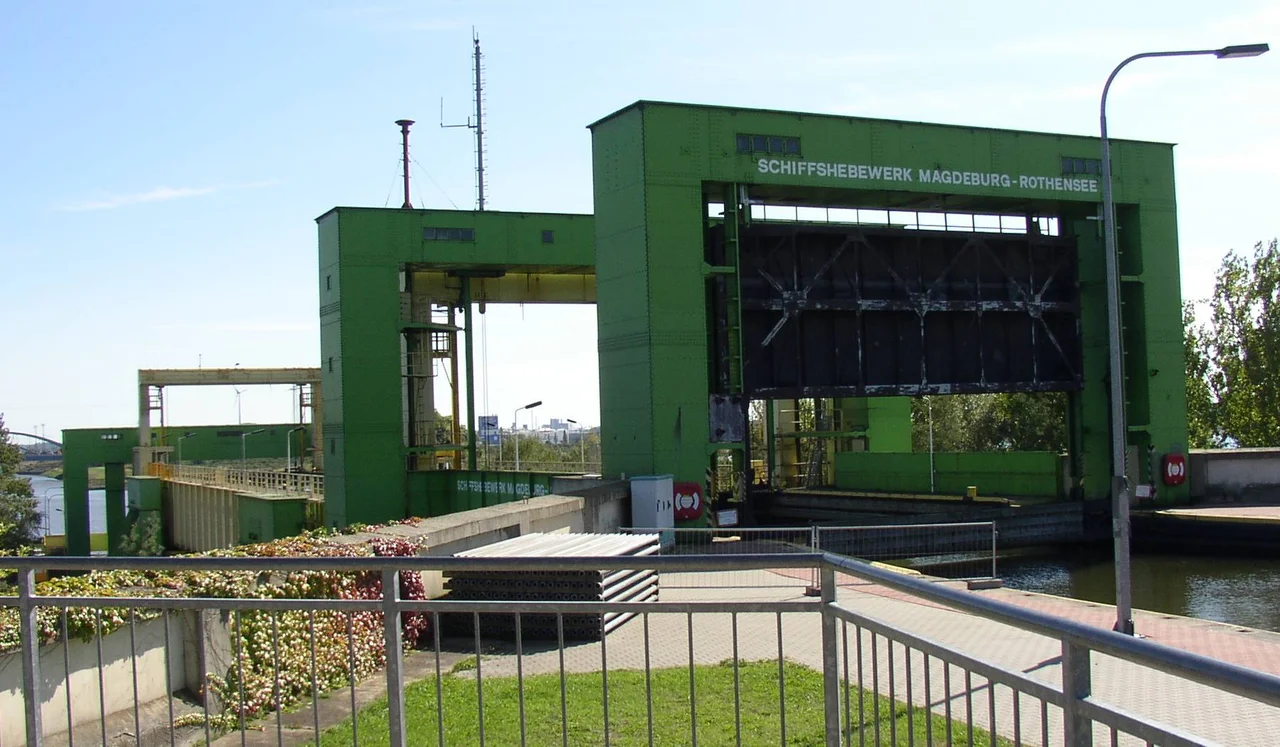

Rothensee boat lift
To sink the shafts, the engineers froze the ground. Each of the two float chambers had to go sixty metres straight down through saturated Elbe-valley sand, and saturated sand at that depth does not stay where you put it, so the whole excavation was chilled to minus forty degrees until it was solid enough to work — four months of waiting before anyone could dig properly. That is the kind of problem the Rothensee boat lift set its builders. Finished in 1938 just north of Magdeburg, at the eastern end of the Mittelland Canal and about 500 metres from where the Rothensee descent canal branches off it, the lift moves ships between the canal and the river Elbe by picking them up in a tank of water and carrying them down. It consumed 225,000 cubic metres of excavated earth and 55,000 cubic metres of concrete. The mechanism that does the actual lifting uses almost no power at all.
Physics Instead of Pumps
The trick is buoyancy. Two cylindrical steel floats, each 36 metres long and 10 metres across, hang in those frozen-and-dug shafts; each is divided internally into three compartments charged with compressed air at a pressure matched to its depth, so that the water pressure outside cannot crush them. Together they supply about 5,400 tonnes of upward force, which is precisely what the trough, its water and whatever ship is floating in it happen to weigh. The whole assembly sits in equilibrium. That means the motors are not lifting anything — they are only overcoming friction — so four worm-geared shafts 27.3 metres long and 42 centimetres thick, turned by eight 44 kW electric motors, are enough to run the entire machine on under 500 kW. Rudolf Mussaeus held the patents behind the design, which applied the same float principle used at the older Henrichenburg lift, here needing only two chambers. The comparison that makes the elegance obvious sits right next door: the modern lock beside it has to back-pump 110 million cubic metres of water every year.
Twenty Minutes, Three of Them Moving
The caisson is 85 metres long and 12.2 metres wide and normally holds 2.5 metres of water. From the floor of the shafts to the upper cross beams the structure stands 97.21 metres, most of it invisible. A standard lift covers about 16 metres, but the Elbe is a river with opinions and its level shifts the drop anywhere between 11 and 18 metres. The travel itself takes three minutes. A boat needs about twenty to get through the whole business, which means the overwhelming majority of the time is spent entering, securing and leaving rather than moving vertically — a ratio familiar to anyone who has worked a lock. In its prime around seventy vessels a day passed through, up to 1,000 tonnes apiece, and in its first fifty years the lift completed 730,000 cycles.
The Half-Built Plan
Rothensee was never supposed to work alone. The design called for the Mittelland Canal to cross the Elbe on an aqueduct and then step down to the Elbe-Havel Canal by way of a twin lift at Hohenwarthe, with Rothensee handling only the local descent into the river. The Second World War stopped everything but the lift. So a machine built for a modest job inherited a national one: with no aqueduct, every barge running from the West German industrial belt to West Berlin had to come down through Rothensee into the Elbe and back up on the far side. It did that for sixty years. The aqueduct was eventually built after reunification, six decades behind schedule, though shaft locks were used at Hohenwarthe instead of the lift that had been drawn there in the 1930s.
Green Paint and a Company Village
A works this size does not run itself, and the people who ran it lived beside it. A company housing colony, the Schiffshebewerk Estate, was built in the neighbourhood while the lift was under construction, so the crews walked to work past the thing they operated. The machinery got its one great overhaul across 1980 and 1981, an eighteen-month strip-down, and that is when it received the green coat of paint it still wears. Green suits it. From below, the lattice of the tower frame and the enormous gear shafts read as something out of an industrial engraving, and the colour keeps it from looking either military or municipal — it looks like a machine that expects to keep going.
Saved
In 2001 a parallel ship lock opened alongside, capable of taking vessels the lift could not, and the older machine became redundant more or less overnight. Operations stopped in late 2006 on cost grounds, and for seven years the lift stood idle while accountants made the obvious case for scrapping it. A local campaign made the other case, and won. On 24 August 2013 the Rothensee boat lift went back into service — not as freight infrastructure any more, but as a listed technical monument, lifting leisure boats and visitors instead of thousand-tonne barges. It is a modest afterlife for a machine that once carried the traffic of a divided country, and a better one than the alternative. The floats are still down there in the shafts, still holding everything in balance.
From the Air
The lift stands at 52.2238°N, 11.6726°E, in the Rothensee district roughly 10 km north of central Magdeburg, on the west side of the Elbe. It is easy to find from the air because the waterways do the work: the Mittelland Canal runs in dead straight from the west, the Elbe curves past to the east, and the short Rothensee descent canal joins them. From 1,000–2,000 ft AGL the lift itself is a tall dark-green lattice tower standing well clear of flat ground, with the newer concrete lock chamber immediately beside it — the two together are unmistakable. The Magdeburg Water Bridge, the aqueduct this lift spent sixty years substituting for, is about 2 km northeast. Magdeburg–Cochstedt (EDBC) lies roughly 48 km southwest, Leipzig/Halle (EDDP) about 100 km south-southeast, and Berlin Brandenburg (EDDB) around 130 km east. The surrounding country is industrial and dead flat, so the tower reads best in low sun when it throws a long shadow across the canal.
Nearby Stories
- Helmstedt–Marienborn border crossing 15 km away
- Inner German Border 18 km away
- Ströbeck 24 km away
- Friesack Camp 26 km away
- All Saints' Church, Wittenberg 29 km away
- Bauhaus Dessau 38 km away
- Holy Blood of Wilsnack 46 km away
- Stones Fan Museum 46 km away