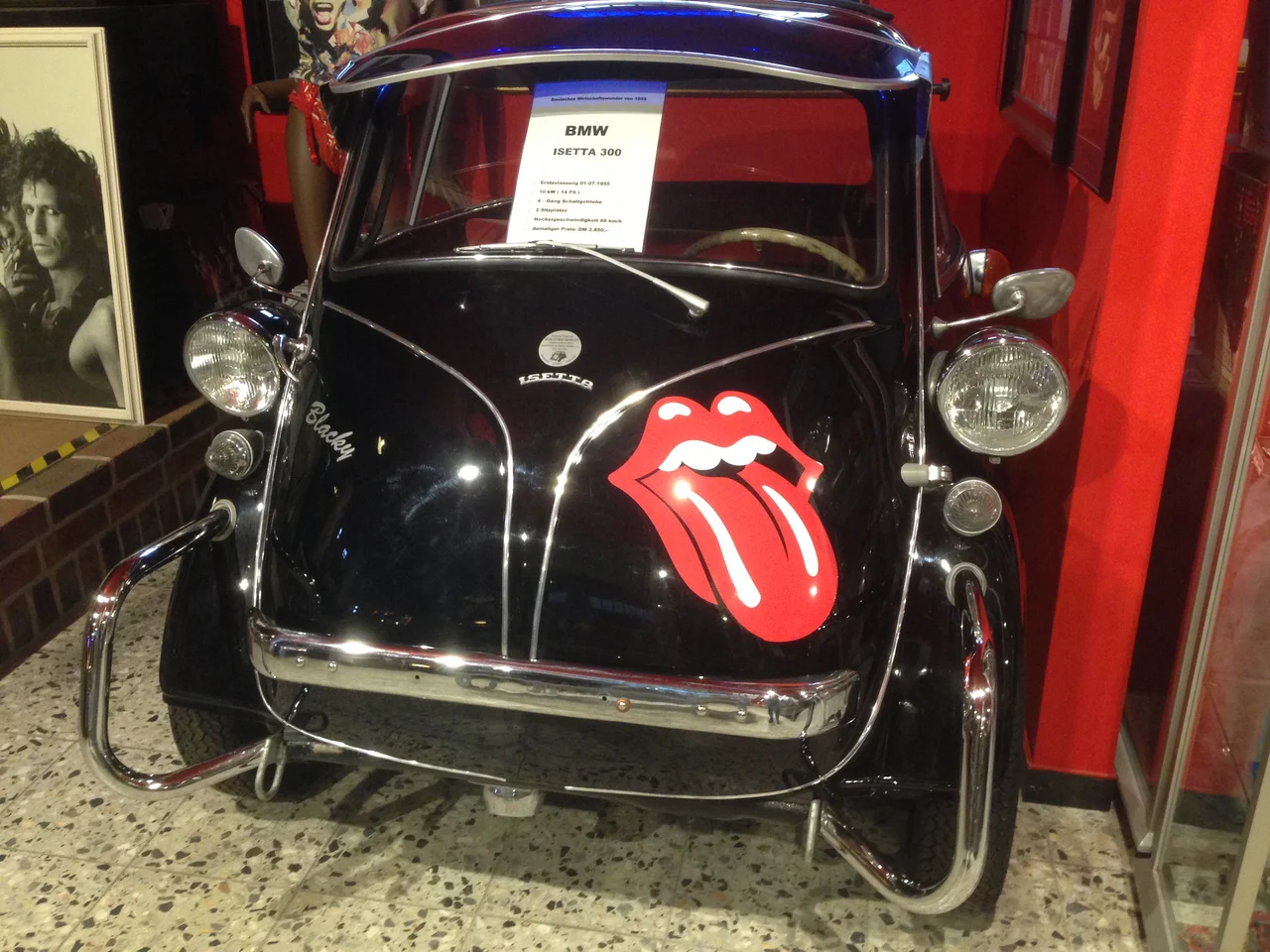

Stones Fan Museum
Ulrich Schröder had to put his own face on the front of the building. That was the deal. A delegation from Universal Records travelled to Lüchow — a small town out in the flat, boggy Wendland of Lower Saxony, nearer the old East German frontier than to any city — for the specific purpose of stopping a retired bank employee from calling his collection The Rolling Stones Museum. Terms were reached. The name became Rolling-Stones-Fan-Museum, later trimmed to Stones Fan Museum, and Schröder mounted a portrait of himself at the entrance so that nobody could mistake the place for an official enterprise. What sits behind that portrait is a thousand square metres of Mick and Keith in a converted grocery store, and it exists because a fifteen-year-old went to three concerts in 1965 and never entirely came home.
Fifteen, and Never Recovered
In 1965 the Rolling Stones played Germany, and Ulli Schröder — fifteen years old, and already a fan from the very beginning — went to all three shows. He then did what most fifteen-year-olds do, which is grow up and get a job at a bank. The difference is that the collecting never stopped. It accumulated for decades in the way these things do: records, posters, tickets, photographs, the ordinary sediment of a life spent paying attention to one band. He opened the museum in May 2011, while the building was still a construction site, and fans came from several European countries to stand in the half-finished rooms. The work was not actually finished until April 2012. Somewhere in between, the district government of Lüchow-Dannenberg looked at this and decided it was tourism, awarding him a 100,000-euro incentive.
The Aisle Where the Cornflakes Were
The building had been a supermarket. That is roughly the right shape for the job — one thousand square metres of open floor, high ceilings, loading access, the architecture of bulk retail repurposed for the architecture of obsession. The museum is a member of the Museumsverbund Lüchow-Dannenberg, the local museum association, which places it in the company of regional-history collections and rural heritage sites, and makes it easily the loudest member. German newspapers have described it as the only Rolling Stones fan museum in existence, and the geography is part of the joke: this is the Wendland, a corner of Lower Saxony known for its round villages, its wetland birds and its long-running anti-nuclear protests. Not, historically, for satisfaction.
Forty Metres of Rock History
In 2012 Schröder and the artist Heino Jacobsen designed a mural forty metres long. Jacobsen then painted it onto ten garage boxes in Lüchow, working six weeks at twelve hours a day. It is not graffiti — no spray cans, no stencils, all of it applied by hand — and it depicts a train, with the major stations of the band's career strung along the line like stops on a timetable. The unveiling came in July, timed to the Rolling Stones' fiftieth anniversary. It is a peculiarly German gesture: a monument to the world's most disreputable rock band, executed with the patience and precision of a man restoring a church ceiling, on a row of garages in a town most Germans could not find on a map.
The Lips Problem
Early in 2012 the museum acquired an international reputation, briefly, for its plumbing. Schröder had installed urinals modelled on the tongue-and-lips logo John Pasche designed for the band at the start of the 1970s. Local campaigners objected that they encouraged discrimination against women. The specific complaint was a matter of design: the tongue had been left out, and without the tongue the mouths simply read as women's mouths rather than as Mick Jagger's. Town administrators said several women had complained. Schröder was unmoved, and gave the press a line worthy of the band itself — that it was neither a man's mouth nor a woman's mouth but art — before adding that the fixtures had been damned expensive and were staying. That was final.
Why Lüchow
There is no commercial logic to any of this. Lüchow is not on the way to anywhere; for forty years it sat in the dead-end pocket of West Germany pressed up against the inner German border, a place people left rather than arrived at. A museum here is not a business plan, it is a statement of intent. Which is precisely what makes the Universal Records delegation so telling: a global music corporation felt it necessary to send people to a small town in the Wendland to have a conversation about a name. Schröder gave up the name and kept everything else, including the right to hang his own face on the wall as a legal disclaimer. Few fans have ever been asked to prove their fandom quite so literally.
From the Air
The Stones Fan Museum sits at 52.968°N, 11.155°E in Lüchow, Lower Saxony, roughly 15 km west of the Elbe. The town is small and low-contrast from altitude; the reliable visual anchor is the Elbe itself, curving north-west toward Hamburg, with the flat Wendland lakes and heathland to the west. Overfly at 3,000–5,000 ft AGL for useful ground detail — the terrain here is almost entirely below 100 m elevation, so there is nothing to climb for. Nearest major fields are Hamburg (EDDH) about 100 km north-west, Hannover (EDDV) about 110 km south-west, Braunschweig-Wolfsburg (EDVE) to the south, and Berlin Brandenburg (EDDB) roughly 130 km south-east. Expect low stratus and haze in autumn and winter; the clearest light over the Wendland comes on cold, high-pressure mornings.
Nearby Stories
- Scharnebeck Twin Ship Lift 5.2 km away
- Ebstorf Abbey 9.7 km away
- Holy Blood of Wilsnack 24 km away
- Ludwigslust Palace 28 km away
- Gardelegen Massacre 32 km away
- Tangermünde 33 km away
- Celle 34 km away
- Fusion Festival 76 km away