
Fusion Festival
The festival writes its own name in Cyrillic. On the posters and the stage banners it appears as Fuzion, in the alphabet of an army that left in the 1990s, and the reason is painted on the walls: when Kulturkosmos took over the airfield at Larz in 1997, Soviet lettering was still legible inside the grass-covered hangars. Rather than scrub it off, they adopted it. Nearly thirty years later the hangars are dance floors, the taxiways are footpaths, and most summers around seventy thousand people arrive for four to six days of what the organisers cheerfully describe as Ferienkommunismus, holiday communism, on a piece of ground built to test weapons.
The Field Before the Festival
The German Empire bought this flat, sandy stretch of Mecklenburg in 1916 as a research and training ground for aviation, and opened it to the air service in August 1918. After the Luftwaffe was founded in 1935 it became part of the Rechlin complex, the Reich's central aircraft testing establishment, and it worked in that role until early 1945. The Red Army took the field on 2 May 1945 and the Soviet air force kept it for the next forty-five years, parking fighters inside concrete shelters and turfing the roofs over so they read from the air as low green mounds. Twelve of those hangars are still there. Civil flying resumed in 1994, the site was sold to the Muritz Airpark group in 2010, and the runway is still an active airfield - which is why arriving festivalgoers walk past windsocks.
No Lineup, No Sponsors, No Advertising
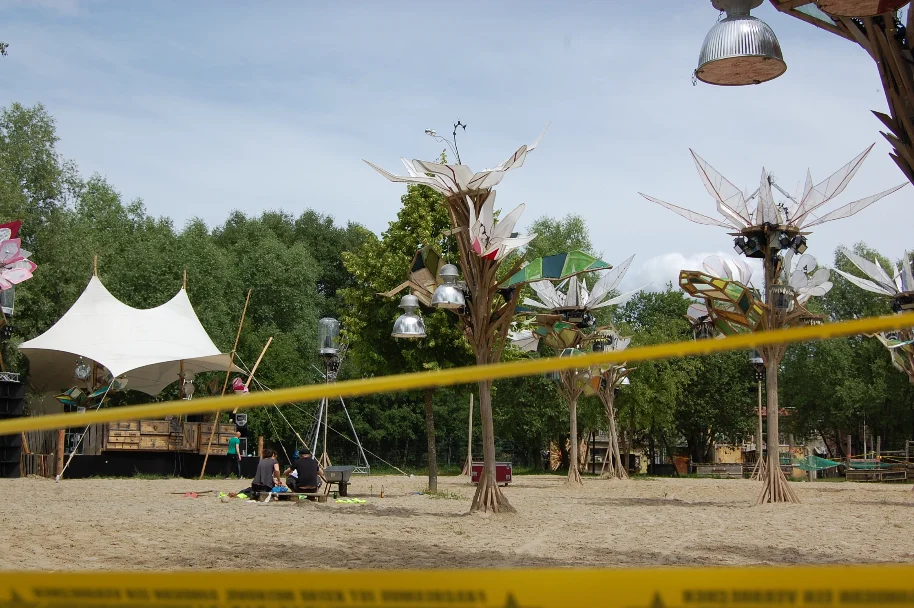
Fusion is defined as much by what it refuses as by what it offers. The lineup is not published in advance, so nobody can buy a ticket for a particular headliner. There are no major sponsors and no advertising hoardings. Since 2012 tickets have been allocated by lottery rather than sold first-come, which removes the scramble and, with it, the resale market. The food sold on site is entirely vegetarian and vegan. Parts of the grounds are clothing-optional. Attendees are encouraged to bring their own instruments, their own art and their own costumes, and much of what fills the site each year - installations, art cars, sculptures, a film festival - is made by the people attending. The music runs heavily to underground electronic styles, but there is no rule against anything else.
Holiday Communism
The phrase is the organisers' own, and it is only half a joke. The aim is a temporary autonomous zone: a few days in which the ordinary machinery of work, rent and status is switched off and something else is tried in its place. Foreign observers reach for the comparison with Burning Man, and it is not wrong, though Fusion is older in its politics and considerably wetter. The festival has grown from about fifteen thousand people in 2004 to around seventy thousand a year since 2013, peaking near eighty thousand in 2023, with seventy-nine thousand in 2024 and seventy thousand in 2025. An awareness team, on site since 2014, exists to deal with harassment and to make the freedoms usable by everyone rather than only by the loudest.
The Summer the Police Wanted a Station
In 2019 the arrangement that had held for two decades came apart in public. Police in Mecklenburg-Vorpommern demanded a permanent station inside the festival grounds, along with riot vehicles and water cannon on standby. Kulturkosmos refused, arguing that a self-governing space cannot be self-governing under a police post, and a petition against the plan collected more than 130,000 signatures. The state interior minister intervened. In the end the organisers submitted a revised security plan under which officers would enter on an incident-specific basis, and the festival went ahead. It remains the sharpest test the project has faced of whether a temporary autonomous zone can hold seventy thousand people without the state standing in the middle of it.
What It Costs to Keep Going
The 2020 festival was cancelled outright. In 2021 the main event was called off again, replaced by three smaller gatherings of about ten thousand people each in August and September under the name Plan:et C. The return in 2022 drew sixty-seven thousand and left the organisation with a deficit of roughly 1.5 million euros - the arithmetic of a festival that will not take sponsorship money and will not raise prices to the point where the people it is for cannot come. It survived. Most Junes the tents go back up between the shelters and the runway that was built to test what aircraft could do to people gets used for something else entirely - though the organisers have pencilled in 2027 as a deliberate gap year, a 'Kreativpause' for landscape work and rethinking the annual workflow before the festival returns in 2028.
From the Air
The Fusion site sits at 53.308 N, 12.736 E on the airfield at Larz, in the Mecklenburg Lake District about 160 km north-northwest of Berlin and 230 km east of Hamburg. The field is Rechlin-Larz (EDAX), an active airfield, and the festival occupies the grass and hardstanding beside it - do not plan an approach here during the festival window in late June and early July without checking current NOTAMs, as the site is dense with tents, cranes and installations. The visual signature from 1,500-3,000 ft AGL is unmistakable: a long runway in flat pine and heath country with a row of turfed-over aircraft shelters that look like a line of low green barrows. Lake Muritz, the largest lake lying entirely within Germany, lies about 12 km west and dominates the horizon. Neubrandenburg (EDBN) is roughly 45 km northeast, Parchim (EDOP) about 65 km west, and Berlin Brandenburg (EDDB) about 110 km south.
Nearby Stories
- Feldberg Lake District Nature Park 5.2 km away
- Neuruppin 18 km away
- Carinhall 20 km away
- Holy Blood of Wilsnack 28 km away
- Wöbbelin Concentration Camp 54 km away
- Historical Technical Museum, Peenemünde 64 km away
- Lilleø 154 km away
- Copenhagen City Hall 230 km away