
Carinhall
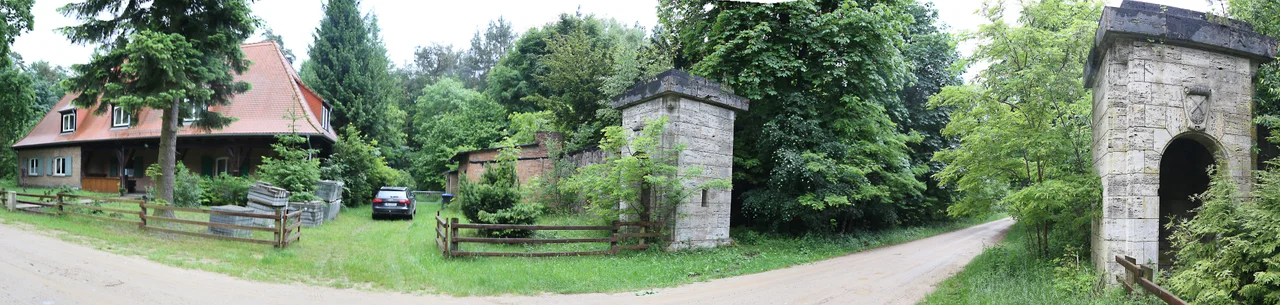
Two stone gate pillars stand in the Schorfheide forest north-east of Berlin, opening onto nothing. Behind them there is undergrowth, a few foundation lines, some carved blocks half-swallowed by moss. This was the entrance to Carinhall, the country estate of Hermann Göring — hunting lodge, private gallery, and terminus for art stolen from across occupied Europe. On 28 April 1945, with the Red Army approaching, a Luftwaffe demolition squad blew the compound apart on Göring's own orders. Two days before Hitler shot himself in a Berlin bunker, the second man in the Nazi state was arranging the destruction of his own house.
A House Named for a Dead Wife
Göring's first wife, Carin, a Swede born in 1888, died in 1931, and he named the estate for her. Construction began in stages from 1933; in June of that year he commissioned the architect Werner March to build a Swedish-style hunting lodge on a stretch of ground between the lakes Großdöllner See and Wuckersee. It did not stay a lodge. The buildings grew, the grounds grew, and in 1934 Carin's remains were brought from Sweden and placed in a crypt built for her on the property. Hitler walked in the funeral procession on 20 June 1934. The following April, on the tenth, Carinhall hosted the wedding banquet for Göring's second marriage, to the actress Emmy Sonnemann. His smaller hunting lodge at Rominten in East Prussia was nicknamed Emmyhall in her honour.
The Collection That Was Not His
As German forces occupied one country after another, Göring funneled his share of the plunder back to Carinhall. Paintings, sculpture, antiquities, furniture — objects taken from Jewish families, from national museums, from dealers coerced into selling and dealers who did not need coercion. He acquired a Roman sarcophagus carved with lions from an art dealer in Rome in 1942. The house was arranged as a gentleman's collection, hung and lit as though everything in it had been chosen rather than seized, and Göring conducted visitors through it as a connoisseur. The provenance of a very large share of what hung on those walls was a family in an occupied city who had been given no say in the matter, and in many cases had not survived to object.
Twenty-Eighth of April
By the spring of 1945 the front was moving west through Brandenburg. Much of the collection had already been evacuated south to Berchtesgaden, but a great deal was left behind — some concealed in bunkers, some simply buried in the gardens. Then the demolition squad arrived and the compound came down. What had been hidden did not stay hidden. Soviet soldiers and local residents found the caches over the following months and years; objects were carried off, and others were smashed where they lay. The estate that had been assembled out of Europe's stolen art was itself picked over and broken up, which is a kind of symmetry, though not one that returned anything to the people it had been taken from.
Scattered Objects
Pieces of Carinhall survive in public collections around Berlin and Brandenburg, and they are odd things to encounter. Franz von Stuck's bronze Kämpfende Amazone, cast in 1897, now stands at Eberswalde. Kronenhirsch, a crowned stag by Johannes Darsow made in 1937, is at Tierpark Berlin in Friedrichsfelde. The Roman lion sarcophagus Göring bought in 1942 was recovered from the ruins and is on display in the Neues Museum in Berlin, where the museum has published research on its history — the object's biography now includes the years it spent in a Nazi hunting lodge. A marble allegory by Étienne-Maurice Falconet, looted from the Paris collection of Baron Maurice de Rothschild, was excavated in pieces from the estate's bunker in the 1990s; no one connected it to its owner until 2016, and it now hangs in the Jewish Museum Berlin — one of the few objects from Carinhall that carries not just a nation's name but a family's. That kind of transparency is comparatively recent. For decades, provenance research on wartime acquisitions was something German museums did not much want to undertake.
A Ruin Kept Ruined
Treasure hunters have dug on and off since the 1990s. In 1993 one uncovered the entrance to the estate's air-raid bunker and was allowed to excavate it until 1995, when a forester finally had it sealed with a bulldozer; in February 2020 police arrested another crew trying to haul out a marble column, which the local museum association later recovered and conserved properly. The ruins are now a protected monument, the old bunker doubles as a bat roost, and the only concession to interpretation is a granite boulder engraved 'Carinhall' with a small information panel of historical photographs. Carin Göring's grave shows nothing but a depression in the ground. The gates stand, the foundations show through the leaf litter, and the forest continues to take the rest. The argument for leaving it mostly unmarked is straightforward: some places are better left with as little as possible to photograph.
From the Air
The ruins lie at 53.009°N, 13.636°E in the Schorfheide, part of the Schorfheide-Chorin Biosphere Reserve, roughly 65 km north-east of central Berlin. The site sits on the neck of land between Großdöllner See and Wuckersee; the two lakes are the reliable visual fix, since nothing of the building itself is visible from altitude. Eberswalde-Finow (EDAV) is about 20 km south and is the natural base for this area; Berlin Brandenburg (EDDB) is roughly 72 km south. Recommended viewing altitude 1,500-2,500 ft over an almost unbroken pine and beech canopy — the lake shapes and the forest tracks are what you navigate by. Autumn and winter, with the leaves down, give the best chance of picking out the old road alignments.
Nearby Stories
- Waldsiedlung 3 km away
- Feldberg Lake District Nature Park 11 km away
- Nauen Transmitter Station 12 km away
- Oderbruch 13 km away
- Rheinsberg Palace 14 km away
- Fusion Festival 19 km away
- St. Mary's Church, Chojna 25 km away
- 1962 Szczecin Military Parade Accident 37 km away