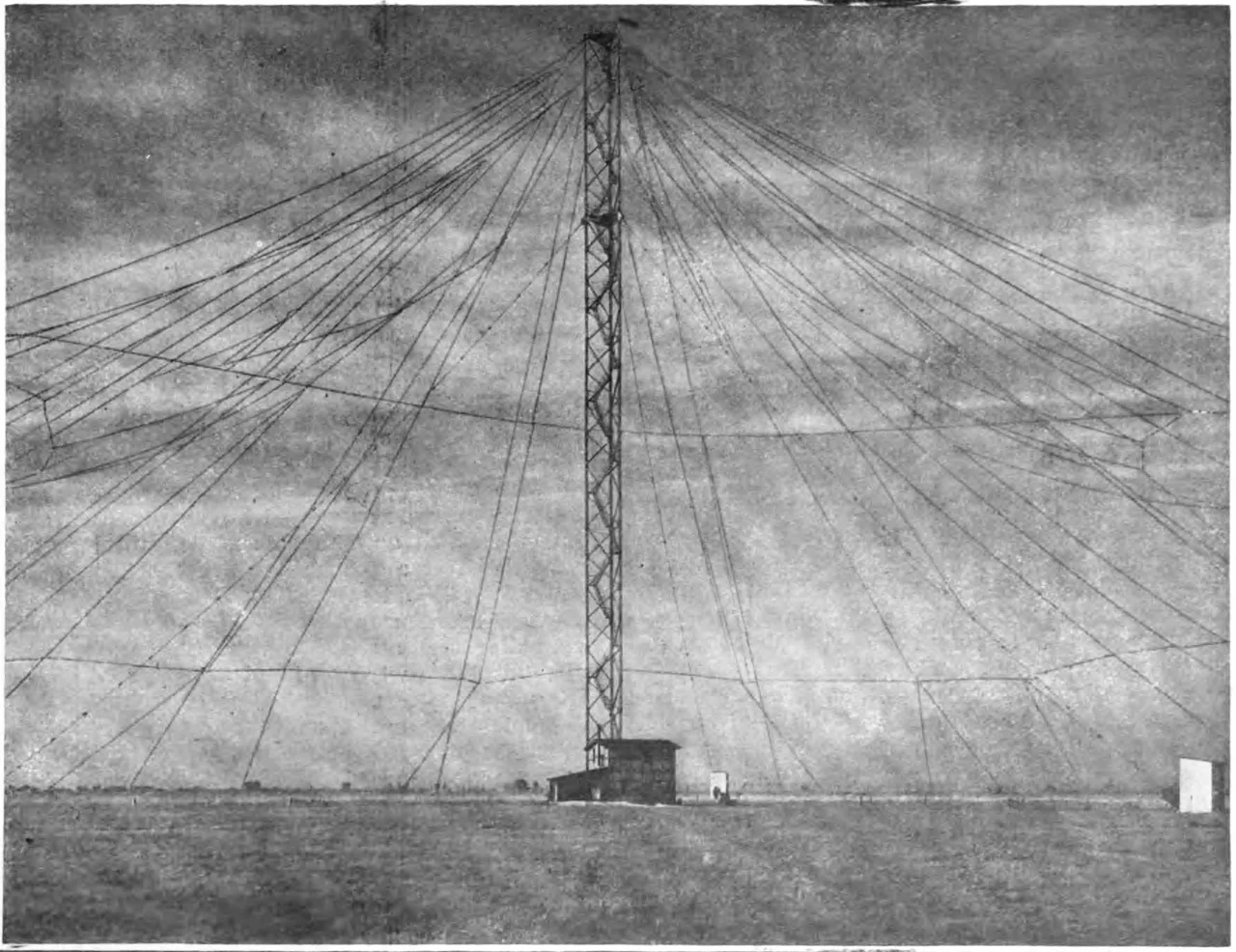

Nauen Transmitter Station
For ten years the most advanced long-range radio station Germany ever built was a potato cellar. The Soviets had stripped it in 1945 — every transmitter carted east, every mast dynamited, the equipment vanishing so completely that nobody afterwards could say where any of it went — and the great hall Hermann Muthesius had designed in 1920 was scheduled for demolition too. Somebody talked them out of it. So from 1945 to 1955 the cathedral of German wireless, the building whose facade once read Drahtloser Übersee-Verkehr, wireless overseas traffic, sat on the flat land north of Nauen with root vegetables stacked inside it. That building is still standing, and still working, which is the whole reason the place matters.
A Steam Tractor for a Power Plant
Telefunken founded the station on 1 April 1906, when its engineer R. Hirsch leased forty hectares of Havelland farmland from a landowner named Fritz Stotze. Trials began on 9 August and regular service on the 16th. Everything about that first installation sounds improvised and was not: a 25-kilowatt spark-gap transmitter designed by Georg von Arco, an umbrella antenna hung from a hundred-metre steel lattice mast insulated from the earth, and — because there was no commercial electricity out here — a 35-horsepower steam tractor parked inside a half-timbered shed, driving an alternator. It worked between 75 and 100 kilohertz, radiated about ten kilowatts, and could be heard some two thousand two hundred miles away. In 1909 a post office official named Hans Bredow took over as director with the intention of making Nauen a superpower station, and he did.
The Voice Left When the Cables Were Cut
Submarine telegraph cables were Britain's, and in both world wars Britain cut Germany's. That single fact made Nauen strategic. Its high-frequency alternator could hold a daylight transatlantic circuit with its sister station at Sayville on Long Island, making it for a time by a wide margin the most powerful radio transmitter on Earth, and during the First World War it became Germany's main link with the world outside the blockade. The doubler transformers ran at ninety percent efficiency and still threw off forty kilowatts of waste heat, enough that they needed forced-oil cooling to survive. Radio traffic went out as Morse fed from punched paper tape at speeds no human hand could match. In 1918 Woodrow Wilson transmitted his terms to Nauen from the alternator station at New Brunswick, New Jersey — the American surrender demand arriving by the same physics that had kept Germany talking.
Muthesius Builds a Nave
The 1920 building is the reason people photograph this place. Hermann Muthesius, one of the most influential German architects of the era, gave the station a hall on the scale of a nave, all mass and rhythm, its facade carrying relief sculpture above that inscription, to house the next generation of high-power gear. Friedrich Ebert, president of a two-year-old republic, inaugurated it on 29 September 1920. It is a protected heritage building today. The technology inside it changed underneath the architecture: the last longwave transmitter went in in 1923, vacuum-tube shortwave sets from 1924 onward once the skywave discovery made short waves the way to reach across oceans, and the Reichspost took the whole station over on 1 January 1932. By 1939 Nauen was among the largest communications complexes anywhere. In 1937 the obsolete alternator transmitters were modernised rather than scrapped, because very low frequencies do something short waves cannot — they penetrate seawater, and reach a submarine that does not want to surface.
How Old Is Oldest
English-language sources routinely call Nauen the oldest continuously operating radio transmitting installation in the world, and the claim deserves the qualification German sources give it. Die älteste noch bestehende Sendeanlage der Welt is the careful formulation: the oldest transmitting facility still in existence. Continuity is the part that does not hold. From the Soviet dismantling in 1945 until reconstruction began in 1955, Nauen transmitted nothing at all. What is true, and remarkable enough, is that no other site has been sending signals from the same ground for as long. The mast bases, the leased farmland, the Muthesius hall — 1906 is still underneath all of it.
Propaganda, and What Came After
East Germany brought the site back to life in 1955 and turned it outward in 1959, when it became the GDR's international shortwave service, broadcasting as Radio Berlin International. Between 1959 and 1989 the station accumulated twenty-one transmitters and forty-five antenna systems; from 1971 to 1981 it added three 500-kilowatt monsters feeding twenty-three high-gain curtain antennas, each one aimed at a country the Politburo cared about. Only Moscow put out more power in the Eastern Bloc. Nearby at the Dechtower dyke, two German firms had built one of the first rotating shortwave broadcast antennas in 1964; it ran until the Cold War ended. After reunification the site passed through Deutsche Telekom to Media Broadcast, which runs it now. Four rotatable ALLISS antennas went up between 1995 and 1997 — enormous steel sails that turn on their own bases to point anywhere on the compass. Deutsche Welle stopped broadcasting shortwave from Nauen in 2011. The antennas still turn.
From the Air
The station stands at 52.648°N, 12.910°E on open farmland roughly 5 km north-northeast of Nauen and about 40 km west-northwest of central Berlin. Best viewed between 2,000 and 4,000 ft — high enough to take in the whole antenna field, which sprawls across several square kilometres of otherwise featureless Havelland. The four ALLISS antennas are the giveaway: large rotatable curtain structures on individual turntables, unlike anything else in the region, with the boxy Muthesius transmitter hall among the low buildings at the site. Guyed masts and their wires make low overflight genuinely hazardous; treat the whole complex as an obstacle group and check current heights and lighting. Nauen town and the Berlin–Hamburg rail line lie just south. Nearest airfield is Bienenfarm (EDOI), a Sonderlandeplatz about 11 km west; Berlin Brandenburg (EDDB) is roughly 52 km southeast. Winter fog settles readily over this lowland and can leave the mast tops standing clear above it.
Nearby Stories
- Neuruppin 2.5 km away
- Arkenberge 3.3 km away
- Werder (Havel) 7 km away
- Berlin Brandenburg Airport 9.9 km away
- Carinhall 22 km away
- Holy Blood of Wilsnack 25 km away
- Jerichow Monastery 25 km away
- Stork Farm Loburg 33 km away