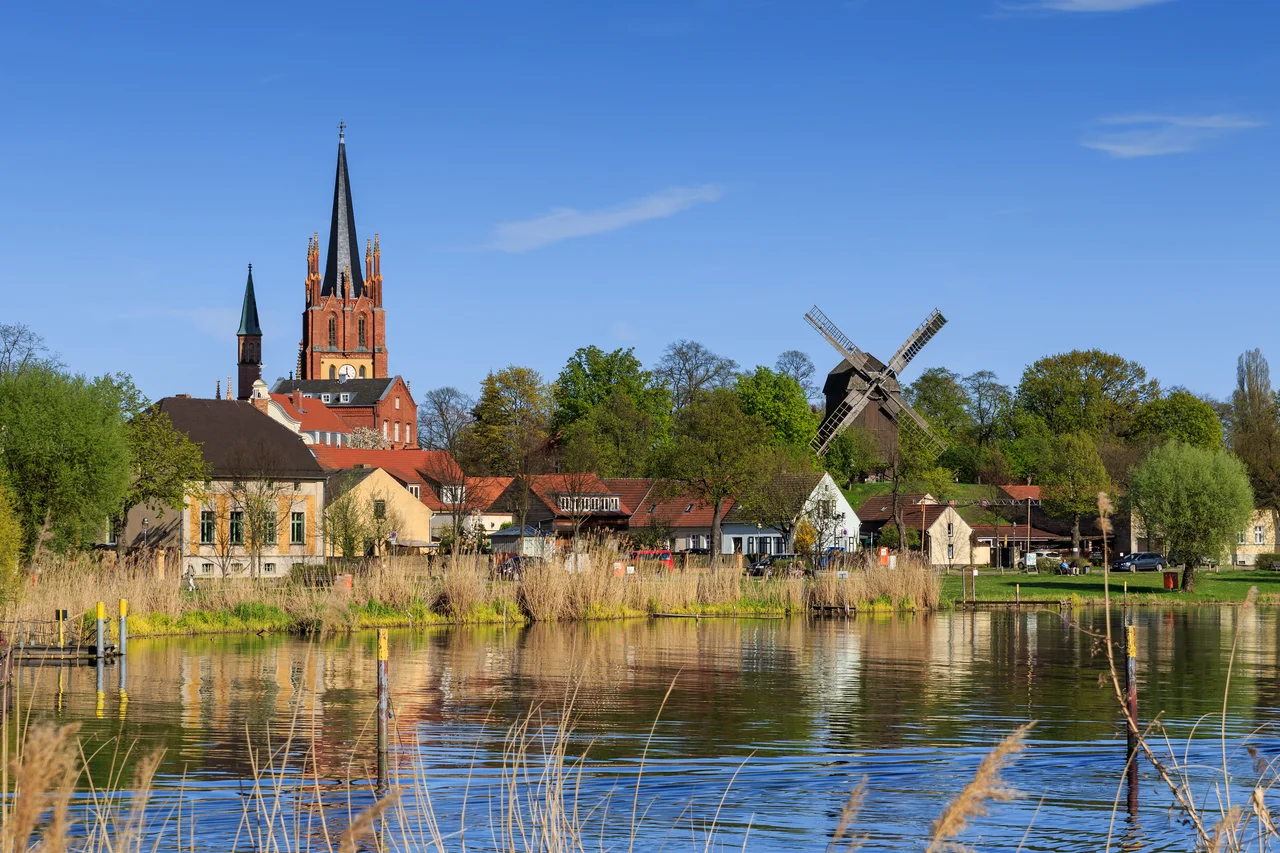

Werder (Havel)
For about ten days each spring, a town of some twenty-seven thousand people has to make room for half a million. The Baumblütenfest - the tree blossom festival - began in 1879, when the Werder fruit growers' association decided the world ought to know exactly when their orchards came into flower and arranged a special train from Berlin. The first trainload of guests arrived on 10 May 1879. By 1998 the count had reached roughly 750,000 visitors in a single season, which was more than the town could comfortably absorb, and recent years have settled around half a million. The draw is not only the blossom. It is the fruit wine, poured in the growers' own gardens, by people who have been making it for generations.
A Town the Shape of a Coin
The oldest part of Werder is an island in the Havel, round as a coin, joined to the mainland by a bridge that a deed already took for granted in 1317. That deed records the margraves' ministeriales selling their estates here to the monks of Lehnin Abbey, and it is not even the year's first mention: a charter of Margrave Waldemar names the place on 5 April 1317, months before the Lehnin sale in August. The name itself is a landscape word. Werder - like Wörth in Upper German - simply means river island. Older traces sit at the edges of the settlement: broken glass at the southwest end, and at the south end the remains of what may have been an early medieval Slavic castle wall. Swedish troops wrecked the town during the Thirty Years' War, and it rebuilt, as Brandenburg towns generally did.
Cherries Where the Vines Were
Wine was the second-oldest trade here after fishing, brought to the Havel before 1300 by Cistercian monks, and for a while it was serious business - more than a hundred hectares under vine in the first half of the eighteenth century. Then the climate had its say. The frost of the winter of 1739/40 lasted into June. Both wine and fishing declined through the eighteenth century, and fruit filled the gap. The Lehnin monks had cultivated orchards here from early on, and Werder simply kept going: cherries, apples and strawberries above all, but also raspberries, gooseberries, currants, blackberries, apricots, peaches, pears and plums. Tomatoes came later, most of them under glass. The blossom festival is not a marketing invention layered onto a pretty town. It is the annual advertisement for what the sandy ground actually does.
Golden, Silver, Bronze Jugs
The festival now falls in the week around 1 May and runs roughly ten days. Historically, residents simply sold wine out of their own gardens - no licence, no marquee, just a table and a view over the trees. That informality survives in modified form: numerous fruit farms in the surrounding villages open their yards, and the best fruit wines are judged and awarded so-called Golden, Silver and Bronze Kruken, the stoneware jugs the wine has always been served in. Werder counted about 300,000 visitors in 1993, then averaged half a million as word spread. Covid cancelled the festival three years running, from 2020 to 2022, and the 144th edition returned in 2023 in a deliberately quieter, more family-shaped format - a decision that annoyed some and relieved others.
The Airfield in the Pines
North of the town, an airfield operated before and during the Second World War, used together with an adjacent park to train pilots. Werder was the base of the Luftwaffe general Karl Koller during the Battle of Berlin, which put a very small Brandenburg orchard town briefly at the centre of the Reich's collapsing air command. Soviet troops moved into the same ground after the war and stayed for decades; the last Russian soldiers left in the early 1990s, a few years after reunification. It is an ordinary Brandenburg sequence - Prussian, Nazi, Soviet, federal - compressed into one patch of pine forest at the edge of a town that spends most of its energy on fruit.
Certified Restful
Werder holds the federal designation Erholungsort, which is not decorative: it certifies air and climate quality suitable for recuperation, and it has to be re-earned. The town's most famous residents were drawn by roughly the same qualities. Karl Hagemeister, born here in 1848, painted the water and light of these lakes for a living. Anna Simson, born in 1835, spent her life on women's rights. Adolf Damaschke, the land-reform economist, moved here in 1907 and stayed. In the outlying village of Petzow there is a small castle, a church, a fisherman's house and a former brickyard, all within a walk of the shore - the kind of arrangement that makes a place feel like it was designed for a slow afternoon, though nobody designed it at all.
From the Air
Werder sits at 52.378 N, 12.935 E, on the Havel about 9 km west of central Potsdam and 39 km southwest of Berlin Brandenburg (EDDB). From 2,000-4,000 ft the geography does the navigating for you: the Havel widens into a chain of lakes - Großer Zernsee, Glindower See, Schwielowsee to the southeast, Großer Plessower See to the south - and the old town appears as a distinct round island with a bridge at its neck. The 60-metre Wachtelberg rises east of the river, the only real relief for miles. In late April and early May the orchard belt reads as pale patchwork across the flat ground, and the A10 Berlin ring passes just west. Nearest general-aviation field is Schönhagen (EDAZ), about 25 km southeast; Berlin's controlled airspace begins not far east of Potsdam and should be checked before transiting. Terrain is flat; summer haze over the Havel lakes is the usual visibility limiter.
Nearby Stories
- Schönhausen Palace 3.8 km away
- Battle of Nauen 5.3 km away
- Berlin Brandenburg Airport 12 km away
- Genthin Rail Disaster 16 km away
- Dessau-Wörlitz Garden Realm 19 km away
- Wittenberg 22 km away
- Spreewald 46 km away
- Holy Blood of Wilsnack 50 km away