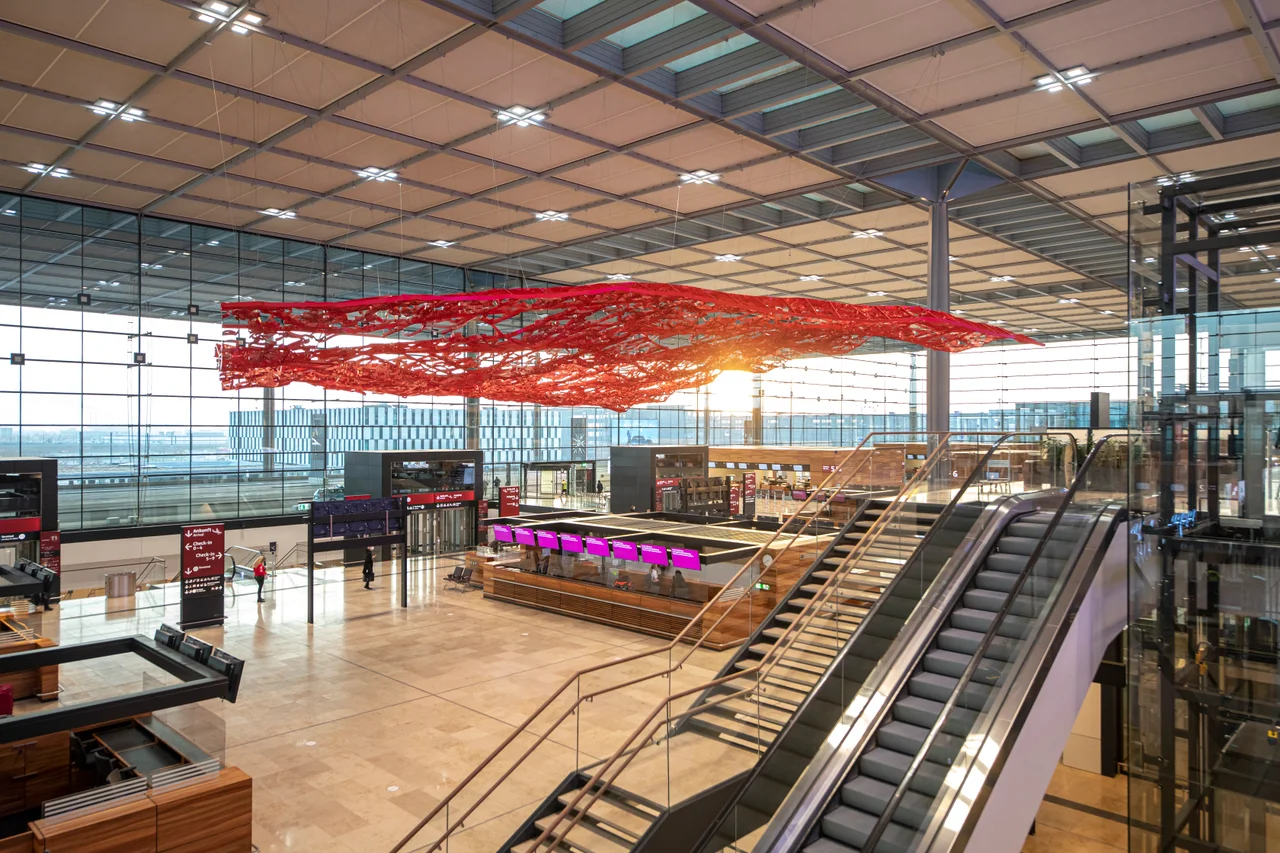

Berlin Brandenburg Airport
Diepensee went first. In 2004 the village's 335 residents took their compensation, moved into new houses at Königs Wusterhausen, and left the ground they had lived on to be cleared for a runway. Selchow's 35 villagers followed in the middle of 2005. Construction began the next year with an opening booked for October 2011. The airport those villages made way for opened on 31 October 2020: fourteen years after the first shovel, twenty-nine years after Berlin started planning it, and about nine years after the people of Diepensee could reasonably have expected to hear something overhead. Berlin Brandenburg is now a perfectly ordinary airport that handles twenty-six million people a year, which is somehow the least interesting thing about it.
Three Airports Into One
Berlin came out of the Cold War holding three airports and no coherent plan. Tegel had served West Berlin from a hexagonal terminal built for a smaller and more isolated city. Schönefeld had been East Berlin's. Tempelhof sat in the middle of town, a 1930s monument with a runway too short for modern jets. Planning for a single replacement began in 1991, and the site eventually chosen was Schönefeld's - eighteen kilometres southeast of the centre, in Brandenburg rather than Berlin, which meant building the new airport around and beside a working one. Tempelhof closed in 2008 and became a park. Tegel and Schönefeld were supposed to close on the day the new airport opened. They kept going for another twelve years.
Making Smoke Go Down
The delay has many parents, but the fire safety system deserves top billing. The terminal was designed with smoke extraction ducts in the ceiling that, for aesthetic reasons, would not vent through the roof. Smoke was instead to be drawn from the ceiling down a shaft and out through the basement. Hot air rises; this design required it to do the opposite, at the scale of an airport terminal, which nobody had achieved before and nobody achieved here. The man who designed the system turned out to be qualified as an engineering draughtsman rather than as an engineer. The airport company dismissed him in May 2014, citing serious defects in the work and a relationship of trust that was, in the wording of the termination notice, now finally shattered. His plans were to be disposed of. Rebuilding the system, split into three manageable zones, cost a nine-figure sum.
Four Weeks' Notice
Trials began on 24 November 2011. Twelve thousand volunteers checked in, cleared security, boarded and reclaimed 15,000 pieces of luggage, working night operations and emergency scenarios. Airlines rewrote their timetables. Shops fitted out their units. A Lufthansa A380 was booked to make the first departure, to Frankfurt, at 06:00 on 3 June 2012, and the regional broadcaster cleared twenty-four hours of continuous live coverage. On 8 May, four weeks out, the opening was cancelled. The stated reason was the fire protection system. A Brandenburg state audit later assessed the building's usability that spring at 56.2 percent - there were no ticket counters, and the escalators did not run.
The Decade of Dates
Then came 17 March 2013, then 27 October 2013, then, in January 2013, no date at all: four opening dates announced and abandoned inside two years. Inspectors kept finding work that would have to be undone. Conduits held too many cables, or incompatible ones - telephone lines run beside high voltage. Sixty kilometres of cooling pipe had gone in without thermal insulation. Exterior vents sat where rain came in through them. The main hall's exhaust system, which the construction workers called the monster, needed ninety kilometres of wiring, and eighteen kilometres of its ducting was reported to leak. The general planning consortium went insolvent and the architects were dismissed. Chief executives arrived and departed. In 2015 a former airport manager was remanded over alleged bribes from a contractor that had built part of the smoke extraction system, and that contractor's German arm went bankrupt the same August. A 2009 budget of €2.83 billion finished somewhere between €5.4 and €6.5 billion.
What Finally Opened
BER opened on 31 October 2020, into a pandemic that had emptied the skies - a scale of anticlimax that is difficult to arrange deliberately. Terminal 1 is built for 28 million passengers a year and Terminal 2, opened on 24 March 2022, for six million more. Terminal 5, the old Schönefeld building, shut in February 2021 and was declared permanently closed in November 2022. Two parallel runways lie 1,900 metres apart: one of 3,600 metres inherited from Schönefeld and dating to the 1960s, the other of 4,000 metres, finished in 2012 and left unused for eight years. In October 2024 both were renumbered, from 07L/25R and 07R/25L to 06L/24R and 06R/24L, because the earth's magnetic field had drifted far enough to require it. Six railway tracks run beneath the terminal in a 3.1-kilometre tunnel, and the express service reaches Berlin Hauptbahnhof in twenty-two minutes. In 2025 the airport handled just over 26 million passengers. The name on the building is Willy Brandt's.
From the Air
Berlin Brandenburg Airport (BER / EDDB) sits at 52.362°N, 13.501°E in Schönefeld, Dahme-Spreewald, about 18 km southeast of central Berlin at roughly 48 m (157 ft) elevation. Runways are 06L/24R (3,600 m) and 06R/24L (4,000 m), parallel and 1,900 m apart on an ENE-WSW alignment, with the terminal complex between them. Navigation landmarks: the A113 autobahn running along the northern boundary into Berlin, the Berlin ExpoCenter Airport on the southeastern edge of the field, and the lake country of the Dahme valley to the east. Tegel (formerly EDDT) closed in 2020 and Tempelhof in 2008; both remain visible as intact former airfields inside the city, 24 km and 15 km northwest respectively. Recommended viewing altitude for the surrounding landscape 2,000-3,000 ft outside controlled airspace - EDDB's control zone and approach corridors cover this area, so check current charts and clearances.
Nearby Stories
- Caputh 5.9 km away
- Schönhausen Palace 9 km away
- Battle of Nauen 11 km away
- Oderbruch 20 km away
- Falkenhagen Bunker 25 km away
- Wendish-German double church 28 km away
- Lutherhaus 31 km away
- Spreewald 34 km away