
Caputh
Albert Einstein could not swim. He bought a sailing boat anyway, and for four summers the most famous scientist in the world could be seen alone on the water below Caputh, working the tiller in no particular hurry and going nowhere in particular. The boat was moored beneath a small wooden house on a wooded slope above the Havel lakes, a few kilometres south of Potsdam and about thirty-five from the middle of Berlin. He was fifty years old when the house was finished, in 1929. He had it for barely four years. Then he sailed out of the season, went to America to lecture, and never came back to any of it.
Wood, Not Stone
The house is timber, which for a man of Einstein's standing in 1929 was an unusual choice - the Berlin professoriate built in brick and stucco. The architect was Konrad Wachsmann, then in his late twenties and working for Christoph & Unmack of Niesky, a firm that manufactured prefabricated timber buildings. Wachsmann would spend the rest of his career on the problem of the factory-made house, eventually in America; Caputh was an early answer. Redwood imported from the United States and fir from Galicia went into a low, plain structure set among pines, with the ground falling away toward the water. There is no grandeur in it at all. That is the point of it, and it explains why the building has such a hold on people who come to see it: this is what a genius actually wanted, given the choice.
Older Than the Physicist
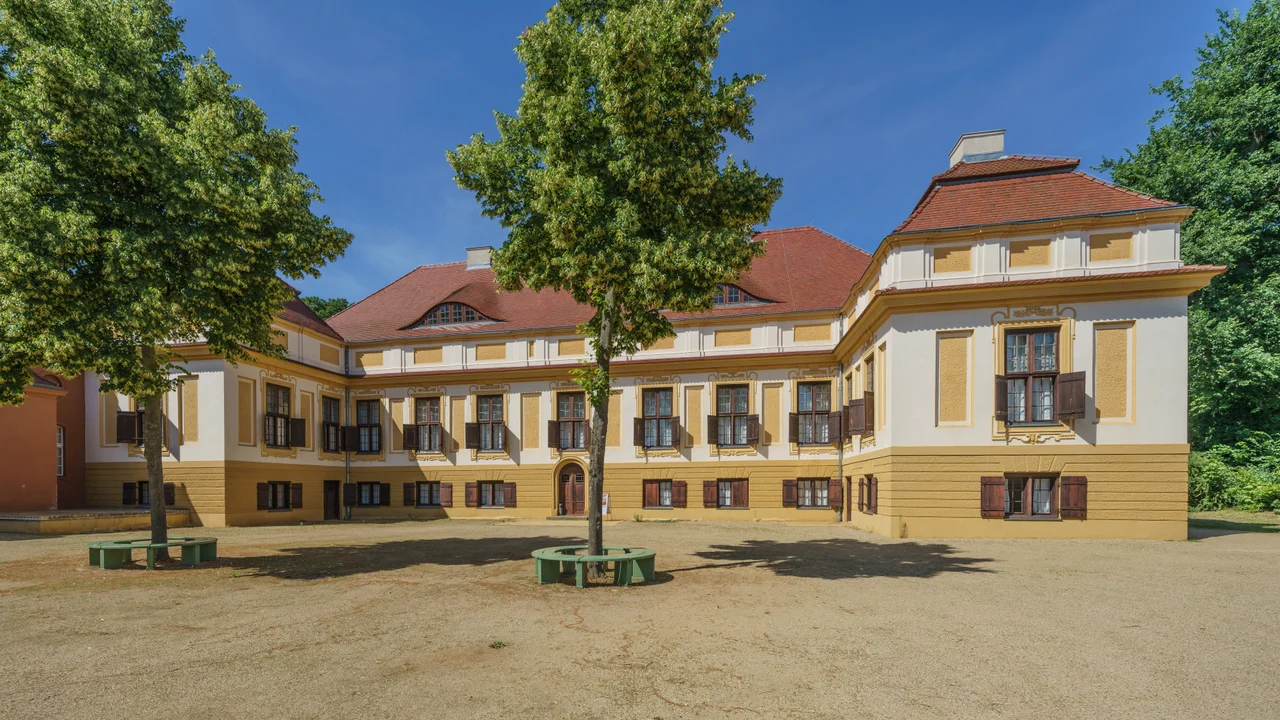
Caputh did not need Einstein to have a history. In 1662 Philip de Chiese, quartermaster general to the Elector Frederick William of Brandenburg, built a palace on the shore, and in 1671 the Elector gave it to his second wife, Princess Dorothea Sophie of Schleswig-Holstein-Sonderburg-Glücksburg, who enlarged it and filled it with fine furniture and paintings. Its strangest room came later. Around 1720, on the order of King Frederick William I - the parsimonious Soldier King, not a man given to decoration - roughly 7,500 pieces of Delftware were set into the walls and floor of a single chamber, the Fliesensaal, turning it blue and white from end to end. Peter Joseph Lenné laid out the park in 1820. The village church, a basilica by Friedrich August Stüler, was consecrated in 1852 with Frederick William IV standing in the congregation. A railway station arrived in 1904, and with it the wealthy Berliners who had begun to regard this stretch of water as a suitably remote place to live.
Four Summers
The Caputh years fall at the end of Einstein's Berlin period, when relativity was behind him and the search for a unified field theory - which he never completed - was ahead. What the village gave him was quiet, and a lake. He sailed constantly and, by every account, badly, in the manner of someone for whom the pleasure was the drifting rather than the sailing. A non-swimmer alone in a small boat is a fact that alarms people retrospectively; it did not appear to trouble him. Guests came out from Berlin, work happened on paper, and the summers passed. Then in the winter of 1932 he crossed the Atlantic for a visiting term in California, as he had done before, expecting to return in the spring.
January 1933
He was still abroad when Hitler took power. Einstein, horrified by the Nazi persecution of German Jews, decided not to go home, and he never set foot in Germany again. The house was not seized immediately. For a time it was rented out to a Jewish school - one of the institutions created because Jewish children were being pushed out of state education. By 1935 the state had taken it and sold it to the municipality of Caputh for less than a fifth of what it had cost to build. The Wehrmacht used the building during the war. Afterwards, in East Germany, it was let as ordinary housing, and people who had never heard the word relativity lived in Einstein's rooms and hung their washing where his boat had been.
What Survived
The house came under monument protection and was restored in 1979, still behind the Iron Curtain. After reunification came a restitution claim, and the property passed to the Hebrew University of Jerusalem, the institution Einstein had helped to found and to which his estate went. The Einstein Forum - directed since 2000 by the philosopher Susan Neiman - now uses the summer house for conferences, workshops and lectures, which is a better fate than a velvet rope. A permanent exhibition in the village community centre, Einsteins Sommer-Idyll in Caputh, tells the story of the house through documents, photographs and models, alongside Wachsmann's own life. Of all the addresses Albert Einstein had in Germany - the flats in Berlin, the rooms in Bern and Prague and Zurich - this small timber house on a Brandenburg slope is the only one still standing. He had it for four summers, and it outlasted everything that took it from him.
From the Air
Caputh lies at 52.347°N, 12.995°E, on the narrow neck of water linking the Templiner See and the Schwielowsee, immediately south of Potsdam. From 2,000-3,000 ft the geography does the navigating for you: this is a landscape of interlocking lakes and pine forest, and Caputh sits on the pinch point where the village and its ferry crossing squeeze between two broad sheets of water. The baroque palace is the obvious visual anchor, a low rectangular block hard against the shoreline with formal parkland behind it; Einstein's summer house is small and tree-covered on the slope above and will not be seen from the air. Potsdam's Sanssouci terraces lie a short distance north. Berlin Brandenburg (EDDB) is about 35 km east and its controlled airspace dominates the area - check it before any low-level transit. Schönhagen (EDAZ) is roughly 20 km southeast. Terrain is flat; the lakes hold morning mist well into the day in autumn.
Nearby Stories
- Schönhausen Palace 3.8 km away
- Battle of Nauen 5.3 km away
- Berlin Brandenburg Airport 12 km away
- Genthin Rail Disaster 16 km away
- Dessau-Wörlitz Garden Realm 19 km away
- Wittenberg 22 km away
- Spreewald 46 km away
- Holy Blood of Wilsnack 50 km away