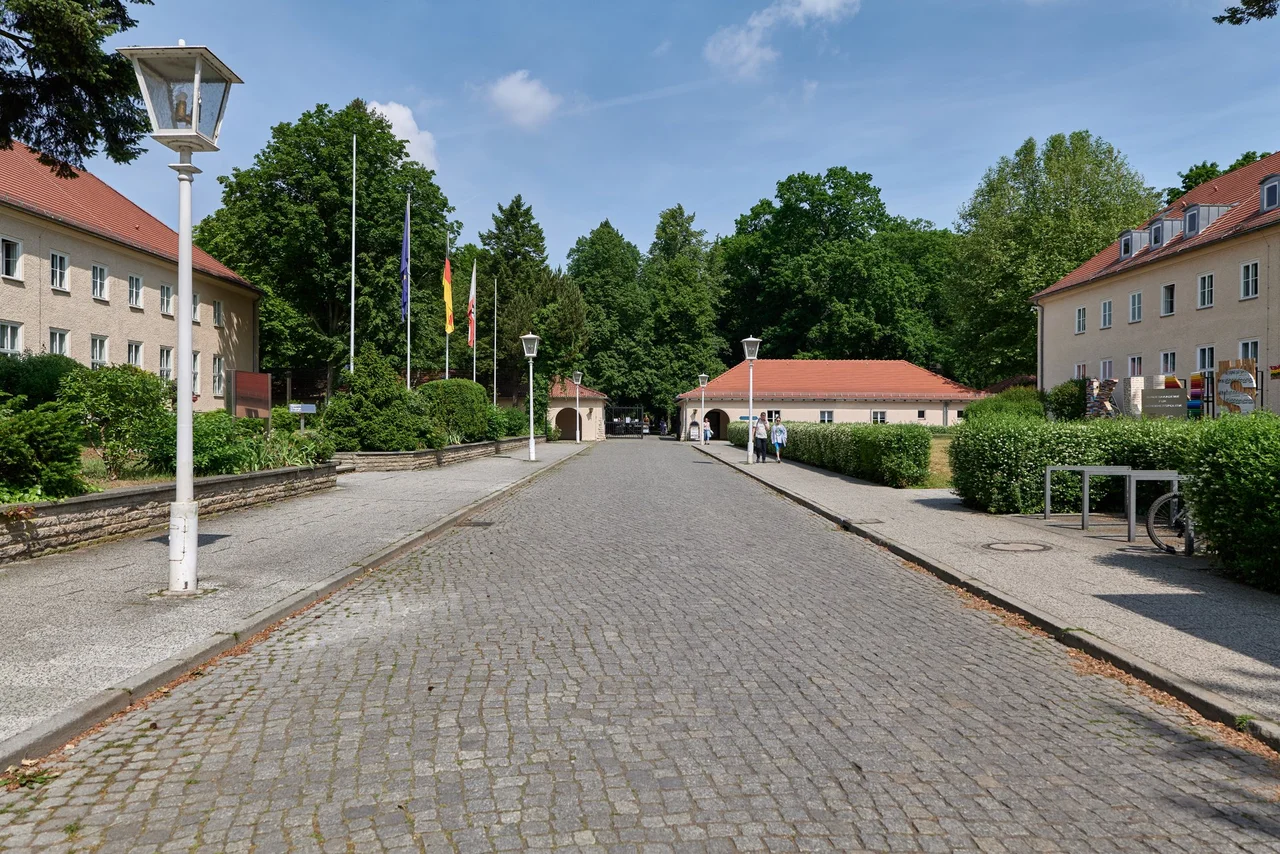

Schönhausen Palace
For fifty summers, from 1740 to 1790, Elisabeth Christine of Brunswick-Bevern came out to Schönhausen. Her husband never came with her. Frederick the Great spent his summers at Sanssouci, thirty kilometres southwest in Potsdam, and in half a century of a marriage the records describe only as strained, he did not visit his wife's palace once. She had the stucco done anyway, most probably by the artist Johann Michael Graff, and the plasterwork in the upstairs rooms remains the loveliest thing in the building. Two hundred years later the same rooms would hold Wilhelm Pieck, Ho Chi Minh, Fidel Castro, and the negotiators who dissolved a divided Germany.
A Dutch House North of the Gates
In 1662 Countess Sophie Theodore, of the Holland-Brederode family and married to the Brandenburg general Christian Albert of Dohna, bought the lands of Niederschönhausen and Pankow, then well beyond the Berlin gates. Two years later she built a manor here in the Dutch style, with the little Panke river running through the grounds.
It changed hands twice before it mattered. Minister Joachim Ernst von Grumbkow acquired it in 1680, and in 1691 his widow sold it for 16,000 Thalers to the Hohenzollern elector Frederick III, who had wanted it for years. Frederick had Johann Arnold Nering remodel the manor into a palace between 1691 and 1693, and in August 1700 he sat here planning the coronation that would make him Frederick I in Prussia. His son had no such affection for the place. After 1713 civil servants moved into the rooms as offices, land was leased off, and palace and park quietly fell apart.
Russians in the Park, a Horse in the Garden
In 1760, during the Seven Years' War, Russian troops drove deep into Prussia, occupied Berlin and wrecked Niederschönhausen. The queen sat the war out in the fortress at Magdeburg. After 1763 Johann Boumann rebuilt the palace into essentially the shape it holds today, and the gardens were redone in Rococo à la française.
Elisabeth Christine died in 1797, and the palace went quiet again — mostly a furniture and picture store, occasionally lived in by Frederica of Mecklenburg-Strelitz, widow of Prince Louis Charles, who had Peter Joseph Lenné turn the grounds into an English landscape garden.
One rumour outlived all of them: that Frederick the Great buried his favourite horse Condé in these gardens, under a particular hillock. It cannot be true in the way people tell it. Condé outlived his owner and died in 1804 at the age of thirty-eight. The skeleton is at the Free University's veterinary department.
What the Regime Called Degenerate
The Hohenzollerns held the palace until 1920, when the family was dispossessed after the revolution of 1918-19 and Schönhausen passed to the Free State of Prussia. It opened to the public and filled up with art exhibitions. Under the Nazis it housed the government's art department, and several paintings of the modern art the regime had banned as 'degenerate' were stored in these rooms.
The Battle of Berlin damaged the building but did not gut it. A Pankow artists' initiative repaired it fast enough to mount an exhibition in September 1945, four months after the surrender. The Soviet Military Administration then requisitioned it as an officers' mess, and later as a boarding school for Soviet children.
The President's Palace
When the German Democratic Republic was founded on 7 October 1949, the Soviets handed Schönhausen to the new East German state, and until 1960 it served as the official residence of Wilhelm Pieck, the GDR's first and only president. Khrushchev was received here. So was Ho Chi Minh. Garages went up on the north side for the presidential fleet, a casino and chancellery on the south, with two gatehouses framing a formal court. Reinhold Lingner laid out the inner garden in the bright, open manner of the 1950s — and a wall went through the park, dividing it into a private half and a public one.
After Pieck died in 1960 the building briefly housed the new State Council, which moved to Mitte in 1964. It then became the government guest house, renamed Schloss Niederschönhausen. Indira Gandhi stayed here. So did Fidel Castro. So, in October 1989, did Mikhail and Raisa Gorbachev, on the eve of the revolution that ended the state that was hosting them.
The Table Where It Ended
In 1989 and 1990 the Round Table — the negotiating body that bridged the collapsing GDR government and the opposition — met in the palace outbuildings. Major portions of the Two Plus Four talks, the Treaty on the Final Settlement with Respect to Germany, were held here too. A plaque now marks it. The palace had gone from a queen's summer house to a president's residence to the room where the country signed itself out of existence.
What followed was bureaucratic. The federal property office took it over, Berlin became the owner in 1991 and put it up for sale in 1997. A 2003 proposal to lodge the President of Germany here while Bellevue was refurbished collapsed over an estimated twelve million euros of works. In June 2005 the Prussian Palaces and Gardens Foundation took ownership with €8.6 million in federal funds, and on 19 December 2009 Schönhausen reopened — Elisabeth Christine's rooms and Wilhelm Pieck's office, in the same building, on the same ticket.
From the Air
Located at 52.5783 N, 13.4056 E in Niederschönhausen, borough of Pankow, about 6.5 km north of the Fernsehturm. From the air the giveaway is the park rather than the palace: a compact rectangle of mature trees and open lawn set into an otherwise tight grid of Wilhelmine apartment blocks and villa streets, with the thin line of the Panke river threading through it and Tschaikowskistraße running along its southern edge. The palace itself is a modest pale two-storey block with a shallow hipped roof, easy to mistake for a large administrative building; the formal court with its two gatehouses on the south side is the identifier. Recommended viewing altitude 1,500-2,500 ft AGL. This is inner-city controlled airspace beneath the Berlin TMA, so expect clearance limits and brief the boundary early. Berlin Brandenburg (EDDB) is about 24 km south, Schönhagen (EDAZ) about 45 km south-southwest, Strausberg (EDAY) about 35 km east-southeast. Best in early spring or late autumn, when bare trees expose the building; in full summer leaf the park hides it almost completely.
Nearby Stories
- Berlin Brandenburg Airport 3.3 km away
- Caputh 4.1 km away
- Nauen Transmitter Station 6.6 km away
- Carinhall 13 km away
- Neuruppin 14 km away
- Oderbruch 14 km away
- St. Mary's Church, Chojna 25 km away
- Frankfurt (Oder) 34 km away