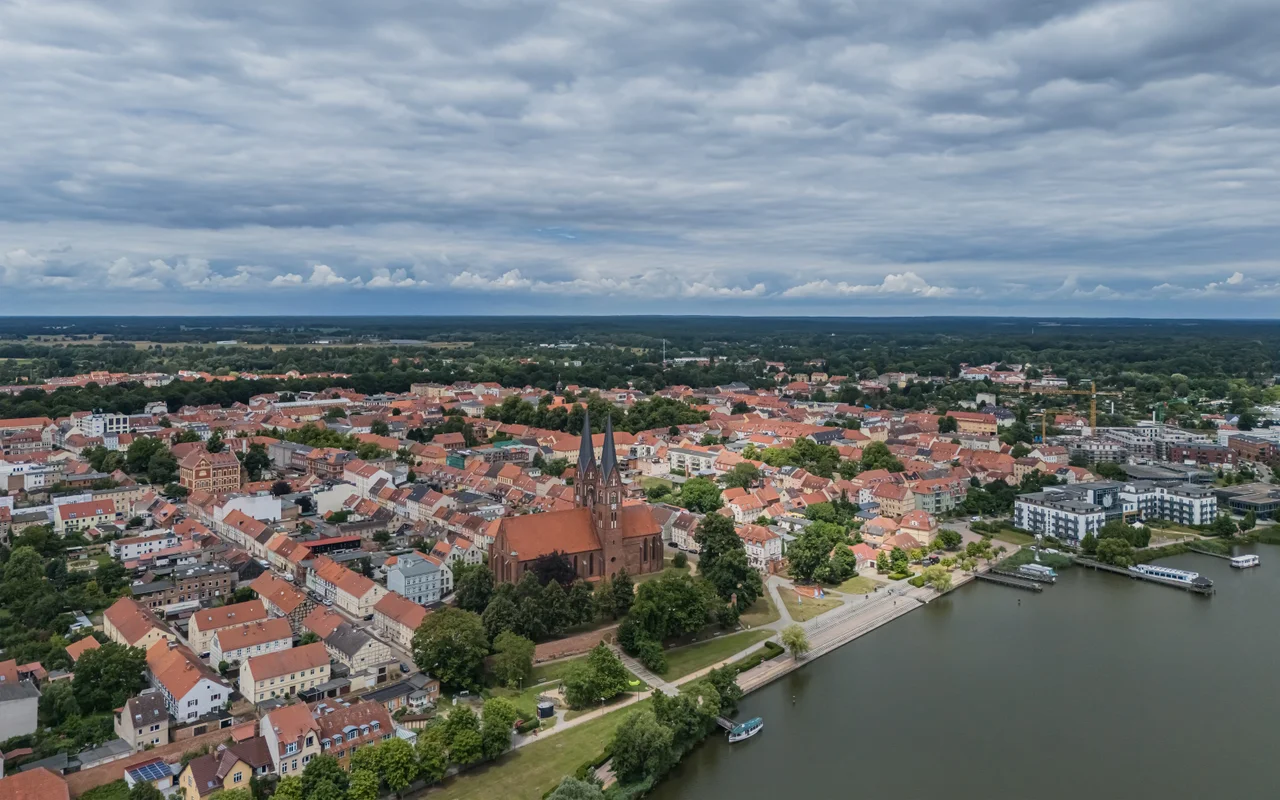

Neuruppin
It started in a barn full of grain by the Bechliner Tor, on a Sunday afternoon in late August 1787. By the time it burned out, Neuruppin had lost 401 townhouses, 159 outbuildings, 228 stables, 38 barns, the town hall, the Reformed church, the Prince's Palace and the parish church of St Mary. Two thin strips at the eastern and western edges survived. Among the dead was the father of a six-year-old boy named Karl Friedrich Schinkel. What rose from the ashes was not a patched-up medieval town but something stranger: a small provincial place rebuilt, in fifteen years, as a complete work of neoclassical urban planning.
Before the Fire
In late Slavic times the Zamzizi tribe held this shore. After the Wendish Crusade of 1147 brought German nobility into the region, the counts of Lindow-Ruppin built a lowland castle around 1200 and founded a planned town southwest of it — the Neuruppin of today, first mentioned in 1238 and granted Stendal town rights on 9 March 1256.
A Dominican monastery went up in 1246, the order's first house between the Elbe and the Oder. Twenty-four Wiekhäuser and two high towers studded the town wall. In 1512 Elector Joachim I threw a three-day jousting tournament here to celebrate a peace treaty. In 1688 Neuruppin became one of Brandenburg's first garrison towns, and from 1732 to 1740 a disgraced Crown Prince Frederick — later Frederick the Great — served out his rehabilitation here after a failed escape from his father's court. French Huguenots settled after 1685, and one of their descendants would matter a great deal later.
Rebuilt on Paper
The fire caused damage estimated at nearly 600,000 talers. The insurance fund covered about 220,000, a church collection raised 60,000, and the Prussian state put in 130,000 immediately — eventually more than a million talers in all. Prussia did not simply write cheques. It wrote rules.
The city planning director Bernhard Matthias Brasch executed the reconstruction commission's specifications between 1788 and 1803, expanding the town from 46 to nearly 61 hectares by removing the ramparts between the Tempelgarten and the lake. Two crowded parallel north–south streets were merged into a single broad axis. A rectangular grid went in, lined with continuous two-storey houses of uniform height and punctuated by generous squares. The architecture mixed late Baroque and Gothic details with the new Neoclassical taste, and the work was finished in 1803 — only St Mary's, built between 1801 and 1806, lagged behind.
This is why Neuruppin has been called the most Prussian of all Prussian towns: not for its soldiers, but for its right angles.
Three Sons of a Small Town
Karl Friedrich Schinkel, born here on 13 March 1781, lost his father to the fire and left for Berlin, where he became the architect who gave the Prussian capital its public face.
Theodor Fontane was born on 30 December 1819 into the town's Huguenot community, the son of an apothecary, and trained as an apothecary himself from the age of sixteen. He spent decades as a journalist before turning, in his late fifties, to the novels that made him — Effi Briest among them. First, though, came the Wanderungen durch die Mark Brandenburg, published in volumes between 1862 and 1889: a patient, gossipy, affectionate survey of exactly this flat, sandy, lake-scattered country. No German region has ever been so thoroughly written into being by one man. Neuruppin was officially named Fontanestadt on 11 March 1998.
A third local boy, Paul Carl Beiersdorf, born in 1836, trained as a pharmacist and founded the company that would eventually put Nivea in medicine cabinets worldwide.
Three Million Pictures a Year
Long before mass photography, Germans got their images of war, royalty, scripture and scandal from Bilderbogen — cheap hand-coloured broadsides sold by the sheet. Johann Bernhard Kühn started producing them here, and his son Gustav built the trade into something extraordinary: print runs that reached over three million copies in a single year, notably during the Franco-Prussian War of 1870–71. Sheets went out across the world stamped Neu-Ruppin, zu haben bei Gustav Kühn.
Three competitors — Oehmigke, Riemschneider and Bergemann — worked the same streets, and all three held leading positions in a German market of more than sixty firms. For a few decades, a garrison town in the Brandenburg sand was one of the visual engines of the German-speaking world. Fire extinguishers followed in 1905; the Minimax, easy enough for anyone to use, spread everywhere. There is a certain justice in a town that burned down becoming a place that made things to put fires out.
Soldiers, Silence, and the Lake
On 1 May 1945 Soviet forces reached the far shore of the Ruppiner See and prepared to shell the town. Someone — nobody knows who — climbed the monastery church tower and raised a white flag, and the same thing happened at the parish church. Neuruppin was not destroyed.
The garrison did not leave. Neuruppin became one of the largest Soviet bases in Germany, with roughly as many Soviet soldiers here as residents; the 12th Armoured Division stayed until 1991. Industry arrived too, and the town grew from about 18,000 people in 1970 to 33,000 by 1989, drawing workers from across the GDR and from Vietnam, Angola and Cuba. In 2004 six Stolpersteine were laid at the Ruppiner Kliniken for patients of the former state asylum murdered in the Nazi 'euthanasia' programme — a quiet correction to a long silence.
The barracks are apartments now. Part of the old airfield is used for gliding. And the lake still runs the length of the town, exactly as Fontane described it.
From the Air
Neuruppin sits at 52.92°N, 12.80°E, about 60 km northwest of Berlin. From the air it is unmistakable: a compact rectangular grid pressed against the northwest shore of the Ruppiner See, a narrow lake roughly 14 km long running northeast–southwest, with the twin towers of the monastery church marking the old town. A railway embankment crosses the lake about 2.5 km from the north shore — a straight line where you would not expect one. North of the town the land opens into the Stechlin-Ruppiner Land Nature Park, a scatter of dark lakes in pine forest; Alt Ruppin sits at the lake's northern end. After the 1993 incorporations Neuruppin became one of Germany's largest municipalities by area, so the built-up core is a small bright patch in a very large green rectangle. Fly it at 2,000–3,500 ft AGL for the grid and the lake together. Nearest fields: EDBK (Kyritz) about 25 km west, EDDB (Berlin Brandenburg) roughly 80 km southeast, EDAV (Eberswalde-Finow) about 65 km east. Gliding activity operates from the former airfield — expect soaring traffic on good thermal days. Best light is early morning, when mist lies on the Ruppiner See and the town grid throws long shadows.
Nearby Stories
- Fusion Festival 8.2 km away
- Waldsiedlung 8.9 km away
- Feldberg Lake District Nature Park 9.7 km away
- Nauen Transmitter Station 11 km away
- Templin 17 km away
- Holy Blood of Wilsnack 25 km away
- Tangermünde 31 km away
- Ludwigslust Palace 55 km away