.jpg)
Tangermünde
In 1488 the citizens of Tangermünde rioted against a new excise on beer. This was no small quarrel in a small place: Tangermünde was the residence town of the Electors of Brandenburg, a prosperous Hanseatic port on the Elbe, in the middle of what the town still calls its golden century. Elector John Cicero took the insult personally and moved his court downriver to a pair of unremarkable settlements called Berlin and Cölln. Tangermünde never got its importance back — and that is precisely why it is beautiful. Nobody ever had the money to knock the medieval town down and build a fashionable one on top of it. The gables, the gates, the walls and the towers simply stayed.
Where the Tanger Meets the Elbe
The town stands on a glacial moraine above the left bank, high enough that the Elbe's floods pass beneath it — a piece of geological luck that shaped everything after. Bishop Thietmar of Merseburg recorded a castle here in 1009, probably raised during the reign of Henry the Fowler at the frontier with the Polabian Slavs. The town itself first appears in a deed of 1275, by which point it was taking tolls from every boat working up the river. The chronicles say Margrave John II hid his treasure beneath the parish church and passed the secret to his brother Otto — Otto with the Arrow, for the arrowhead he carried in his skull — who needed it badly when the citizens of Magdeburg captured him and named a ransom. In 1373 Charles IV bought the Margraviate of Brandenburg and rebuilt the castle as an imperial residence. From 1415 the Hohenzollerns lived here.
Blue Tracery on Red Brick
The town hall went up in the 1430s and is the reason architectural historians make the trip. Three staggered gables rise from the façade, the central one climbing well above the roofline, each pierced by a large circular window with two smaller ones beneath, all filled with brick tracery worked as finely as stone. Octagonal buttresses divide the gable into bays of canopied niches, and miniature spires crown the whole assembly like a cathedral front shrunk onto a civic building. What startles is the colour. Structural highlights are picked out in white, the tracery and grilles in dark blue, and everything else is red brick — a palette you will not find on another building of its age. St Stephen's parish church nearby lost everything it owned in the fire of 1617, but it holds a Scherer organ built in 1624, since completely restored.
Grete Minde
On 13 September 1617 fire took nearly the whole town. Someone had to answer for it, and the answer fell on Margarete Minde, a patrician's daughter born around 1593 who had lost a lawsuit over her inheritance and was scraping a living as a herb woman and fortune teller. She fitted the shape a suspect was supposed to have: poor, female, aggrieved, standing just outside respectable society. The court convicted her of arson on 13 March 1619 and burned her at the stake nine days later, on 22 March. Historians now doubt her guilt. The case rests on a confession obtained by the interrogation methods of the age and on a motive that was really only a grudge the town could point at. Theodor Fontane made her the subject of a novella in 1879, which is how most Germans know the name. In 2009 Tangermünde unveiled a bronze by Lutz Gaede showing her bent beneath her chains.
The Ring That Held
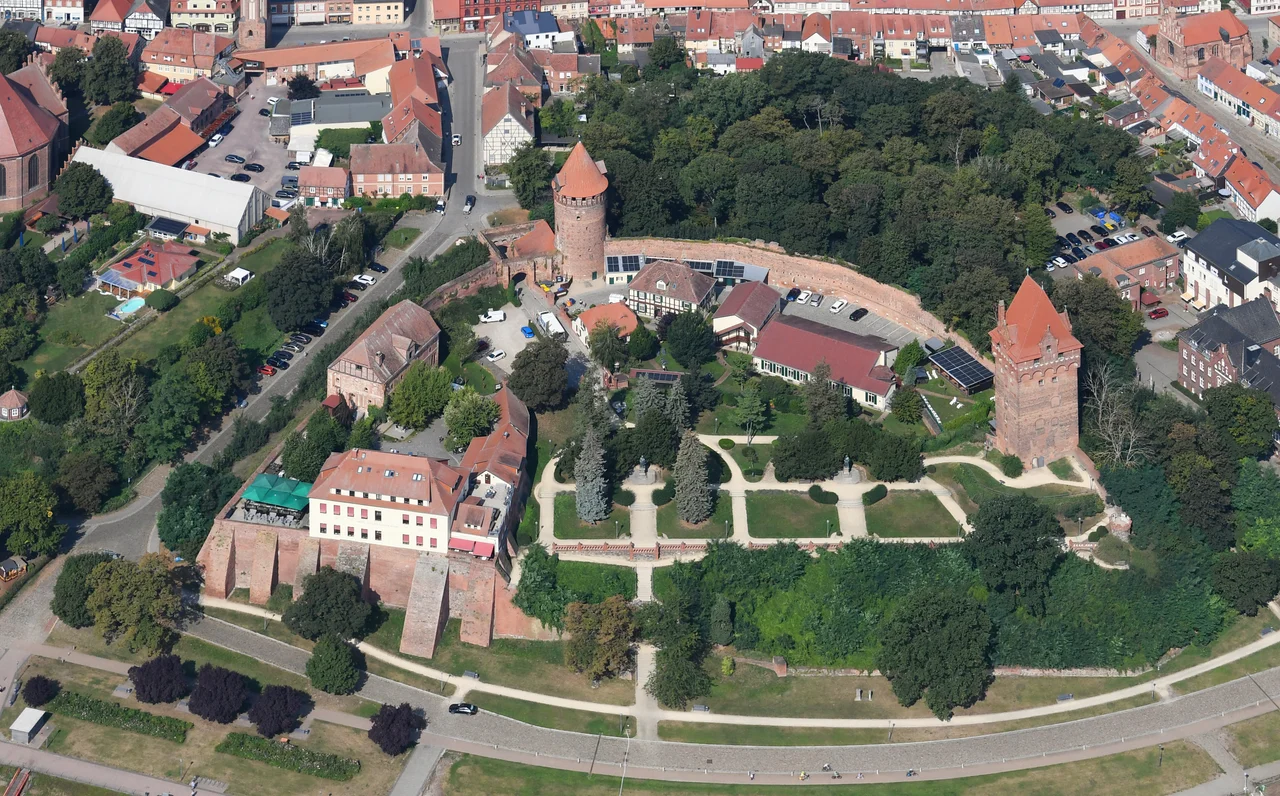
Tangermünde kept its city wall, which is rarer than it sounds. Begun around 1300, it was repaired and rebuilt for centuries in part because it doubled as a flood defence, and it still runs almost unbroken around the old centre. The Neustädter Tor of 1450 is the showpiece gate, facing a twelfth-century church of St Nicholas whose belltower dates from 1470; the Wassertor opens toward the river. Of the surviving towers the Schrotturm is the tallest at 47 metres, while the Eulenturm, its foundations laid around 1300, is the oldest at 24. Up at the castle the Kapitelturm of 1376 climbs 50 metres and gives the view over town and river. The tower above the gate served as the town prison, and is still called the Gefängnisturm.
April 1945, and the Bridge
The war barely touched Tangermünde until 12 April 1945, when American units reached the town and its strategic crossing — a combined rail and road bridge opened in 1933 — and a short, fierce fight followed. Retreating German forces blew the bridge. Weeks later the Elbe had become the line between the American and Soviet zones of occupation, and between 4 and 7 May as many as 100,000 German soldiers and civilians climbed across the wreckage on foot, surrendering to the Americans rather than waiting for the Red Army; Allied cameramen filmed them coming over. The remnants of the 12th and 9th Armies gave themselves up here. A temporary bridge carried traffic until 2001, when the present one opened. Behind it the old town, restored steadily since reunification, looks much as it did in 1500.
From the Air
Tangermünde lies at 52.541°N, 11.969°E on the left bank of the Elbe in the Altmark, about 50 km north of Magdeburg and 90 km west of Berlin. From the air the town reads unusually clearly for its size: the old centre sits on a low terrace above the river, ringed by an almost complete medieval wall, with the castle on the bluff over the inland harbour and the 50-metre Kapitelturm and 47-metre Schrotturm the tallest points. The Elbe meanders broadly here across flat floodplain, and the modern road bridge of 2001 marks the crossing where its predecessor was destroyed in 1945. Best viewed at 1,500–2,500 ft AGL on a run along the river from the south-east, with morning light on the brick. Nearest fields are Magdeburg City (EDBM) about 50 km south, Magdeburg-Cochstedt (EDBC) further south-west, and Berlin Brandenburg (EDDB) about 90 km south-east. Terrain is flat throughout; expect valley fog on still autumn mornings and haze over the floodplain in summer.
Nearby Stories
- Stork Farm Loburg 10 km away
- Battle of Fehrbellin 10 km away
- Gardelegen Massacre 14 km away
- Paretz 15 km away
- Treuenbrietzen 19 km away
- Holy Blood of Wilsnack 28 km away
- Free Republic of Wendland 36 km away
- Schöningen spears 43 km away