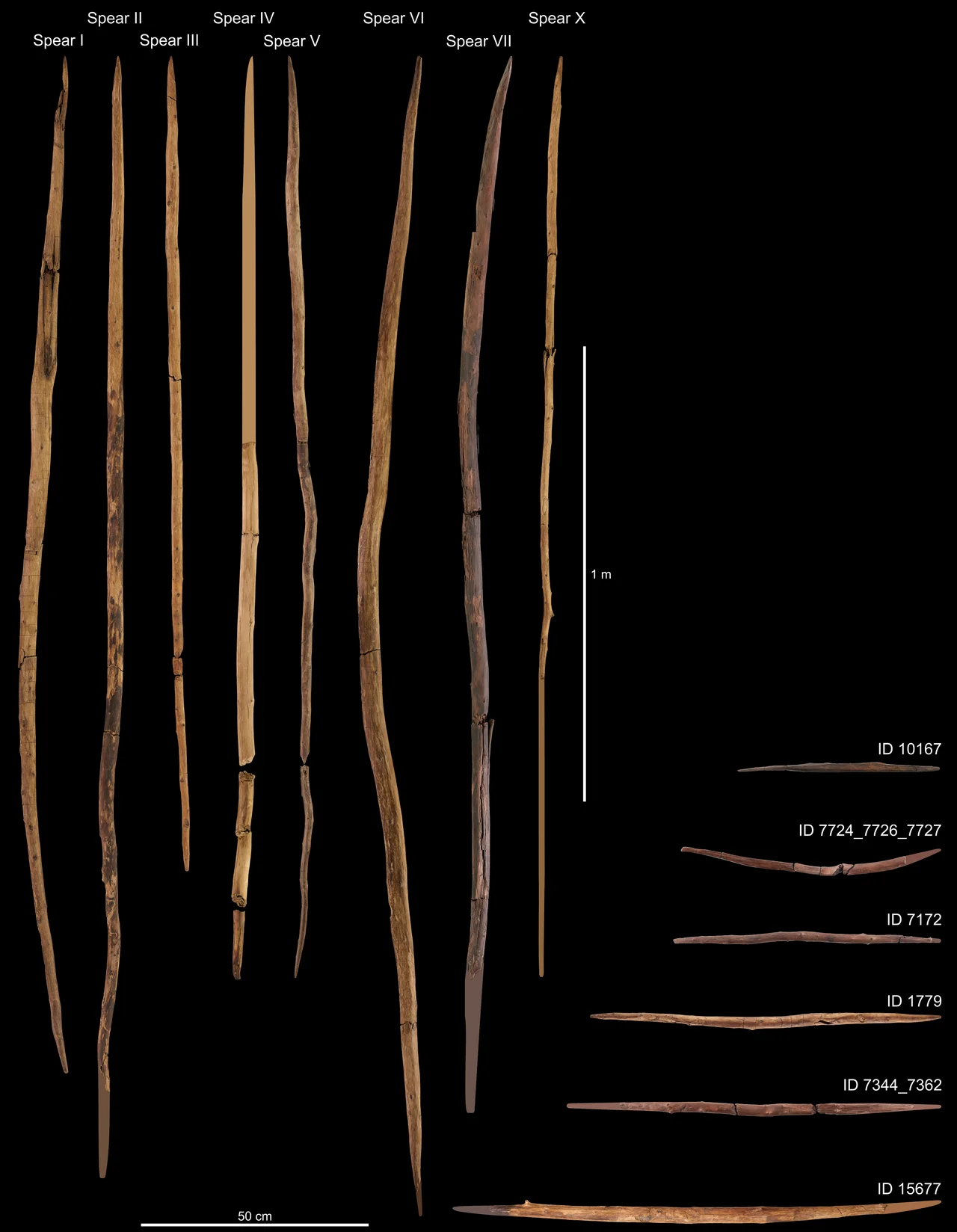

Schöningen spears
Wood is the material archaeology almost never gets. It rots, it burns, insects eat it, and a few thousand years is a good run. The standard picture of early human technology is therefore a picture of stone, because stone is what lasted. Then, between 1994 and 1999, archaeologists working ahead of the machines in an open-cast lignite mine at Schöningen lifted ten wooden spears out of a seam of ancient lakebed mud. They were complete, shaped at both ends, and at least two hundred thousand years old.
Ahead of the Excavators
The finds came from a layer that archaeologists now simply call the Spear Horizon, part of the site catalogued as Schöningen 13 II-4, excavated under Hartmut Thieme of the Lower Saxony State Service for Cultural Heritage. It had been a lakeshore. When the Elsterian ice sheet retreated, sediment came down fast enough to seal the shoreline almost as it was, and the waterlogged ground that resulted kept oxygen away from anything organic for the rest of the Pleistocene.
What survived is not just weapons. The same layer produced two double-pointed sticks that look like throwing sticks, a charred spruce stick nearly 88 centimetres long that may have been a skewer, fragments of worked wood, fruits, seeds and pollen. A 60-metre excavation base was fenced off from the coal so the work could continue; its exposed face shows five stacked sediment packages recording a lake that rose, fell and silted up over millennia, visited the whole time by animals and by people.
A Date That Will Not Sit Still
Everything about Schöningen is settled except when it happened. The first assessment put the spears at 380,000 to 400,000 years old, during Marine Isotope Stage 11, based on their position sandwiched between deposits of the Elsterian and Saalian glaciations in a well-studied sedimentary sequence. Then thermoluminescence dating of heated flints in a deposit below the spear layer pulled the range down to between 337,000 and 300,000 years, at the close of the interglacial Marine Isotope Stage 9, and most scholarship followed.
In May 2025 the number moved again. A study in Science Advances led by Jarod Hutson used amino acids preserved in fossil freshwater snail shells from the same layer and arrived at roughly 200,000 years — a shift of another hundred millennia. That date places Schöningen in the Middle Palaeolithic and hands the spears to early Neanderthals rather than to Homo heidelbergensis. No hominin bones have ever been found in the Schöningen deposits, so the makers remain, strictly speaking, unidentified.
Made From Slow Wood
Most of the spears were cut from the trunks of slow-growing spruce; spear IV is pine. The complete examples start at 1.84 metres, with shaft diameters in the low tens of millimetres, and all of them have been squeezed and warped to varying degrees by the sediment that saved them.
The craft is what impresses. Each shaft was debarked and worked at both ends, tapering to a point front and back. The points were taken from the base of the trunk, where the wood is hardest and densest, and the soft pith running down the centre of a conifer was deliberately offset so that it did not sit at the tip. Spear VI is the exception, untapered at the rear and carrying a natural kink, and it reads as a thrusting weapon rather than a thrown one; replicas of Spear II have also been tested in the hand. Whoever shaped these knew which part of which tree to use, and why.
Horses, and the Cat on the Shore
The spears were lying among the bones of Equus mosbachensis, an extinct horse, and many of those bones carry cut marks from butchery. By 2015 the site had produced around 1,500 stone tools and more than 12,000 animal bones. The stone assemblage is all denticulates, retouched flakes, scrapers and a few bifacially worked pieces, with no handaxes and no handaxe thinning flakes at all. Bone tools from the Spear Horizon appear to have been used for knapping flint and for breaking bones open for marrow. The order of the marks matters: humans reached the carcasses first, and carnivores came afterward.
Those carnivores included Homotherium, the lion-sized scimitar-toothed cat, whose remains turned up in the same layer. Sharing a lakeshore with an animal like that is one reason the double-pointed design is read as defensive as much as offensive. Straight-tusked elephants, Merck's rhinoceros, aurochs, Irish elk and the giant beaver Trogontherium are all in the deposit too, most of them accumulated naturally.
Arguments in the Mud
Schöningen's interpretation is still contested, which is a sign of how much data it produced. Isotope analysis and wear patterns on the horse teeth at the University of Tübingen show wide variation in diet and habitat, suggesting the bone bed built up through many small events across different seasons rather than one great slaughter. Lake algae, sponges and small crustaceans in the sediment led to a further suggestion that the deposit was submerged the whole time, in which case the horses were killed in shallow water rather than at a dry edge. Whether these hunters could throw hard and accurately enough for spears to work at distance is argued to this day.
The Forschungsmuseum Schöningen opened at the start of 2013 to hold the answer, or at least the evidence. Its laboratories are visible through glass, twenty-four hectares outside are planted with the vegetation of an interglacial, and the oldest complete hunting weapons in the world sit on display a short walk from the pit that nearly took them.
From the Air
Schöningen lies at 52.1335°N, 10.9893°E in the Helmstedt district of eastern Lower Saxony, where the wooded ridge of the Elm rises to the west and the excavated basins of the Helmstedt lignite field cut pale terraces into otherwise flat farmland. The former inner-German border ran a few kilometres east of the town. Best viewing is 2,500-4,000 ft, where the stepped walls of the open-cast workings and the museum's grounds beside them are easy to pick out. Nearest airfields: Braunschweig-Wolfsburg (EDVE) 36 km northwest, Magdeburg-Cochstedt (EDBC) 42 km southeast, Hannover (EDDV) 95 km west. Terrain is gentle, with no significant obstacles; low cloud and winter fog in the Börde lowlands are the usual limiting factor.
Nearby Stories
- Sack of Magdeburg 1.9 km away
- Herzog August Library 5.4 km away
- Quedlinburg 8.7 km away
- Upper Harz Water Regale 15 km away
- Autostadt 20 km away
- Tangermünde 31 km away
- Celle State Stud 41 km away
- Bauhaus Dessau 43 km away