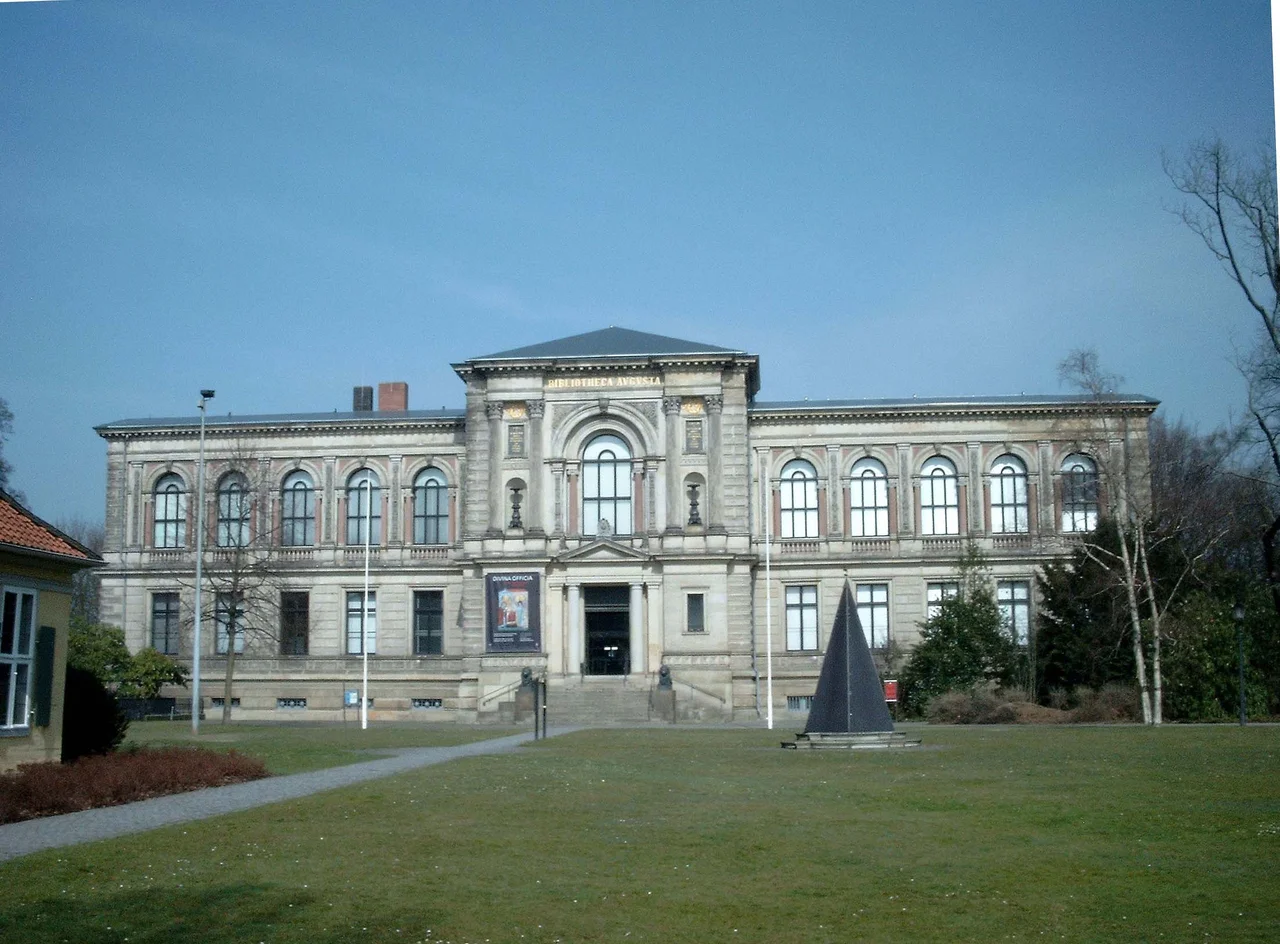

Herzog August Library
Duke Augustus the Younger did not merely buy books. He read the sale catalogues, chose the titles, had several short works bound together into single volumes to save space and money, and then sat down and catalogued the whole thing himself, by hand. By the time he died in 1666 the library at Wolfenbüttel held around 135,000 titles in about 35,000 volumes, and there was no larger collection anywhere north of the Alps. He had spent sixty-odd years on it, in a residence town of a few thousand people, in a duchy most of Europe would have struggled to find on a map.
What Julius Started
The library predates Augustus by a generation. Duke Julius of Brunswick-Lüneburg began collecting around 1550 while studying in France — chivalric romances first, then scholarly literature, then from 1558 theology in bulk. In 1567 he made his first wholesale purchase: the working library of Michael von Kaden, a Nuremberg city councillor, mostly legal and humanist writings.
The Reformation then handed him a windfall. Between 1570 and 1572 the libraries of the monasteries at Dorstadt, Wöltingerode, Heiningen and Steterburg were dissolved into ducal custody and carted to Wolfenbüttel. On 5 April 1572 Julius issued the first Liberey Ordinance, the document that counts as the library's founding charter. He had already handed day-to-day responsibility to Leonhart Schröter, a church musician, which makes a composer the first Wolfenbüttel librarian.
The Collection That Left and Came Back
Nothing about the library's survival was inevitable. In 1618, only a few years into his reign, Duke Friedrich Ulrich handed the entire collection — roughly 5,000 manuscripts and printed books by then — to the university library at Helmstedt, and out of Wolfenbüttel it went.
It took nearly two centuries to come home. Helmstedt University closed in 1810, and large parts of the holdings were returned. By then the library had long since become something else: Augustus had built a second, vastly larger collection around the hole the first one left, and the Bibliotheca Augusta was famous across Europe. In 1705 work began on a purpose-built home for it, a domed rotunda finished in 1713 and reckoned the first free-standing secular library building in Europe. It stood until 1887, when a neo-baroque replacement opened and the rotunda came down.
Leibniz Upstairs, Lessing Downstairs
From 1691 until his death in 1716, the librarian at Wolfenbüttel was Gottfried Wilhelm Leibniz. He held the post as a sideline, kept his household in Hanover, and turned up only occasionally — but he compiled the first alphabetical catalogue of the collection and pushed acquisitions, including the Gudian manuscripts.
Half a century later the job went to Gotthold Ephraim Lessing, who arrived in 1770 and stayed until he died in 1781. Wolfenbüttel was a quiet posting for a man who had been at the centre of German letters, and he delegated most of the administration and travelled a good deal. He also wrote Nathan der Weise here, and he went through the manuscripts with a scholar's appetite — recovering, among other things, Berengar of Tours' Rescriptum contra Lanfrancum, an eleventh-century theological text that had been presumed lost.
Never Lost a Book
Armies crossed this country repeatedly for three hundred years — the Thirty Years' War, the Seven Years' War, the Napoleonic campaigns — and the library was in the path of most of them. Generals put it under special protection. In the Second World War the most important holdings went into the salt mine at Grasleben and Wolfenbüttel, a small town of no military interest, came through the bombing of Lower Saxony essentially untouched.
The result is a claim very few institutions can make: the Herzog August is among the oldest libraries in the world never to have suffered a loss to its collection. In 2006 it held around 11,500 manuscripts and 900,000 books, of which some 350,000 were printed between the fifteenth and eighteenth centuries — 3,500 of those incunabula, printed before 1501.
The Most Expensive Book in the World
One volume gets a room of its own. The Gospels of Henry the Lion were made at Helmarshausen Abbey, most likely in 1188, for the altar of the Virgin in the duke's church at Brunswick: 266 pages, fifty of them full-page paintings, one of the great surviving works of Romanesque illumination.
On 6 December 1983 it came up at Sotheby's in London and sold for £8,140,000 — the most expensive book in the world, a record it held until Bill Gates bought Leonardo's Codex Leicester in 1994. The buyers were the German federal government, the states of Lower Saxony and Bavaria, the Prussian Cultural Heritage Foundation and private donors, many of them from Brunswick, getting back a manuscript that had been made for their own city. It lives at Wolfenbüttel now and is put on display only once every two years. Around it sit the rest: the Codex Guelferbytanus palimpsest, whose lower layer preserves fragments of a Gothic Bible; the Liber Floridus of about 1150; nine volumes salvaged from the shattered library of Matthias Corvinus; and Luther's Wolfenbüttel Psalter, the only surviving copy of the glosses he wrote for his lectures on the Psalms beginning in 1513.
From the Air
The library stands at 52.167°N, 10.533°E in Wolfenbüttel, about 12 km south of Braunschweig on the Oker river. From 2,000-3,000 ft the town is easy to read: an almost intact grid of half-timbered streets around the moated Wolfenbüttel Castle, with the library's block and the Lessinghaus immediately west of the castle and the tall Renaissance tower of the Hauptkirche Beatae Mariae Virginis marking the centre. The Oker runs north toward Braunschweig, and the Harz mountains rise clearly to the south. Braunschweig-Wolfsburg (EDVE) is 15 km north — the closest field and the one whose airspace matters here. Hannover (EDDV) lies about 70 km northwest and Hildesheim (EDVM) about 40 km west. Visibility is generally good; expect afternoon cumulus and occasional thunderstorm development over the Harz in summer, and valley fog along the Oker in autumn.
Nearby Stories
- Upper Harz Water Regale 4.5 km away
- Schöningen spears 6.4 km away
- Herrenhausen Gardens 9.9 km away
- GEO600 14 km away
- Bode Gorge 15 km away
- International Wind- and Watermill Museum 17 km away
- Holzminden prisoner-of-war camp 26 km away
- Gardelegen Massacre 39 km away