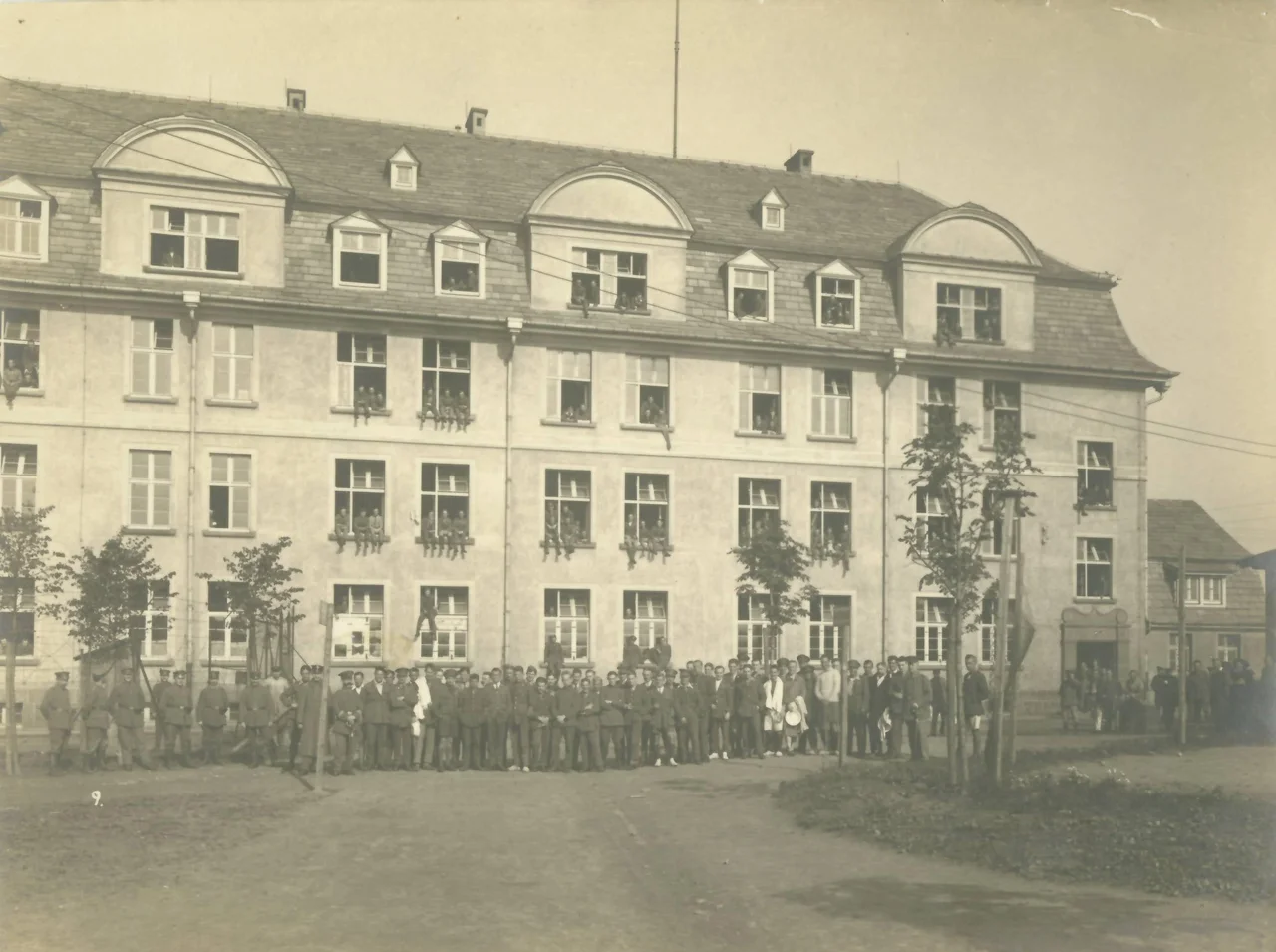

Holzminden prisoner-of-war camp
The tunnel gave way on the thirtieth man. It was the night of 23 July 1918, and behind him in the dark stretched a waiting list eighty-six officers long, now going nowhere. Twenty-nine had already come up beyond the wire and scattered into the Lower Saxon fields. Nine months of digging under a staircase in the orderlies' quarters ended there, with a partial collapse and a queue of men filing quietly back to bed.
A Barracks with the Wrong Guests
Holzminden opened at the start of September 1917 in a cavalry barracks built only four years earlier. Two four-storey blocks — Kaserne A and B to the Germans, A House and B House to the British — held between 500 and 600 captured officers of Britain and the Empire, transferred in from smaller camps at Clausthal, Ströhen and Schwarmstedt and from overcrowded ones at Freiburg and Krefeld.
The buildings were partitioned. The western end of A House was the Kommandantur, where the German garrison lived. The eastern end of B House housed 100 to 160 other-ranks prisoners designated as orderlies: men whose captivity consisted of waiting on the officers and doing the camp's menial work. The basements held punishment cells. In front stood a row of wooden huts: cookhouses, woodshed, bath-house, and the parcel room, which would matter more than any of them.
Milwaukee Bill
The camps of X Corps answered to General Karl von Hänisch, who wanted them run hard. Holzminden's first commandant, the elderly Colonel Habrecht — "a kindly old dodderer of about seventy," one prisoner called him — lasted under a month before his deputy, Hauptmann Karl Niemeyer, took over and held the post until the camp closed.
Niemeyer and his twin brother Heinrich, who commanded Clausthal, had lived seventeen years in Milwaukee, leaving in spring 1917 when the United States entered the war. Karl spoke American English and the prisoners were merciless about it: he "talked broken American under the impression that it was English," one of them wrote. They called him Milwaukee Bill and treasured his most famous sentence: "You think I do not understand the English, but I do. I know damn all about you."
The ridicule was a form of resistance, and it should not soften the record. Niemeyer's regime was arbitrary and punitive, prisoners were bayoneted, and he was placed on a British war-crimes blacklist. William Leefe Robinson, the first British pilot to shoot down a German airship over Britain, spent much of his captivity in solitary confinement. He died in England in December 1918 of the Spanish flu; the Daily Express had no doubt that Niemeyer had driven him to it.
Parcels and Black Bread
In January 1919 the Daily Sketch called Holzminden "the worst camp in Germany." That needs the qualification the paper left out: officer prisoners across Germany lived considerably better than the other ranks, and the Allied blockade had left little food locally even for civilians.
What kept the officers fed were parcels, from families and from the Red Cross, and the parcel room made them at times better provisioned than their guards. The imbalance became a currency. Prisoners traded food for lenient treatment and contraband, and sometimes weaponised it, drawing their full ration of German black bread and burning it in front of men who had nothing to spare. When they left in December 1918 they made a bonfire of the camp furniture and everything else that would catch. One of them remembered "a splendid sight," with the Germans standing by helplessly, condemning the waste.
Theatre in B House
The enemy inside the wire was time. The prisoners answered it with football, hockey and tennis, with lectures and reading, and above all with concerts and plays.
For one of them the plays mattered enormously. James Whale acted, wrote, produced and designed sets here, found the work "a source of great pleasure and amusement" and the audience reaction "intoxicating," and went home to become one of Hollywood's leading directors. The archaeologist O. G. S. Crawford, who read and studied through his captivity, delivered the driest verdict in the camp's literature: he had been far less unhappy at Holzminden than at Marlborough College. The camp also held William Stephenson, later a spymaster and one of the real-life models for James Bond.
Ten Made It Home
Escaping was constant and mostly futile. Officers cut the wire, or walked out of the gates dressed as German guards, as workmen, and at least once as a woman. The first stage often worked; almost everyone was back within days.
The tunnel was different because it was patient. Its entrance lay beneath a staircase in the orderlies' quarters, which officers were forbidden to enter, so for months the diggers went in wearing orderlies' uniforms, until a hidden door was cut in the attic of B House. The men whose rooms concealed the shaft, and who lived as the officers' servants, made the whole thing possible.
Of the twenty-nine who got out on the night of 23 and 24 July, ten reached the neutral Netherlands and eventually Britain — the largest successful escape by British prisoners of the war. Colonel Charles Rathborne, the senior British officer, spoke German well enough to buy rail tickets and crossed the Dutch border in five days. The rest walked, most for a fortnight or more. Edgar Henry Garland, still underground when the roof came down, attempted escape eight times in all.
Both barrack blocks still stand, surrounded now by suburbs and still in use by the German Army.
From the Air
The camp site lies at 51.8325°N, 9.4609°E on the eastern edge of Holzminden, where the Weser swings through a wooded gap between the Solling upland to the east and the Vogler hills to the north. From 1,500–3,000 ft the river and its bridge at Holzminden are the primary references; the two long parallel barrack blocks are still identifiable in the suburbs south-east of the old town, and remain an active military installation, so keep clear. Höxter-Holzminden (EDVI) sits about 6 km south-west on the far bank, Kassel-Calden (EDVK) about 45 km south, Paderborn-Lippstadt (EDLP) about 65 km west-south-west, Hannover (EDDV) about 70 km north. The Weser valley funnels wind and holds fog on autumn mornings; the Solling rises to over 500 m immediately east.
Nearby Stories
- Heinz Nixdorf MuseumsForum 5.5 km away
- PS Speicher 5.9 km away
- Reich Harvest Thanksgiving Festival 6.4 km away
- Bernward Doors 15 km away
- Hercules Monument 22 km away
- Halle (Westfalen) 30 km away
- Warsteiner 32 km away
- 1st German Bratwurst Museum 52 km away