
Bernward Doors
There was exactly one attempt. The lost-wax process destroys its own mould: the wax model is melted out, the metal goes in, and to get the casting back out you break the mould apart. So when the workshop at Hildesheim poured the first leaf of Bishop Bernward's doors — 4.72 metres tall, more than a metre wide, some 1.85 tonnes of molten gunmetal running into a form stood on its long side so the flow would spread evenly — there was no second chance and no way to test the idea at scale beforehand. They did it twice, once for each leaf. Both survive. A thousand years later you can still find the cooling cracks in the metal.
One Pour, One Chance
The alloy was gunmetal: more than eighty percent copper, with roughly equal parts of lead, tin and zinc. Material analysis has never managed to identify which deposit the ore came from, though the great ironworks at Rammelsberg near Goslar has been ruled out.
Modellers carved the individual scenes from thick slabs of wax or tallow, then assembled them on an iron armature — which is almost certainly why the bands dividing the panels run slightly irregularly, a hand-built frame rather than a ruled grid. Even the door knockers, grotesque lion heads with rings in their mouths, were part of the original model rather than soldered on afterwards. What came out of the broken mould would have been rough, studded with the metal stubs left by the channels that fed bronze in and let air out. All of that had to be cut away and the whole surface worked up by hand.
Reading Down, Reading Up
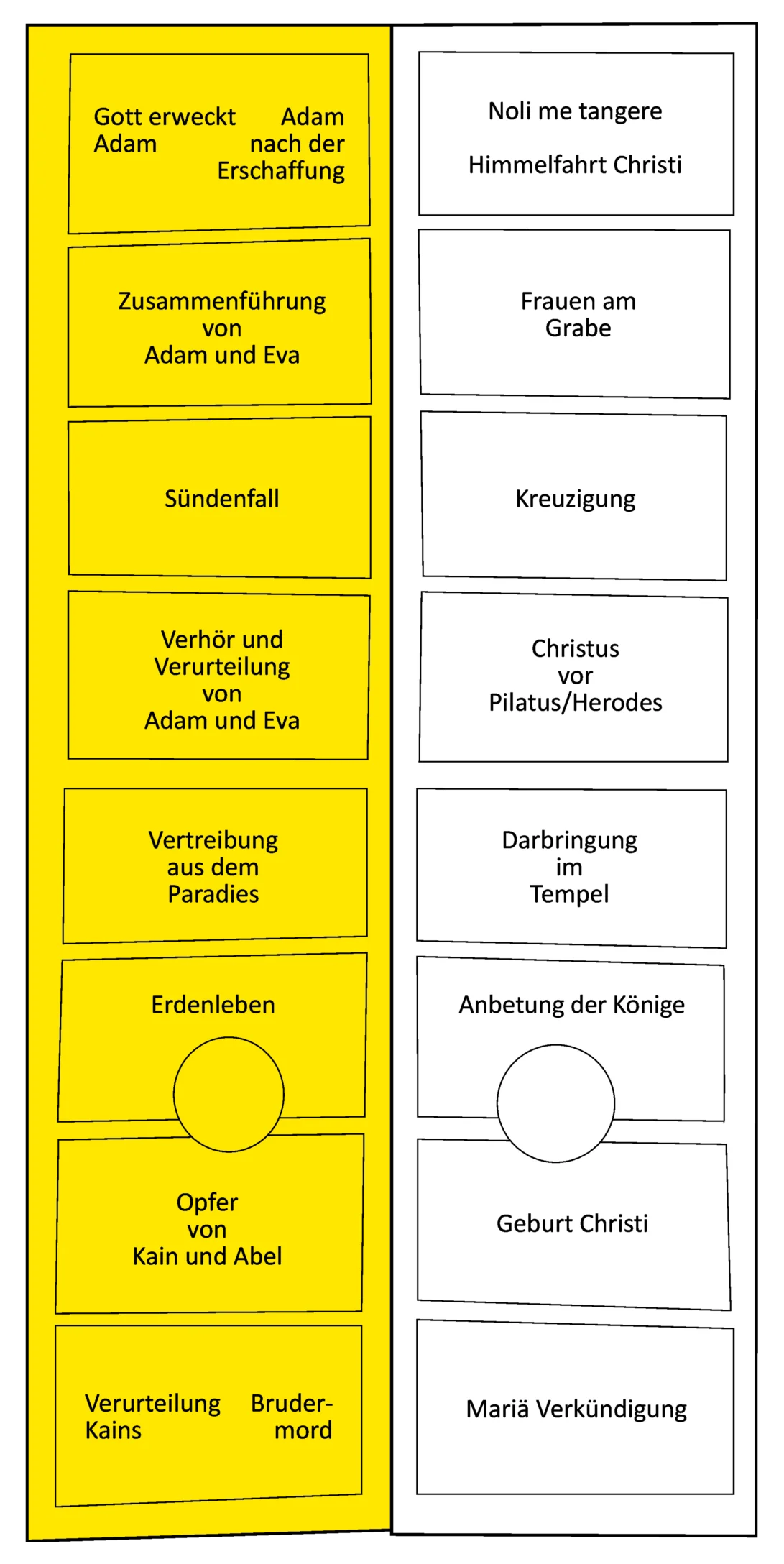
Eight panels to a leaf, sixteen in all. The left door runs Genesis from the top down, and the direction is the point: God creates Adam, Adam and Eve are introduced, the Fall, the interrogation, the expulsion, life on earth, the offerings of Cain and Abel, and at the bottom Cain killing his brother. Humanity descends.
The right door runs the Gospels from the bottom up. The Annunciation, the Nativity, the Magi, the presentation in the Temple, Christ before Pilate and Herod, the Crucifixion, the women at the tomb, and at the top the risen Christ and the Ascension. Set side by side, each panel answers the one across from it — Adam's sin against Christ's redemption, a typological reading of scripture drawn largely from the Church Fathers, Augustine above all. Time behaves oddly in places. In the creation panel Adam appears twice, once being made and once made, a convention borrowed straight from illuminated manuscripts.
Roses on a Trellis
The backgrounds are nearly empty. Where Carolingian art crowded its scenes with ornament, the Hildesheim workshop stripped everything out — a few plants on the left leaf, a few architectural props on the right, present only where the story cannot be read without them. What remains is space, and the figures gesture across it. None of them makes sense alone; each is reaching toward, recoiling from, or accusing another.
The relief itself does something unusual. The figures do not stand a uniform distance off the plate; they lean out of it, so that seen from the side they have been compared to roses on a trellis with nodding heads. Mary in the Adoration of the Magi is the clearest case: her lower body is barely raised, her torso and the child project further, and her shoulders and head are cast fully in the round. Faces follow the Pre-Romanesque type — oval, oversized, huge almond eyes under sharp brows — but expression breaks through anyway. Cain looks up at the Hand of God with terror and pulls his cloak tight around himself.
The Year 1015
A Latin inscription gives 1015 as the date by which the doors existed. No artist's name survives. Older scholarship tried to sort the panels among several hands, but Rainer Kahsnitz argued the differences are too slight to carry that weight — as easily explained by the demands of casting as by different temperaments. The likeliest answer is one artist with a handful of apprentices.
Bernward had seen what was possible. As tutor to the young Otto III he stayed in Rome in 1001-2, at the Schola Francorum by the Vatican and then in the imperial palace on the Palatine, where he could have studied the bronze door of Old St Peter's and the late antique wooden doors of Santa Sabina, whose panels already set Old and New Testament scenes against each other. In 1006 he was at Tours, and several scenes on the left leaf are arranged almost identically to the Moutier-Grandval Bible, a Carolingian manuscript made there.
The Penitents' Door
For centuries the doors were liturgical machinery rather than decoration. A cathedral ordinal of 1473 describes the Ash Wednesday rite: the bishop sprinkled ashes and expelled the public penitents, who left barefoot with the clergy through the great bronze doors and later came back in through the same doors. The meaning was hanging right there on the left leaf — Adam and Eve driven out of Paradise. Penitents confined to the vestibule through Lent had Genesis in front of them the whole time, cast at eye level.
The leaves came within three years of destruction. On the initiative of the cathedral chapter they were taken down in 1942, hauled lying lengthwise in a scaffold by two teams of horses, and buried in the Kehrwieder wall in the southeast of the old town. The air raid of 22 March 1945 wrecked the cathedral around the empty doorway. The doors came home. They hang today in the west paradise — the oldest monumental image cycle in German sculpture, and the oldest cast in metal anywhere in the country.
From the Air
The doors hang inside Hildesheim Cathedral at 52.1489°N, 9.9464°E, on the Domhügel at the southern edge of the old town, with the Innerste valley to the west. From 2,000-3,500 ft the cathedral's baroque crossing tower and heavy westwork mark the hill; St Michael's Church stands on its own rise a short distance northwest, and the two together make the UNESCO pairing that defines the city from the air. Hildesheim lies under the approach and departure paths for Hannover (EDDV), 28 km north, so expect controlled airspace and traffic; Braunschweig-Wolfsburg (EDVE) is about 45 km east and the local field at Hildesheim-Drispenstedt (EDVM) sits on the northeastern edge of town. Valley fog in the Innerste basin is common through the winter half of the year and can persist well past midday.
Nearby Stories
- Holzminden prisoner-of-war camp 3.3 km away
- Battle at the Harzhorn 6.4 km away
- Brocken 7.8 km away
- Asse II mine 8.5 km away
- Hamelin 9.2 km away
- International Wind- and Watermill Museum 12 km away
- Herrenhausen Gardens 22 km away
- Dümmer 79 km away